


Court’s decision
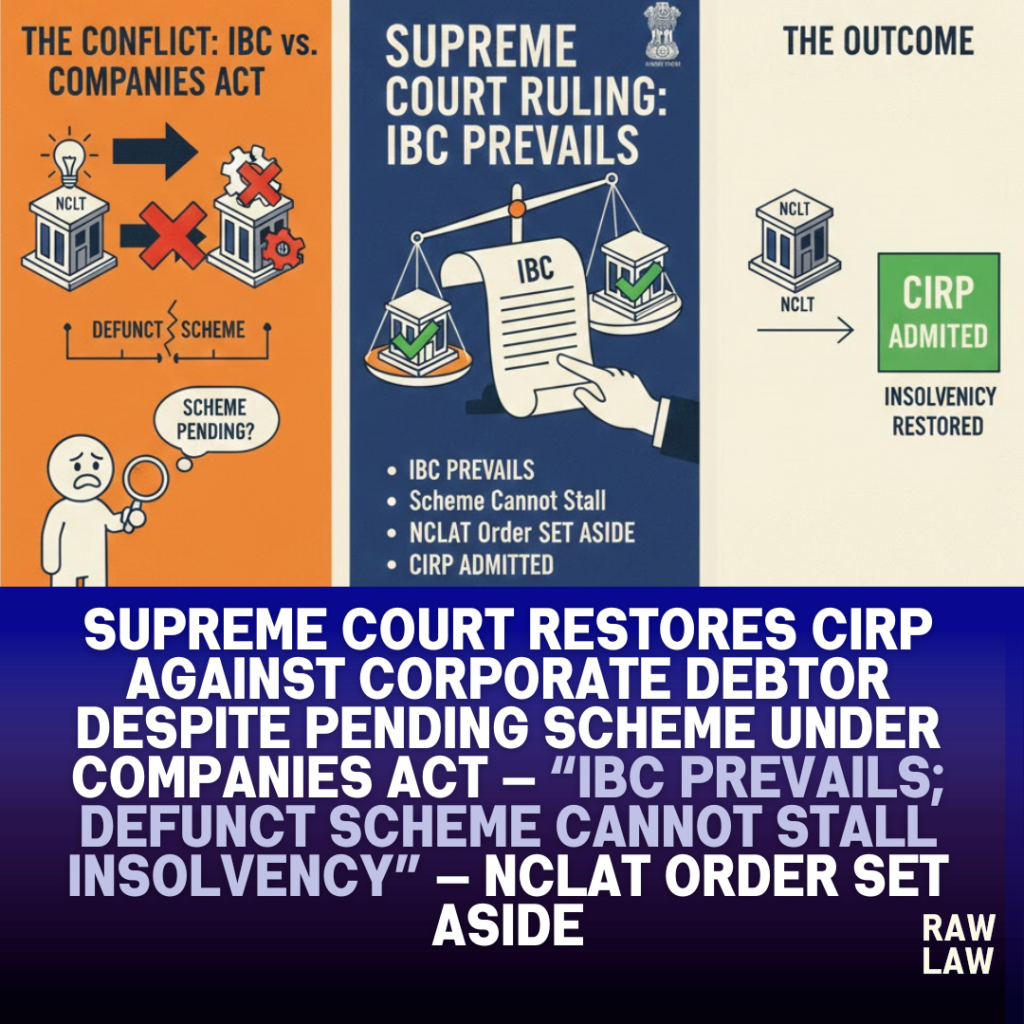
The Supreme Court allowed the appeal filed by Omkara Assets Reconstruction Private Limited and restored the Corporate Insolvency Resolution Process (CIRP) initiated under Section 7 of the Insolvency and Bankruptcy Code, 2016. Setting aside the National Company Law Appellate Tribunal’s order that had kept insolvency proceedings in abeyance due to a pending Scheme of Arrangement (SOA) under the Companies Act, 1956, the Court held that the IBC has overriding effect under Section 238. It ruled that a defunct and procedurally non-compliant scheme cannot obstruct insolvency proceedings aimed at revival of a corporate debtor.
Facts
The dispute arose from loans disbursed in 1999 and 2000 amounting to ₹10.60 crore, with default commencing from 1 January 2003. The outstanding liability, with interest, had escalated to over ₹154 crore. The Stressed Assets Stabilisation Fund of IDBI Bank, whose interest was later assigned to the appellant asset reconstruction company, initiated proceedings under Section 7 of the IBC before the National Company Law Tribunal (NCLT).
The corporate debtor resisted the insolvency petition on the ground that a Scheme of Arrangement under Sections 391–394 of the Companies Act, 1956 was pending before the Punjab and Haryana High Court. It alleged suppression of this fact before the NCLT.
The NCLT admitted the insolvency application, declared moratorium under Section 14, and appointed an Interim Resolution Professional (IRP). On appeal, the NCLAT stayed the CIRP until the High Court proceedings concluded. The Supreme Court revived the moratorium during pendency of the present appeal.
Issues
The Supreme Court examined:
- Whether a pending Scheme of Arrangement under the Companies Act could bar initiation or continuation of CIRP under the IBC.
- Whether the SOA was valid and operative despite delay and non-compliance with statutory timelines.
- Whether judicial discipline required deference to the High Court proceedings.
- Whether the IBC’s overriding provision under Section 238 applied in the present case.
Appellant’s arguments
The appellant contended that the SOA had become defunct due to failure to comply with mandatory procedural requirements under Section 391 and the Companies (Court) Rules, 1959. It argued that although creditors had initially consented in 2008, the second motion was not filed within prescribed time, nor was the sanctioned order filed before the Registrar within 14 days as mandated.
The appellant emphasised that the sanction order passed in 2019 came nearly a decade later and was itself recalled in 2022 for inoperability. Even the filing of Form INC-28 in 2023 was grossly delayed. Hence, the scheme was unenforceable and redundant.
Relying on Section 238 of the IBC and precedents, the appellant argued that insolvency proceedings under the IBC are independent and cannot be stalled by stale company law proceedings.
Respondent’s arguments
The respondent argued that judicial discipline required the insolvency tribunal to respect pending High Court proceedings relating to the SOA. It contended that the scheme had received creditor consent and High Court sanction, and therefore CIRP should not be initiated.
It sought to distinguish Supreme Court decisions permitting continuation of IBC proceedings, asserting that in those cases no approved scheme existed. It also argued that unseating the management through CIRP would disrupt ongoing revival efforts.
Analysis of the law
The Court undertook a detailed examination of Section 391 of the Companies Act, 1956 and the Companies (Court) Rules, 1959. It noted that the second motion for sanction must be filed within seven days of the creditors’ meeting report, and the sanction order must be filed with the Registrar within prescribed time to bring the scheme into effect.
The Court found that these statutory timelines were blatantly violated. The second motion was filed belatedly; the sanction order was passed after ten years; and filing with the Registrar was delayed beyond permissible limits. Such non-compliance rendered the scheme defunct.
Crucially, the Court reiterated that Section 238 of the IBC gives it overriding effect over inconsistent provisions of any other law. The IBC, being a special statute focused on revival of corporate debtors, prevails over general company law provisions.
Precedent analysis
The Court relied on A. Navinchandra Steels (P) Ltd. v. Srei Equipment Finance Ltd. (2021) 4 SCC 435, which held that IBC proceedings are independent and not eclipsed by winding-up proceedings. The emphasis under IBC is revival, not liquidation.
It also referred to Sunil Kumar Sharma v. ICICI Bank Ltd. (2025 SCC OnLine SC 145), where continuation of IBC proceedings was permitted despite pendency of a scheme that had not come into effect.
The Court clarified that even under the Companies Act, a compromise under Section 230 of the 2013 Act can be considered within IBC proceedings at appropriate stage. Thus, the IBC does not foreclose arrangements but integrates them within its framework.
Court’s reasoning
The Supreme Court observed that the SOA of 2008 was never operationalised and became redundant due to passage of time and non-compliance. The sanction order of 2019 lacked jurisdiction under the Companies (Transfer of Pending Proceedings) Rules, 2016, as the matter ought to have been transferred to the NCLT.
The Court rejected the argument of judicial discipline, observing that such principle cannot be invoked by “tardy litigators” to jeopardise public funds and delay insolvency resolution.
It emphasised that economic implications extend beyond private parties, involving public funds and industrial rehabilitation. The IBC’s objective of corporate revival in the larger public interest could not be frustrated by stale and procedurally flawed company law proceedings.
Conclusion
The Supreme Court set aside the NCLAT order and restored the NCLT’s admission of the Section 7 application. The Interim Resolution Professional was directed to proceed, and earlier interim directions keeping management involved were vacated.
The appeal was allowed, reaffirming the supremacy of the IBC in cases of conflict with company law proceedings.
Implications
This judgment strengthens the primacy of the IBC over legacy company law mechanisms. It clarifies that:
- A defunct or procedurally non-compliant Scheme of Arrangement cannot stall CIRP.
- Section 238 IBC overrides inconsistent provisions of other statutes.
- Judicial discipline does not require insolvency tribunals to defer to inoperative schemes.
- Revival under IBC serves larger public and economic interest.
The ruling reinforces the IBC’s central objective of timely and effective insolvency resolution.
Case law references
- A. Navinchandra Steels (P) Ltd. v. Srei Equipment Finance Ltd. (2021) 4 SCC 435
Held that IBC proceedings are independent and revival-oriented, prevailing over winding-up proceedings. - Sunil Kumar Sharma v. ICICI Bank Ltd. (2025 SCC OnLine SC 145)
Allowed continuation of IBC despite pendency of scheme not operationalised.
FAQs
1. Can a pending Scheme of Arrangement block insolvency under IBC?
No. If the scheme is defunct or non-operational, it cannot bar initiation or continuation of CIRP under Section 7 IBC.
2. What is the significance of Section 238 IBC?
Section 238 gives overriding effect to the IBC over any inconsistent provision in other laws.
3. Can compromise schemes be considered during insolvency?
Yes. Arrangements under Section 230 of the Companies Act, 2013 may be considered within IBC proceedings at appropriate stages.