


Court’s decision
The Supreme Court allowed the appeal filed by Catalyst Trusteeship Ltd., setting aside concurrent orders of the National Company Law Tribunal and the National Company Law Appellate Tribunal which had refused to admit a Section 7 application under the Insolvency and Bankruptcy Code, 2016.
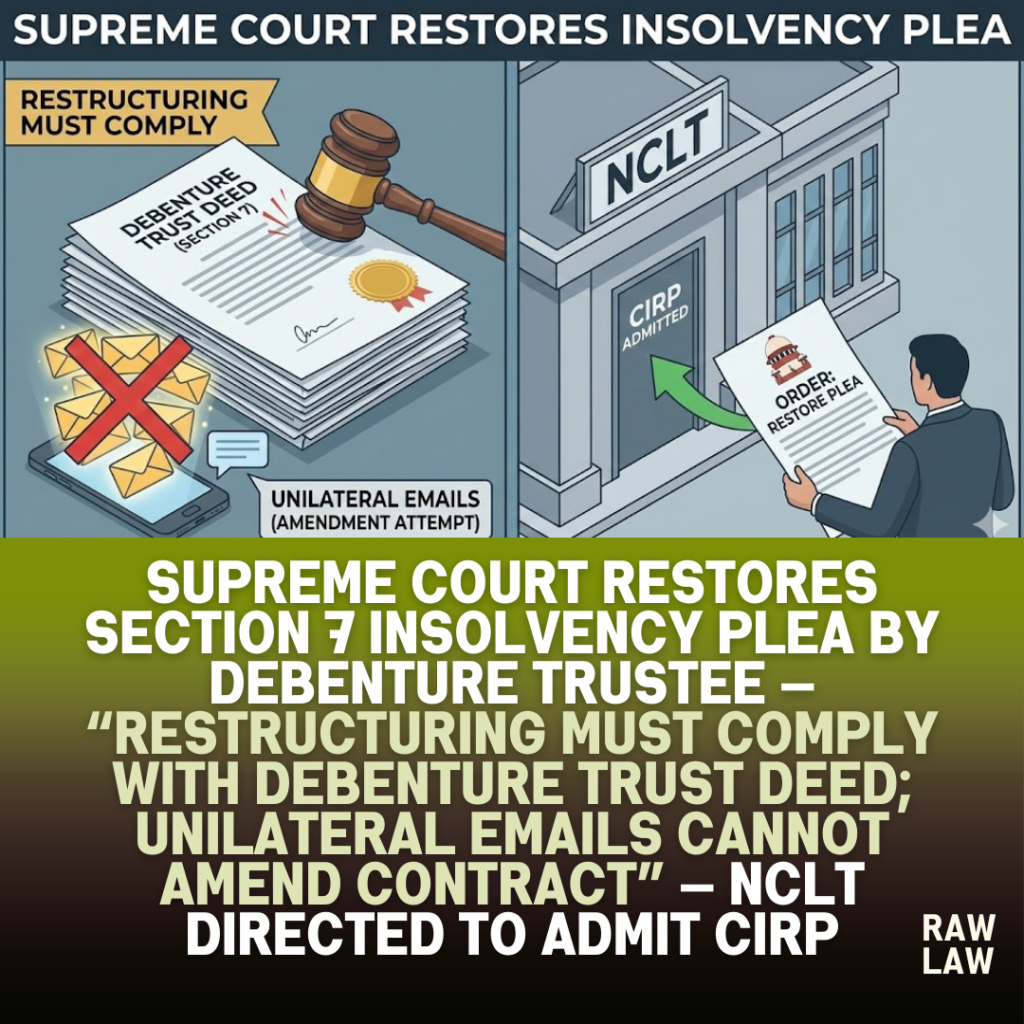
The Court held that the alleged restructuring of debenture repayment was never validly effected in accordance with the Debenture Trust Deed (DTD). It ruled that the NCLT and NCLAT erred in inferring a moratorium based on informal email exchanges with one debenture holder. The insolvency petition deserved admission as financial debt and default were clearly established.
Facts
The respondent company proposed a large residential-cum-retail project in Mumbai and resolved on 20 March 2018 to issue 850 redeemable non-convertible debentures aggregating ₹850 crore in two series. A Debenture Trust Deed dated 27 March 2018 was executed, appointing Catalyst Trusteeship Ltd. as debenture trustee.
Series A debentures worth ₹600 crore were fully subscribed and disbursed. Series B debentures worth ₹250 crore were never issued.
In March 2022, facing repayment stress, the respondent engaged in email correspondence with one debenture holder proposing restructuring and an 18-month moratorium. However, this communication was not shared with the trustee or other debenture holders.
Subsequently, overdue interest of ₹65.49 crore remained unpaid. A loan recall notice dated 21 July 2022 demanded ₹1,203.55 crore (principal plus interest). The trustee filed a Section 7 application, which was dismissed by the NCLT and upheld by the NCLAT on the premise that a moratorium was in place.
Issues
The Supreme Court examined:
- Whether a valid restructuring or moratorium had come into existence.
- Whether email exchanges with one debenture holder could amend the DTD.
- Whether default under Section 7 IBC stood established.
- Whether NCLT and NCLAT erred in treating the dispute as a bar to admission.
Appellant’s arguments
The debenture trustee contended that modification of the DTD required strict compliance with Clause 33, mandating prior written consent of debenture holders through “approved instructions” and execution of necessary deeds.
It argued that no such process occurred. The alleged restructuring discussions were unilateral and involved only one debenture holder without authority to bind others.
The trustee further relied on Innoventive Industries Ltd. v. ICICI Bank to assert that for admission under Section 7, only existence of financial debt and default must be shown; pre-existing disputes are irrelevant.
Respondent’s arguments
The respondent company argued that negotiations with a major debenture holder resulted in an 18-month moratorium and restructuring understanding, thereby negating default.
It claimed legitimate expectation and alleged that the trustee and debenture holders acted in concert to engineer default.
Reliance was placed on conduct such as release of certain securities and disbursal of project expenses to suggest acceptance of restructuring.
Analysis of the law
The Court reiterated the settled position from Innoventive Industries Ltd. v. ICICI Bank (2018) that admission of a Section 7 application requires only proof of financial debt and default. Pre-existing disputes are irrelevant in financial creditor applications.
It further relied on Indus Biotech Pvt. Ltd. v. Kotak India Venture (2021), clarifying that while a corporate debtor may show no default, this cannot morph into raising an indirect contractual dispute.
The Court examined Section 62 of the Contract Act on novation, holding that substitution of contract requires consensus of all parties.
Crucially, Clause 33 of the DTD mandated written consent of debenture holders through a Special Resolution mechanism for any amendment. Clause 37 required express written waiver. No such compliance occurred.
Precedent analysis
The Court applied:
- Innoventive Industries Ltd. v. ICICI Bank (2018) 1 SCC 407 — Section 7 admission limited to debt and default inquiry.
- Indus Biotech Pvt. Ltd. v. Kotak India Venture (2021) 6 SCC 436 — corporate debtor may show no default but cannot transform proceedings into dispute adjudication.
It also noted that the Bombay High Court had refused interim relief in a commercial suit seeking declaration that the DTD stood amended by emails, holding that modification without compliance with Clause 33 was impermissible. This order attained finality but was disregarded by NCLT and NCLAT.
Court’s reasoning
The Supreme Court found that the NCLT and NCLAT committed grave error by inferring a moratorium based on incomplete correspondence. The restructuring proposal was addressed only to one debenture holder without proof of authority to bind others.
No meeting of debenture holders was convened; no Special Resolution was passed; no written amendment was executed.
The alleged release of security and minor fund disbursals were consistent with existing DTD clauses and not evidence of restructuring.
The Court held that the concurrent findings were perverse and based on conjecture. The trustee was duty-bound to protect debenture holders’ interests and could not be accused of collusion.
Since debt and default were clearly established, the insolvency petition deserved admission.
Conclusion
The Supreme Court set aside orders of the NCLT and NCLAT. Company Petition (IB) 922/MB/C-I/2022 was restored and directed to be admitted under Section 7 IBC by a separate order.
The appeal was allowed.
Implications
This ruling reinforces contractual sanctity in structured finance transactions.
Key takeaways:
- Debenture Trust Deed modification requires strict adherence to prescribed procedure.
- Informal email negotiations cannot constitute novation.
- Section 7 IBC admission hinges solely on debt and default.
- NCLT cannot re-write contractual terms based on perceived equity.
- Concurrent findings can be set aside where perversity is evident.
The judgment strengthens the enforceability of debenture covenants and clarifies the limited scope of inquiry at the admission stage under IBC.
Case law references
- Innoventive Industries Ltd. v. ICICI Bank (2018) 1 SCC 407
Section 7 admission requires only proof of debt and default; disputes irrelevant. - Indus Biotech Pvt. Ltd. v. Kotak India Venture (2021) 6 SCC 436
Corporate debtor may show no default but cannot convert Section 7 proceedings into contractual dispute adjudication.
FAQs
1. Can email negotiations amend a Debenture Trust Deed?
No. Amendment requires compliance with procedures stipulated in the DTD, including written consent and special resolution where required.
2. What must be proved for admission under Section 7 IBC?
Only existence of financial debt and default. Disputes do not bar admission.
3. Can NCLT infer moratorium from informal restructuring talks?
No. Unless formally approved and documented as per contract, such discussions do not negate default.