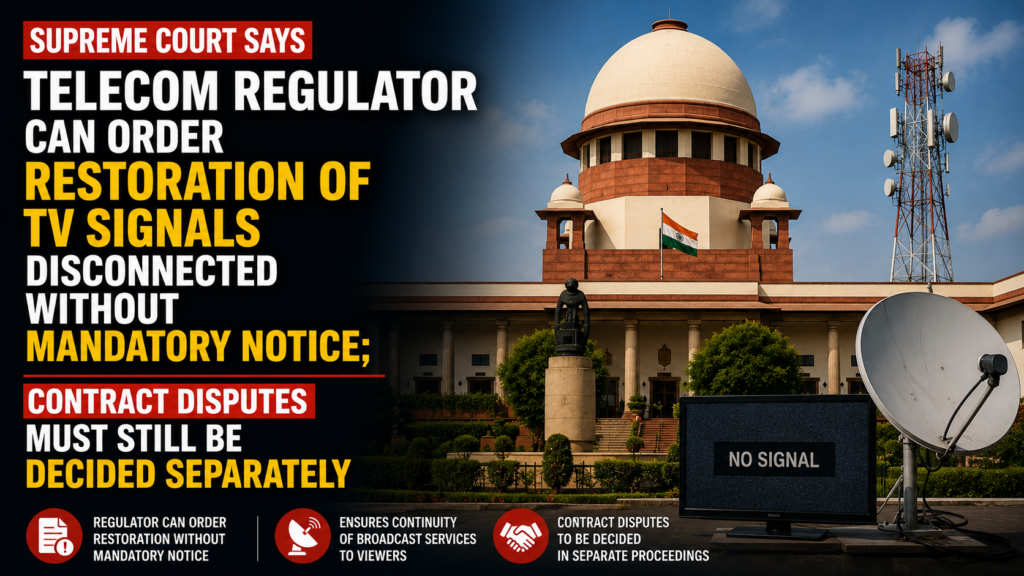
Cable Network Challenged TRAI’s Direction and Show-Cause Notice as Beyond Its Powers; Supreme Court Holds TRAI Can Enforce Regulations Without Deciding Contractual Disputes
Facts
The appeal arose from a dispute concerning the regulatory powers of the Telecom Regulatory Authority of India, or TRAI, and the adjudicatory jurisdiction of the Telecom Disputes Settlement and Appellate Tribunal, or TDSAT.
M/s Polimer Cable Network was a Multi-System Operator, commonly referred to as an MSO, operating in Salem, Tamil Nadu. The other private respondents were Local Cable Operators, or LCOs, who received cable television signals from the MSO for distribution to consumers.
Disputes arose between the MSO and four LCOs:
- M/s Kadal TV;
- M/s Ramesh Cable Net Works;
- M/s Amman Cable Net Works;
- M/s Suganya Cable Net.
The LCOs alleged that the MSO abruptly disconnected cable television signals to their respective networks at approximately 6:00 a.m. on 16 June 2008.
The supply and disconnection of television signals were governed by the Telecommunication (Broadcasting and Cable Services) Interconnection Regulations, 2004, as amended in 2006.
Regulation 4 prescribed safeguards before signals could be disconnected. These included:
- Giving three weeks’ notice to the distributor;
- Stating the reasons for the proposed disconnection;
- Informing consumers about the dispute and proposed disconnection;
- Publishing notices in at least two local newspapers, including one in the local language.
The LCOs initially approached the Madras High Court through writ petitions. The High Court directed TRAI to consider their representations in accordance with law within eight weeks after hearing both the LCOs and the MSO.
Acting on those representations, TRAI examined the matter and, on 21 October 2008, formed a prima facie view that the MSO had violated Regulations 4.1 and 4.3.
TRAI issued a direction under Section 13 read with Section 11(1)(b) of the TRAI Act, requiring the MSO to restore the signals immediately and submit a compliance report within ten days.
The MSO claimed that it had complied with the direction. The LCOs disputed this.
To verify the factual position, TRAI sought a status report from the Commissioner of Police, Salem. A report dated 16 December 2008 indicated that the MSO had not genuinely restored the mainstream Optical Fibre Cable connection.
According to the report:
- The Optical Fibre Cable links had been disconnected without valid reason;
- Testing through a spectrum analyser showed reduced signal strength;
- A non-functional domestic link was found hanging outside the control room instead of a proper mainstream connection.
On the basis of this report, TRAI formed a prima facie opinion that the MSO had failed to comply with its direction dated 21 October 2008.
TRAI therefore issued a show-cause notice dated 19 February 2009. It called upon the MSO to explain why TRAI should not file a complaint before the competent criminal court under Section 34 of the TRAI Act for wilful failure to comply with the direction.
Instead of replying to the show-cause notice, the MSO approached TDSAT.
The MSO challenged both TRAI’s direction dated 21 October 2008 and the show-cause notice dated 19 February 2009 as being without jurisdiction and void from inception.
TDSAT accepted the MSO’s challenge. It held that TRAI had no jurisdiction to adjudicate a dispute between an MSO and LCOs and declared both the direction and show-cause notice illegal and void.
TRAI then approached the Supreme Court under Section 18 of the TRAI Act.
Issues
The Supreme Court considered the following principal issues:
- Whether TRAI had jurisdiction to issue a direction requiring the MSO to comply with the Interconnection Regulations.
- Whether TRAI’s direction to restore cable signals amounted to adjudication of a private dispute between the MSO and LCOs.
- Whether the 2000 amendment to the TRAI Act completely deprived TRAI of power to act in matters involving disputes between service providers.
- Whether enforcement of a regulation by TRAI could be distinguished from adjudication of contractual rights by TDSAT.
- Whether TRAI could record a prima facie finding of non-compliance with its regulations.
- Whether issuance of a show-cause notice proposing prosecution amounted to a final determination of guilt.
- Whether TRAI could impose or recover the penalty contemplated under Section 29 of the TRAI Act.
- Whether only TDSAT could examine all grievances arising between an MSO and LCOs.
- What was the proper division of jurisdiction among TRAI, TDSAT and the competent criminal court.
TRAI’s Arguments
TRAI argued that TDSAT had misunderstood the nature of the action taken by the regulator.
According to TRAI, it had not attempted to adjudicate the commercial or contractual dispute between the MSO and LCOs.
It had neither determined outstanding subscription amounts nor decided whether either party had breached the private contract governing signal supply.
TRAI maintained that it had merely exercised its statutory regulatory powers to ensure compliance with the Interconnection Regulations.
It submitted that Regulation 4 created mandatory procedural safeguards before signals could be disconnected.
Once a violation of those safeguards was brought to its attention, TRAI was empowered under Sections 11 and 13 of the TRAI Act to issue directions to the concerned service provider.
TRAI argued that its direction dated 21 October 2008 did no more than call upon the MSO to comply with the applicable regulations by restoring signals that had allegedly been disconnected contrary to the prescribed procedure.
TRAI further submitted that:
- Regulations framed under Section 36 constitute binding subordinate legislation;
- Such regulations are laid before Parliament under Section 37;
- TRAI must necessarily possess power to enforce the regulations framed by it;
- A regulator without enforcement powers would be rendered ineffective;
- Requiring compliance with a statutory regulation is not equivalent to deciding a contractual dispute.
TRAI contended that the 2000 amendment separated adjudicatory functions from regulatory functions.
The adjudication of disputes was vested in TDSAT, but TRAI retained its recommendatory, administrative, regulatory and direction-issuing powers.
It argued that a distinction had to be maintained between:
- Deciding private rights and liabilities between service providers; and
- Enforcing compliance with statutory regulations.
TRAI also submitted that the show-cause notice did not determine guilt or impose a penalty. It merely gave the MSO an opportunity to explain why a complaint should not be filed before the competent criminal court.
TRAI emphasised that only the court specified under the Act could decide whether an offence had been committed and whether a fine should be imposed.
Thus, according to TRAI, it had not encroached upon either TDSAT’s adjudicatory jurisdiction or the criminal court’s power to determine liability.
MSO’s Arguments
The MSO contended that TRAI had no jurisdiction to adjudicate disputes between two service providers.
It argued that after the 2000 amendment to the TRAI Act, all adjudicatory functions were removed from TRAI and vested exclusively in TDSAT.
According to the MSO, the dispute concerned supply of cable television signals under a private contractual arrangement between an MSO and LCOs.
Any alleged wrongful disconnection amounted to breach of contract.
The MSO maintained that only TDSAT could:
- Determine whether the contract had been breached;
- Examine rival claims;
- Quantify arrears;
- Consider counterclaims;
- Award damages;
- Direct restoration of signals;
- Balance equities between the parties.
It argued that TRAI could not grant complete relief because it lacked jurisdiction to entertain claims and counterclaims or mould equitable relief.
The MSO also contended that the Madras High Court’s direction to consider the representations “in accordance with law” could not confer jurisdiction upon TRAI where the statute did not otherwise grant such power.
It submitted that if TRAI was permitted to issue binding directions in such disputes, the same conduct could expose a service provider to both civil and criminal consequences.
The MSO further argued that the LCOs were not properly registered under the Cable Television Networks Regulation Act at the relevant time and were therefore not entitled to invoke the regulatory machinery.
It consequently sought quashing of TRAI’s direction and show-cause notice as void from inception.
TDSAT’s Decision
TDSAT accepted the MSO’s contention that TRAI lacked jurisdiction.
It reasoned that the 2000 amendment to the TRAI Act separated regulatory and adjudicatory powers.
According to TDSAT, disputes between two service providers fell within its exclusive original jurisdiction under Section 14.
TDSAT treated the alleged disconnection as a contractual dispute.
It held that regulations framed by TRAI may become part of the contractual arrangement between service providers, but their violation in such a context would amount to breach of contract.
TDSAT reasoned that TRAI could not decide whether such contractual breach had occurred.
It also observed that TRAI lacked the ability to award damages, quantify arrears or balance counterclaims.
TDSAT expressed concern that if TRAI acted upon a contractual breach and initiated prosecution, the same person could be exposed to both civil liability and criminal liability for substantially the same grievance.
It therefore held that TRAI had no exclusive or concurrent jurisdiction to issue the impugned direction.
Consequently, TDSAT declared the direction and show-cause notice illegal, without jurisdiction and void from inception.
Analysis of the Law
Statutory Structure of the TRAI Act
The Supreme Court examined the evolution of the TRAI Act.
When enacted in 1997, TRAI broadly performed three classes of functions:
- Recommendatory functions;
- Regulatory functions;
- Adjudicatory functions.
The Telecom Regulatory Authority of India Amendment Act, 2000 created TDSAT and transferred adjudicatory functions to that specialised Tribunal.
After the amendment:
- TRAI continued to make recommendations under Section 11(1)(a);
- TRAI continued to perform regulatory functions under Section 11(1)(b);
- TRAI could issue directions under Sections 12(4) and 13;
- TRAI could frame regulations under Section 36;
- TDSAT obtained exclusive jurisdiction to adjudicate disputes under Section 14;
- TDSAT also obtained appellate jurisdiction over directions, decisions and orders of TRAI.
The Court held that the 2000 amendment did not extinguish TRAI’s regulatory powers.
It merely separated adjudication from regulation.
Power to Frame Regulations
The Court relied upon Bharat Sanchar Nigam Limited v. Telecom Regulatory Authority of India.
It reiterated that TRAI’s power under Section 36 to make regulations is wide and pervasive.
Section 36 is not confined to the specific subjects listed under Section 36(2). It extends to making regulations necessary to carry out the purposes of the TRAI Act.
Regulations made under Section 36 are subordinate legislation.
They are required to be placed before Parliament under Section 37. Parliament may approve, modify or annul them.
Until modified or annulled, such regulations have binding legal force.
Accordingly, the Interconnection Regulations were not merely contractual guidelines. They constituted binding statutory requirements applicable to service providers.
The Court held that if TRAI could frame binding regulations but lacked power to require compliance, the regulatory framework would become ineffective.
TRAI’s Power to Issue Directions
Section 13 authorises TRAI to issue directions to service providers for discharge of its functions under Section 11(1).
The proviso confines this power to matters falling under Section 11(1)(b).
The Court held that the Interconnection Regulations had been framed in exercise of the powers under Section 36 read with Section 11(1)(b).
Accordingly, TRAI was competent to issue directions requiring service providers to comply with those regulations.
The direction had to remain within the regulatory field.
TRAI could direct compliance with:
- A subsisting regulation;
- A licence condition;
- A regulatory requirement;
- Any matter falling within Section 11(1)(b).
However, TRAI could not use Section 13 to decide contractual claims between private parties.
Difference Between Regulation and Adjudication
The central question was whether TRAI had adjudicated the dispute between the MSO and LCOs.
The Court explained that adjudication involves:
- An existing dispute between two or more parties;
- Assertion of a claim by one party;
- Denial of that claim by another;
- Presentation of evidence and legal arguments;
- Determination of disputed facts;
- Application of law to those facts;
- A final and binding decision disposing of the parties’ rights.
An adjudicatory authority ordinarily determines who is legally right, what obligations are owed and what relief should be granted.
The Supreme Court found that TRAI had done none of these things.
TRAI had not:
- Determined the contractual rights of the MSO and LCOs;
- Calculated subscription arrears;
- Decided whether the LCOs were in default;
- Awarded damages;
- Entertained counterclaims;
- Adjusted equities;
- Passed a final binding order governing their private rights.
TRAI had merely directed the MSO to comply with Regulation 4, which prohibited disconnection of signals except through the prescribed process.
The Court held that a direction to obey a statutory regulation operates against the regulated service provider in TRAI’s regulatory capacity.
It does not amount to final determination of a private dispute.
Prima Facie Finding of Non-Compliance
The Court held that TRAI may record a prima facie finding that a service provider has failed to comply with a regulation or direction.
Such a preliminary finding may be necessary to decide whether regulatory enforcement should be initiated.
However, the finding must remain limited to enforcement.
It cannot become a final and binding determination of:
- Contractual liability;
- Civil rights;
- Arrears;
- Damages;
- Compensation;
- Inter-se obligations of the parties.
In the present case, TRAI’s prima facie conclusion that the MSO had violated Regulations 4.1 and 4.3 was recorded only for deciding whether enforcement action should proceed.
It did not prevent the MSO or LCOs from pursuing their contractual claims before TDSAT.
Nature of the Show-Cause Notice
The Supreme Court held that the show-cause notice dated 19 February 2009 did not amount to adjudication.
A show-cause notice:
- Determines no right;
- Imposes no penalty;
- Records no final guilt;
- Merely informs the noticee of the proposed action;
- Gives the noticee an opportunity to respond.
TRAI had only asked the MSO to explain why a complaint should not be filed before the competent court.
The notice was therefore a preparatory procedural step.
Even if TRAI decided to file a complaint, the determination of the offence and penalty would remain with the competent criminal court.
Accordingly, neither the notice nor the prima facie finding amounted to usurpation of TDSAT’s jurisdiction.
Enforcement Under Sections 29 and 34
Section 29 provides for punishment where a person wilfully fails to comply with a lawful direction of TRAI.
Section 34 regulates cognisance of offences under the Act.
The Court clarified TRAI’s limited role in this enforcement process.
TRAI may:
- Issue a valid direction;
- Examine whether there is prima facie non-compliance;
- Give the service provider an opportunity through a show-cause notice;
- Decide whether to file a complaint before the competent criminal court;
- Act as the complainant under Section 34.
TRAI may not:
- Finally determine guilt;
- Impose the statutory fine;
- Recover the penalty on its own;
- Conduct a criminal adjudication.
The authority to determine guilt and impose punishment belongs exclusively to a court not below the rank of:
- Chief Metropolitan Magistrate; or
- Chief Judicial Magistrate of the First Class.
The Court warned that if TRAI attempted to itself decide disobedience conclusively and directly demand payment of a penalty, it would cross into adjudicatory territory.
That had not happened in the present case.
Jurisdiction of TDSAT
The Supreme Court affirmed that TDSAT retains exclusive jurisdiction to adjudicate disputes covered by Section 14.
These include disputes:
- Between a licensor and licensee, subject to the statutory amendments;
- Between two or more service providers;
- Between a service provider and a group of consumers.
Where the true substance of the grievance concerns contractual rights between an MSO and LCO, the matter must be decided by TDSAT.
TDSAT may determine:
- Whether contractual payments are due;
- Whether disconnection was justified under the contract;
- Whether one party breached its obligations;
- Whether damages or other civil relief should be granted;
- Whether arrears should be quantified;
- Whether counterclaims should be allowed;
- How equities should be balanced.
TRAI cannot exercise these powers.
However, the existence of TDSAT’s jurisdiction does not prevent TRAI from enforcing independent regulatory obligations.
The two jurisdictions operate in distinct fields:
TRAI: Regulatory compliance.
TDSAT: Adjudication of disputes and private rights.
Precedent Analysis
Bharat Sanchar Nigam Limited v. TRAI
The Supreme Court relied significantly upon BSNL v. TRAI for the scope of TRAI’s regulation-making power.
That judgment held that Section 36 confers a wide and pervasive power upon TRAI to frame regulations to carry out the purposes of the Act.
The power is subject to the provisions of the TRAI Act and rules framed under Section 35, but it is not confined by Section 36(2) or controlled by Sections 11, 12 and 13.
The present judgment extended that statutory understanding to regulatory enforcement.
It held that valid regulations cannot be treated as ineffective merely because adjudicatory functions lie with TDSAT.
Cooper v. Wilson
The Court referred to Cooper v. Wilson to explain the essential elements of a judicial determination.
A genuine adjudication presupposes an existing dispute and culminates in a binding determination after examination of facts and law.
TRAI’s direction did not satisfy these characteristics because it did not finally determine the rights of the MSO and LCOs.
Bharat Bank Ltd. v. Employees of Bharat Bank
This decision explained that a true judicial decision ordinarily involves:
- Presentation of cases by the parties;
- Ascertainment of disputed facts through evidence;
- Consideration of legal arguments;
- A binding decision disposing of the entire dispute.
The Supreme Court applied this test and held that TRAI’s regulatory action lacked the essential features of adjudication.
Indian National Congress (I) v. Institute of Social Welfare
The Court relied on this precedent for the proposition that an administrative authority acts judicially or quasi-judicially only where the statute requires it to determine questions affecting the rights of parties in a judicial manner.
TRAI had not been called upon to finally determine private contractual rights.
It had merely enforced a statutory safeguard.
Special Director v. Mohd. Ghulam Ghouse
This precedent supported the principle that a show-cause notice ordinarily decides nothing.
A show-cause notice is merely an opportunity to respond before further proceedings are considered.
The Court therefore rejected TDSAT’s treatment of the notice as a final adjudicatory act.
Court’s Reasoning
The Supreme Court held that TDSAT had framed the wrong jurisdictional question.
TDSAT proceeded on the assumption that TRAI had adjudicated a dispute between an MSO and its affiliated LCOs.
According to the Supreme Court, no such adjudication had taken place.
The actual question was whether TRAI could require a regulated entity to comply with binding regulations.
The Court answered this question in the affirmative.
The Interconnection Regulations prescribed mandatory safeguards against abrupt disconnection of signals.
TRAI’s direction was confined to securing compliance with those safeguards.
It did not decide the underlying contractual relationship between the parties.
The Court found that TDSAT’s interpretation would reduce TRAI to a passive body.
Under that interpretation, TRAI could frame regulations but could not act when those regulations were violated.
The Court held that such a result would defeat the object of the TRAI Act and undermine regulatory governance in the telecom and broadcasting sector.
At the same time, the Court imposed clear limits upon TRAI.
TRAI could not:
- Decide contractual disputes;
- Award damages;
- Quantify arrears;
- Entertain counterclaims;
- Adjust equities;
- Finally determine guilt;
- Impose or recover criminal penalties.
Those functions remained with TDSAT and the competent criminal court, depending upon the nature of the issue.
The Court therefore concluded that TRAI had acted within its regulatory jurisdiction when it issued the direction and show-cause notice.
Principles Laid Down by the Supreme Court
The Supreme Court summarised the law as follows:
- TRAI is empowered under Sections 11(1)(b) and 13 to issue directions to service providers.
- TRAI possesses a wide and pervasive regulation-making power under Section 36.
- Regulations framed by TRAI constitute binding subordinate legislation.
- TRAI may direct compliance with regulations, licence conditions and other matters falling within Section 11(1)(b).
- A regulatory direction must remain confined to securing compliance and cannot decide contractual disputes.
- TRAI may record a prima facie finding of non-compliance for enforcement purposes.
- TRAI cannot render a final and binding determination of the parties’ contractual rights.
- TRAI cannot award damages, quantify arrears, entertain counterclaims or mould equitable relief.
- Non-compliance with a valid TRAI direction may attract Section 29.
- TRAI may act as a complainant under Section 34.
- Only the competent criminal court may determine guilt and impose the statutory penalty.
- Where the substance of the grievance is a dispute between service providers, the matter belongs before TDSAT under Sections 14 and 14A.
- Issuance of a show-cause notice does not itself amount to adjudication.
- Regulatory enforcement by TRAI and dispute adjudication by TDSAT are legally distinct functions.
Conclusion
The Supreme Court allowed TRAI’s appeal and set aside the judgment of TDSAT.
It held that TRAI had jurisdiction to issue the direction dated 21 October 2008 requiring the MSO to comply with the Interconnection Regulations.
It further held that the show-cause notice dated 19 February 2009 was valid and did not amount to adjudication of the dispute between the MSO and LCOs.
The Court clarified that TRAI’s role was limited to regulatory enforcement.
It could record a prima facie finding of non-compliance and decide whether to file a complaint before the competent court.
However, TRAI could neither finally determine the contractual rights of the parties nor impose the penalty under Section 29.
Contractual disputes between service providers remained within TDSAT’s exclusive jurisdiction, while criminal liability for disobedience of TRAI’s directions had to be determined by the competent Magistrate.
The judgment therefore restored the legal distinction between:
- Regulation and enforcement by TRAI;
- Adjudication of service-provider disputes by TDSAT; and
- Determination of criminal guilt and penalty by the competent court.
No order as to costs was passed.
Key Takeaways
- TRAI can enforce compliance with its binding regulations.
- Enforcement of a regulation is not the same as adjudicating a private dispute.
- TDSAT alone decides contractual disputes between telecom service providers.
- TRAI may issue directions under Section 13 in matters covered by Section 11(1)(b).
- TRAI may record a prima facie finding of regulatory breach.
- A show-cause notice does not decide guilt or liability.
- TRAI may file a complaint for wilful non-compliance but cannot impose the statutory fine itself.
- Criminal guilt and penalty must be determined by the competent Magistrate.
- TRAI cannot award damages, quantify arrears or entertain counterclaims.
- A regulator cannot be reduced to a body that frames regulations but has no power to secure compliance.
Case Details
Case: Telecom Regulatory Authority of India v. M/s Polimer Cable Network and Others
Court: Supreme Court of India
Citation: 2026 INSC 742
Case Number: Civil Appeal No. 4359 of 2010
Judges: Justice S.V.N. Bhatti and Justice N.V. Anjaria
Date: 24 July 2026
Result: Civil appeal allowed. TDSAT’s judgment was set aside, and TRAI’s authority to issue the regulatory direction and show-cause notice was upheld. No order as to costs