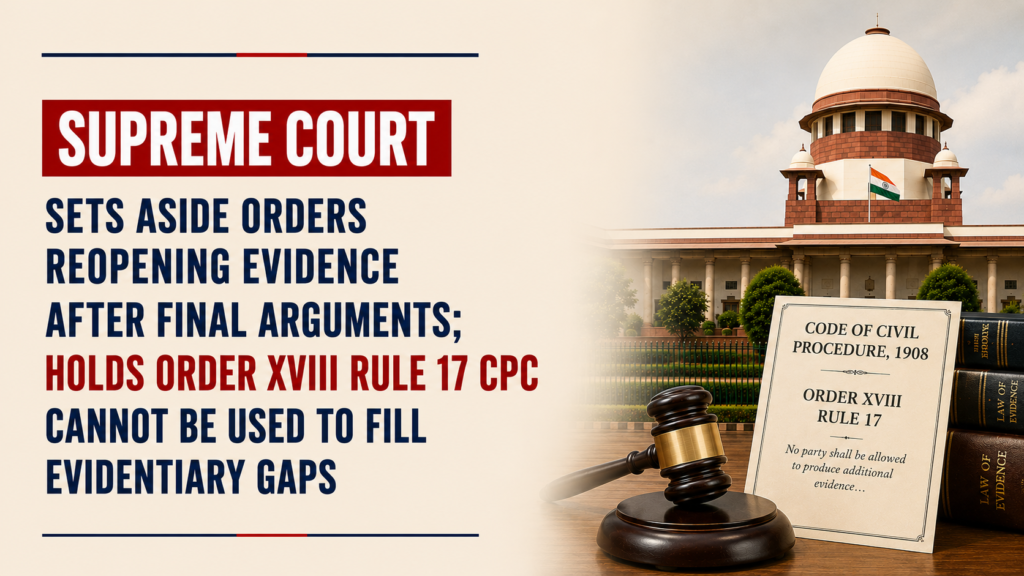
Trial Courts Cannot Permit Recall of Witnesses Simply Because Additional Documents Were Not Filed Earlier, Rules Supreme Court
Facts
The respondents-plaintiffs instituted a civil suit in 2010 seeking declaration of ownership over certain immovable properties, cancellation of sale deeds executed in favour of the appellant, and a permanent injunction. The appellant-defendant claimed ownership under registered sale deeds executed in 1987 and relied upon an earlier decree of perpetual injunction obtained in his favour.
During the trial, both parties completed their evidence. The plaintiffs examined four witnesses and produced documentary evidence. After the evidence was closed and the appellant had substantially concluded final arguments, the plaintiffs filed three interlocutory applications seeking to:
- recall PW-1,
- reopen their evidence, and
- produce additional documents relating to the existence and municipal house numbers of the suit properties.
The Trial Court allowed the applications, and the High Court modified the orders by imposing costs and prescribing timelines. The defendant challenged those directions before the Supreme Court.
Issues
- Whether Order XVIII Rule 17 CPC permits recalling a witness after completion of evidence merely to produce additional documents.
- Whether courts can reopen evidence to enable a party to fill omissions or lacunae in its case.
- Whether absence of prejudice to the opposite party is by itself sufficient to invoke Order XVIII Rule 17 CPC.
Petitioner’s Arguments
- The plaintiffs had already completed their evidence after examining four witnesses.
- The documents sought to be produced were always available and were not newly discovered.
- The applications were filed only after final arguments had substantially concluded.
- Order XVIII Rule 17 CPC is intended only for clarification by the Court and cannot be used to improve a party’s evidence.
- The applications were merely an attempt to fill gaps in the plaintiffs’ case and delay disposal of the suit.
Respondent’s Arguments
- Certain documents regarding municipal house numbers had not been produced earlier.
- These documents became necessary because of issues raised during the course of final arguments.
- Allowing reopening of evidence would enable complete adjudication of the dispute.
- No prejudice would be caused to the defendant if the documents were permitted to be brought on record upon payment of costs.
Analysis of the Law
The Supreme Court undertook an extensive examination of the scope of Order XVIII Rule 17 CPC.
The Court observed that the provision confers power exclusively upon the Court to recall a witness whenever clarification is required regarding evidence already recorded. It is not intended to provide litigants with an opportunity to improve or strengthen their case after completion of evidence.
The Court further explained that after deletion of Order XVIII Rule 17-A CPC, reopening of evidence cannot routinely be permitted under the guise of Section 151 CPC. Inherent powers may be exercised only in exceptional circumstances where justice genuinely requires such intervention.
The Court emphasised that the mere absence of prejudice to the opposite party cannot justify reopening evidence. Independent legal justification must exist before such extraordinary power is exercised.
Precedent Analysis
The Supreme Court relied upon several earlier decisions, including:
- Vadiraj Naggappa Vernekar v. Sharadchandra Prabhakar Gogate – Order XVIII Rule 17 cannot be used to fill omissions in evidence.
- K.K. Velusamy v. N. Palanisamy – reopening evidence after deletion of Rule 17-A is permissible only in exceptional circumstances under Section 151 CPC.
- Bagai Construction v. Gupta Building Material Store – recalling witnesses cannot be permitted for adducing additional evidence.
- Gayathri v. M. Girish – applications for reopening evidence should be entertained only in compelling cases.
- Ram Rati v. Mange Ram – witnesses cannot be recalled merely to elaborate on omitted aspects.
- Shubhkaran Singh v. Abhayraj Singh – the power under Order XVIII Rule 17 is discretionary and intended to assist the Court.
- The Court also approved the view of the Bombay High Court in Balkrishna Shivappa Shetty v. Mahesh Nenshi Bhakta, holding that Order XVIII Rule 17 does not permit parties to cross-examine recalled witnesses as a matter of right.
Court’s Reasoning
The Supreme Court found that the plaintiffs had already examined four witnesses and produced thirty-five exhibits. The additional documents sought to be introduced were available throughout the trial and were not based on any subsequent discovery.
The Court noted that an earlier application seeking appointment of an Advocate Commissioner had itself failed because the plaintiffs admitted that the houses had collapsed and no structures existed. Therefore, reopening the evidence to prove house numbers served no meaningful purpose.
The Court held that both the Trial Court and the High Court wrongly proceeded on the assumption that reopening evidence would cause no prejudice. Such reasoning, by itself, cannot justify exercise of powers under Order XVIII Rule 17 CPC.
The Court concluded that the applications were plainly intended to cure deficiencies in the plaintiffs’ evidence and amounted to an abuse of the procedural provisions of the CPC.
Conclusion
The Supreme Court allowed the appeals and set aside the common order of the Telangana High Court.
It held that Order XVIII Rule 17 CPC is intended only to enable the Court to clarify evidence and cannot be invoked by parties to reopen evidence, recall witnesses, produce additional documents, or fill evidentiary lacunae after completion of trial. The Court reaffirmed that such powers must be exercised sparingly and only in exceptional circumstances.
Case Details
Case: K. Bharathamma v. Bandaru Sakku Bai & Others
Court: Supreme Court of India
Case Number: Civil Appeal Nos. ___ of 2026 (Arising out of SLP (C) Nos. 2744–2746 of 2024)
Judges: Justice S.V.N. Bhatti and Justice N.V. Anjaria
Date: 4 August 2026
Result: Appeals Allowed; High Court’s order permitting recall of witness, reopening of evidence and production of additional documents was set aside.