

Court Rejects DTTDC Workers’ Claim, Holding That the Ten-Year Requirement Under Paragraph 53 of Umadevi Is Mandatory
The Delhi High Court has dismissed a plea for regularisation filed by 11 former helpers and attendants engaged by the Delhi Tourism and Transport Development Corporation, holding that employees who completed only seven years of service could not claim the limited exception recognised by the Supreme Court in Secretary, State of Karnataka v. Umadevi.
A Division Bench comprising Justice V. Kameswar Rao and Justice Manmeet Pritam Singh Arora held that paragraph 53 of Umadevi permits consideration of regularisation only where duly qualified employees were irregularly appointed against sanctioned vacant posts and continued to work for ten years or more without protection of court or tribunal orders.
Since the appellants had worked from 2007 until 31 December 2014, they had completed approximately seven years of service and therefore did not satisfy the essential ten-year requirement.
The Court consequently found it unnecessary to decide whether their initial appointments were irregular or illegal.
Background
The appellants were appointed as helpers and attendants by the Delhi Tourism and Transport Development Corporation in 2007.
Their appointments arose from the Delhi Haat project, which was required to be completed and commissioned by September 2007. To meet the immediate staffing requirement, DTTDC created four posts of helper and issued an advertisement on 26 June 2007 seeking helpers and attendants for a short period.
The appellants were selected pursuant to this advertisement.
Their appointment memoranda expressly stated that the employment would initially continue for six months and would not give them any right to further continuation or regular appointment.
Despite this condition, their services were extended periodically. The appellants continued working until 31 December 2014 and were also granted certain service benefits, including increments and reimbursement of tuition fees.
They subsequently approached the High Court seeking regularisation of their services.
Earlier Proceedings
The appellants had initially filed a writ petition seeking regularisation and age relaxation for future recruitment.
The claim for regularisation was not pressed on merits in that proceeding, though the Court granted them age relaxation for the next recruitment process.
In an intra-court appeal, the appellants were permitted to withdraw the earlier petition and file a fresh case, provided they pleaded facts capable of attracting paragraph 53 of the Supreme Court’s judgment in Umadevi.
They thereafter filed a fresh writ petition seeking regularisation.
A Single Judge dismissed the petition, holding that the appellants had knowingly applied under an advertisement offering employment only for a limited period and could not subsequently claim permanent appointment.
The appellants challenged that decision before the Division Bench.
Employees Rely on the Umadevi Exception
The appellants argued that their appointments were irregular rather than illegal.
They submitted that they possessed the required qualifications, had been appointed against sanctioned posts and had continued working for several years.
According to them, paragraph 53 of Umadevi created an exception for qualified employees irregularly appointed against sanctioned vacant posts.
They argued that DTTDC had failed to undertake a one-time regularisation exercise despite continuing to engage temporary and contractual workers for work of a permanent nature.
The appellants also contended that they had been discontinued only because DTTDC made a statement before the Court in another proceeding that their contracts would not be renewed and that fresh recruitment would be conducted.
According to them, no proper recruitment process was subsequently undertaken, even though regular posts allegedly remained vacant.
They further argued that one set of temporary employees could not be replaced by another set of contractual workers.
DTTDC Opposes Regularisation
DTTDC contended that the appellants had been appointed pursuant to an advertisement that clearly described the engagement as temporary and short-term.
It submitted that persons who might have been interested in regular employment may not have applied because the advertisement offered work only for a limited period.
Converting such temporary appointments into permanent employment would therefore prejudice other eligible candidates who never received an equal opportunity to compete for regular posts.
DTTDC relied on Umadevi to argue that regularisation could not be used to bypass the constitutional requirement of open and competitive public recruitment.
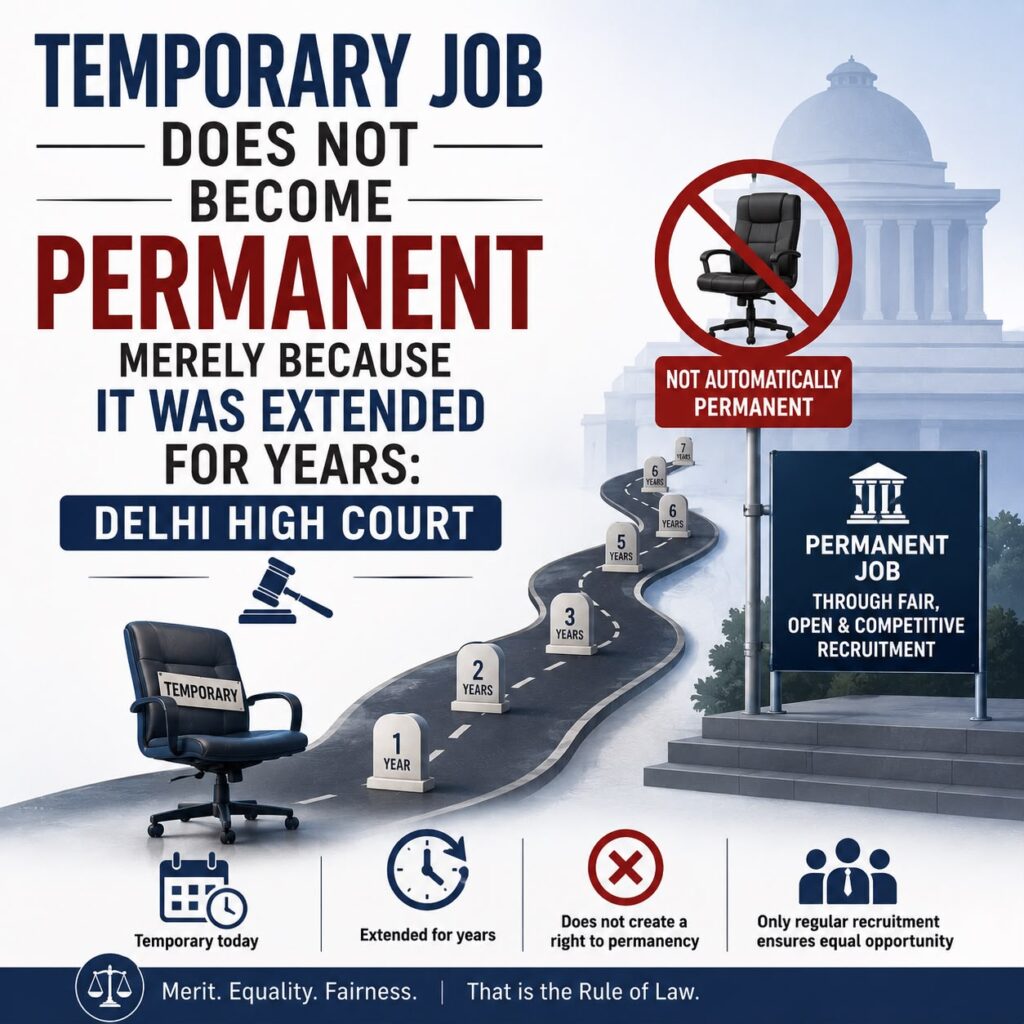
It further submitted that mere continuation in service through repeated extensions did not create a vested right to permanent employment.
Ten Years of Service Is an Essential Condition
The Division Bench held that the appellants’ claim had to be examined strictly within the scope of paragraph 53 of Umadevi, as directed in the earlier round of litigation.
Paragraph 53 recognises a limited one-time exception for employees who satisfy the following conditions:
- their appointments were irregular and not illegal;
- they were duly qualified;
- they were appointed against duly sanctioned vacant posts;
- they had worked for ten years or more;
- their continuation was not protected by orders of a court or tribunal.
The Court noted that the appellants joined between July and October 2007 and their services ended on 31 December 2014.
They had therefore completed only about seven years of service.
The minimum requirement of ten years or more was not satisfied.
The Court held that this deficiency was sufficient to reject their claim under paragraph 53.
Whether Appointments Were Irregular or Illegal Became Irrelevant
The appellants had devoted substantial arguments to showing that their appointments were irregular and not illegal.
However, the Court held that this distinction did not require examination in the present case.
Even assuming that the appointments were merely irregular, the appellants could not claim the benefit of paragraph 53 because they had not completed the prescribed ten years of service.
The Court therefore declined to examine the authorities cited by both sides on the broader questions of temporary appointments, replacement of contractual employees and regularisation against sanctioned posts.
Decision
The Delhi High Court dismissed the appeal and upheld the Single Judge’s refusal to direct regularisation.
The Court held that:
- paragraph 53 of Umadevi applies only to employees who have completed ten years or more of service;
- the appellants had worked for approximately seven years;
- they therefore failed to meet the threshold requirement for consideration under the one-time regularisation exception; and
- it was unnecessary to determine whether their appointments were irregular or illegal.
The pending application was also dismissed.
Key Legal Principle
The one-time regularisation exception under paragraph 53 of Umadevi is available only where the employee has completed ten years or more of service in a duly sanctioned post without protection of judicial orders.
Long continuation through repeated extensions, by itself, does not satisfy the exception where the employee has served for less than ten years.
Why the Judgment Matters
The decision clarifies that paragraph 53 of Umadevi cannot be invoked merely because a temporary employee was qualified, worked against a sanctioned post or continued for several years.
Each condition stated in the exception must be satisfied.
The ten-year requirement is not an approximate or flexible benchmark. An employee who has completed seven years of service cannot seek regularisation under the exception even by arguing that the initial appointment was irregular rather than illegal.
The ruling also reinforces the distinction between continuation in temporary service and acquisition of a legal right to permanent public employment.
Regular public appointments ordinarily require an open recruitment process that provides equal opportunity to all eligible candidates. Repeated contractual extensions cannot, without satisfaction of the conditions recognised in law, substitute that constitutional process.
Case: Keshav Dutt & Others v. Delhi Tourism and Transport Development Corporation Limited & Another
Court: High Court of Delhi
Case Number: LPA 307/2015
Bench: Justice V. Kameswar Rao and Justice Manmeet Pritam Singh Arora
Date of Judgment: 19 June 2026
Result: Appeal dismissed; regularisation refused

READ ALSO: Skincare Brands Cannot Claim Monopoly Over Descriptive Words Like “D-TAN”, Says Delhi High Court