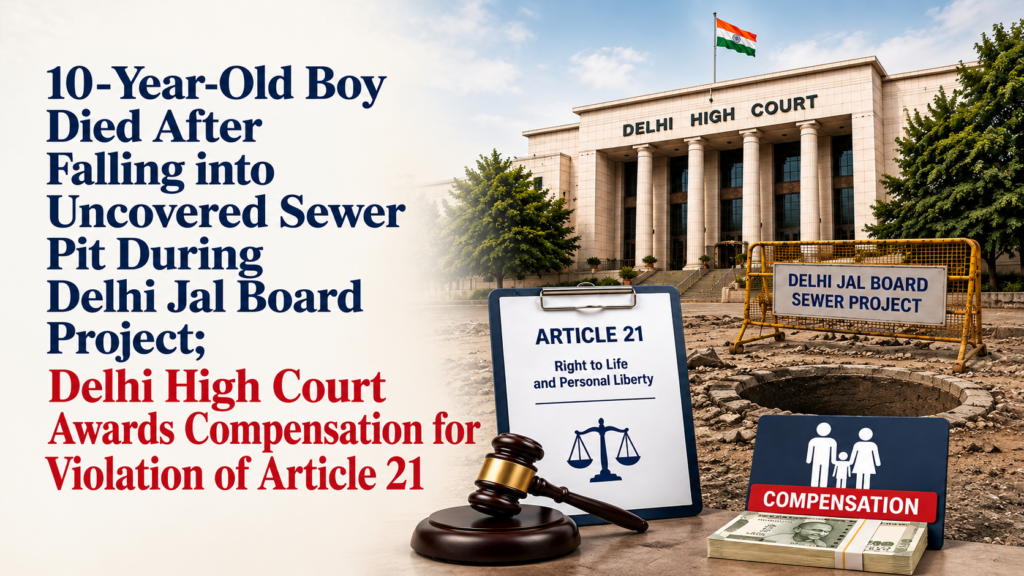
Delhi High Court Holds Government Authorities Liable for Child’s Death Caused by Unsecured Sewer Construction Site; Awards Constitutional Compensation
Facts
The petitioners, parents of 10-year-old Mohd. Nazim, approached the Delhi High Court under Article 226 of the Constitution seeking compensation after their son died on 27 September 2014 by falling into an uncovered sewer pit at a Delhi Jal Board interceptor sewer project near Bhagirathi Vihar, Delhi. The project was being executed by Delhi Jal Board (DJB) through Engineers India Limited (EIL) as project management consultant and DSCL-Fengshun-Wabag Consortium as the executing contractor. An FIR under Section 304A IPC was registered immediately after the incident and criminal proceedings remained pending.
The parents contended that the sewer pit had been left open without barricades, fencing, warning signs or adequate security, resulting in the child’s death. They sought constitutional compensation for violation of their son’s fundamental right to life under Article 21.
Issues
- Whether the writ petition was barred by delay and laches.
- Whether disputed questions of fact prevented exercise of jurisdiction under Article 226.
- Whether private contractors executing a public project were amenable to writ jurisdiction.
- Whether the respondents were negligent in leaving the project site unsafe.
- Whether the petitioners were entitled to compensation under public law for violation of Article 21.
- How compensation for the death of a minor child should be computed.
Petitioners’ Arguments
The petitioners argued that:
- their son died solely because the respondents failed to secure an open sewer pit;
- DJB, EIL and the contractor jointly failed to maintain basic safety measures such as barricades, warning signs and guards;
- the principle of res ipsa loquitur applied because the dangerous condition itself established prima facie negligence;
- the pending criminal case did not bar a constitutional claim for compensation;
- delay in filing the writ deserved to be condoned considering the family’s poverty, trauma and the ongoing criminal proceedings;
- the respondents’ negligence amounted to a violation of the deceased child’s fundamental right to life under Article 21.
Respondents’ Arguments
The respondents contended that:
- the petition suffered from delay and laches since it was filed nearly five years after the incident;
- complicated factual disputes made the writ petition unsuitable for adjudication;
- EIL and its officers merely supervised the project while the contractor was responsible for site safety;
- adequate barricades and safety measures had been installed but were allegedly stolen by unknown persons;
- the incident occurred due to third-party intervention or the child’s own conduct and therefore negligence could not be presumed;
- the private contractor was not amenable to writ jurisdiction and liability, if any, should be determined only after the criminal trial concluded.
Analysis of the Law
The High Court examined:
- Article 21 of the Constitution;
- maintainability of compensation claims under Article 226;
- delay and laches in constitutional litigation;
- public law compensation for State negligence;
- res ipsa loquitur;
- liability of government agencies and contractors engaged in public functions.
The Court held that there is no rigid limitation period for invoking writ jurisdiction to enforce fundamental rights. Poverty, illiteracy, trauma and pendency of criminal proceedings constituted sufficient explanation for the delay. It further held that the existence of disputed questions of fact does not automatically prevent the High Court from exercising writ jurisdiction where the foundational facts are established.
The Court also held that contractors executing public infrastructure projects perform public functions and may be subjected to writ jurisdiction where constitutional rights are implicated.
Precedent Analysis
The Court relied upon several important precedents, including:
- Tukaram Kana Joshi v. Maharashtra Industrial Development Corporation — delay should not defeat claims involving violation of fundamental rights.
- Ram Autar Singh Yadav v. State of Uttar Pradesh — belated writ petitions seeking enforcement of Article 21 cannot be rejected mechanically on the ground of delay.
- A.P. Electrical Equipment Corporation v. Tahsildar — disputed facts do not automatically oust writ jurisdiction.
- Kamla Devi v. Government of NCT of Delhi — laid down principles governing constitutional compensation for violation of Article 21.
- Kishan Lal v. Government of NCT of Delhi — adopted methodology for determining compensation for death of a minor child due to an uncovered manhole.
- M.S. Grewal v. Deep Chand Sood — compensation for children should consider their future earning potential.
- Smt. Kumari v. State of Tamil Nadu — compensation awarded where a child died after falling into an uncovered sewer opening.
Court’s Reasoning
The Court described the case as a classic instance of governmental apathy, observing that every authority attempted to shift responsibility despite the undisputed fact that a child had died because a hazardous construction site was left unsecured. It held that the failure to fence or adequately guard the sewer pit constituted a breach of the State’s duty of care and a direct violation of Article 21.
The Court rejected the objections regarding delay, holding that grieving parents from an economically weaker background who had diligently pursued criminal proceedings could not be denied constitutional relief on technical grounds. It also rejected the argument that disputed facts barred writ jurisdiction, noting that the occurrence of the accident and the child’s death were undisputed.
Further, the Court held that inter se disputes between DJB, EIL and the contractor regarding contractual liability could not deprive the petitioners of compensation. Public authorities executing hazardous civic projects owe a heightened duty to protect members of the public, especially children, and cannot avoid constitutional responsibility by blaming one another.
Conclusion
The Delhi High Court allowed the writ petition and held that the death of the petitioners’ 10-year-old son resulted from the respondents’ failure to secure a hazardous sewer construction site, amounting to a violation of his fundamental right to life under Article 21. The Court awarded constitutional compensation by applying the principles laid down in Kamla Devi, Kishan Lal and M.S. Grewal, while leaving the respondents free to determine their respective contractual liabilities and recover the amount from the party ultimately found responsible.
Case Details
Case: Mohd. Neejam & Anr. v. State, Govt. of NCT of Delhi & Ors.
Court: Delhi High Court
Case Number: W.P.(C) 12566/2019
Judge: Justice Mini Pushkarna
Date: 27 July 2026
Result: Writ petition allowed. The Delhi High Court held that the death of the petitioners’ minor son due to an unsecured sewer construction site violated Article 21 and awarded constitutional compensation, with liberty to the authorities to recover the amount from the party responsible after appropriate proceedings.