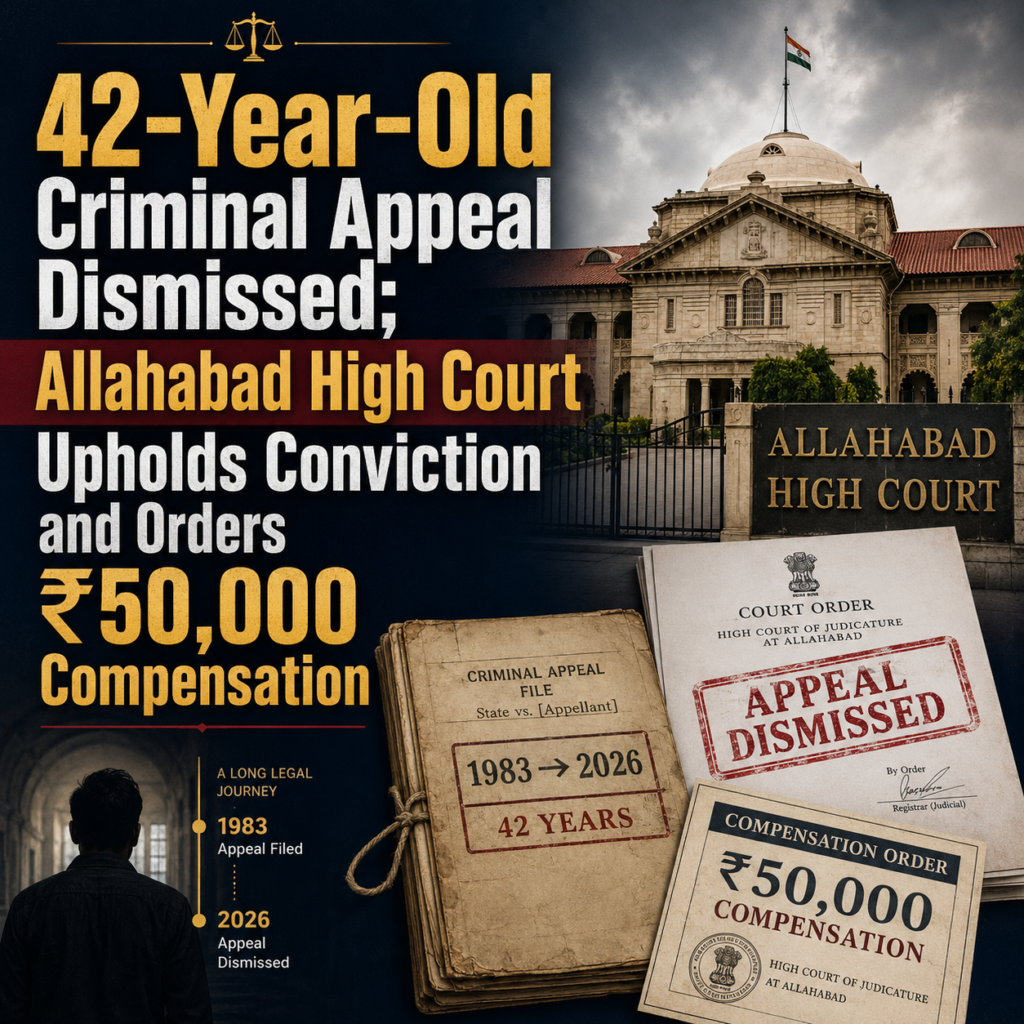
Allahabad High Court Upholds 1983 Conviction, Refuses Probation Despite Four-Decade Delay
Facts
The case arose from an incident reported in February 1982, following which Rakesh and another accused were prosecuted under Section 376 of the Indian Penal Code. The prosecution relied upon the victim’s statement, the prompt FIR, medical evidence showing injuries, and the investigation conducted by the police.
On 23 May 1983, the IV Additional Sessions Judge, Allahabad convicted Rakesh under Section 376 IPC and sentenced him to three years’ rigorous imprisonment. No fine was imposed.
Rakesh challenged the conviction before the Allahabad High Court. The appeal remained pending for approximately 42 years and was finally decided in June 2026.
Issues
- Whether the victim’s testimony was reliable enough to sustain the conviction.
- Whether the medical observations relied upon by the defence created reasonable doubt about the prosecution case.
- Whether the appellant was entitled to probation because of his age, absence of previous criminal history and the prolonged pendency of the appeal.
- Whether the three-year sentence without imposition of a fine complied with the sentencing requirements under Section 376 IPC.
Petitioner’s Arguments
The appellant argued that he had been falsely implicated and that inconsistencies existed in the prosecution evidence.
During the final hearing, however, the principal submission was confined to the sentence. The appellant requested release on probation on the grounds that:
- The appeal had remained pending for about 42 years;
- He was over 60 years old;
- He was suffering from age-related ailments; and
- He had no previous criminal history.
The defence also relied upon certain medical observations to argue that the prosecution allegation was not conclusively supported by medical evidence.
Respondent’s Arguments
The State opposed the appeal and submitted that the trial court had correctly appreciated the evidence.
It argued that:
- The appellant was specifically named in the FIR;
- The report was lodged promptly;
- The victim consistently identified the accused;
- Her account was supported by the injuries recorded during medical examination; and
- No material contradiction existed that could undermine the prosecution case.
The State further submitted that the three-year sentence was already lenient considering the seriousness of the offence. It informed the Court that no separate appeal or revision had been filed seeking enhancement of the sentence.
Analysis of the Law
The High Court reiterated that the testimony of a victim of a sexual offence can form the sole basis of conviction when it is natural, credible and trustworthy.
Independent corroboration is not an absolute legal requirement. Such offences are ordinarily committed away from public view, and the absence of an independent eyewitness cannot by itself weaken a reliable statement made by the victim.
The Court also held that medical observations concerning the physical condition of the victim cannot, by themselves, establish consent or disprove the offence. The existence of earlier physical changes may have several possible explanations and cannot override credible oral evidence.
The Court further observed that the evidence of a young and illiterate witness should not be rejected through an excessively technical interpretation of individual expressions used during cross-examination.
On sentencing, the Court noted that Section 376 IPC, as applicable to the case, contemplated a minimum punishment of seven years unless adequate and special reasons were recorded for imposing a lesser sentence.
The trial court had imposed only three years’ rigorous imprisonment without recording such reasons. It had also failed to impose any fine.
The High Court held that fine formed an important component of the statutory sentence and that the omission required correction. However, since the State had not challenged the three-year imprisonment term, the Court did not enhance the substantive sentence.
Precedent Analysis
Ganga Singh v. State of Madhya Pradesh, AIR 2013 SC 3008
The Supreme Court held that the testimony of a victim of rape is entitled to the same weight as that of an injured witness and does not invariably require corroboration.
The High Court relied upon this principle while accepting the victim’s testimony.
State of Punjab v. Gurmit Singh, (1996) 2 SCC 384
This decision emphasised that courts must assess evidence in sexual offence cases with sensitivity and should not reject credible testimony on minor or technical grounds.
State of Madhya Pradesh v. Ramesh, (2011) 4 SCC 786
The judgment was referred to while considering the importance of complying with statutory sentencing requirements and protecting the rights of victims.
Employees’ State Insurance Corporation v. A.K. Abdul Samad, (2016) 4 SCC 785
The Court relied upon this decision to examine the legal significance of statutory language requiring imprisonment as well as fine.
Hazara Singh v. Raj Kumar, (2013) 9 SCC 516
The Supreme Court held that punishment must remain proportionate to the seriousness of the offence and that undue sympathy leading to an inadequate sentence may weaken public confidence in the criminal justice system.
Gopal Singh v. State of Uttarakhand, (2013) 7 SCC 545
This decision reaffirmed that just punishment must balance proportionality, deterrence, the rights of the accused and the interests of the victim and society.
Court’s Reasoning
The High Court found that the victim’s testimony was consistent on the material aspects of the case. She had clearly identified the accused and described the incident, while the medical evidence recorded injuries that supported her version.
The Court held that the defence had failed to point out any contradiction going to the root of the prosecution case. The trial court’s finding of guilt was therefore neither perverse nor unsupported by evidence.
The Court rejected the request for probation. It held that age, absence of prior criminal history and prolonged pendency of the appeal could not justify probation in a serious offence against the human body.
The Court also observed that the appellant had already received substantial leniency through the three-year sentence. Granting probation would further dilute the deterrent purpose of criminal law.
At the same time, the trial court’s failure to impose a fine was treated as a legal error. The High Court therefore added a fine of ₹50,000, to be paid as compensation to the victim or her legal representatives.
Conclusion
The Allahabad High Court upheld the appellant’s conviction under Section 376 IPC and maintained the sentence of three years’ rigorous imprisonment.
The Court refused to release the appellant on probation despite the appeal having remained pending for approximately 42 years.
An additional fine of ₹50,000 was imposed, payable as compensation to the victim or, if she was no longer alive, to her legal representatives. In default of payment, the appellant would undergo an additional six months’ rigorous imprisonment.
The appellant’s bail bonds were cancelled, and he was directed to surrender before the trial court within ten days to serve the remaining sentence.
Case Details
Case: Rakesh v. State
Court: High Court of Judicature at Allahabad
Case Number: Criminal Appeal No. 1246 of 1983
Judge: Hon’ble Mr. Justice Santosh Rai
Date: 23 June 2026
Result: Conviction and three-year rigorous imprisonment upheld; probation refused; ₹50,000 fine imposed as compensation; appellant directed to surrender within ten days.