

Court’s decision
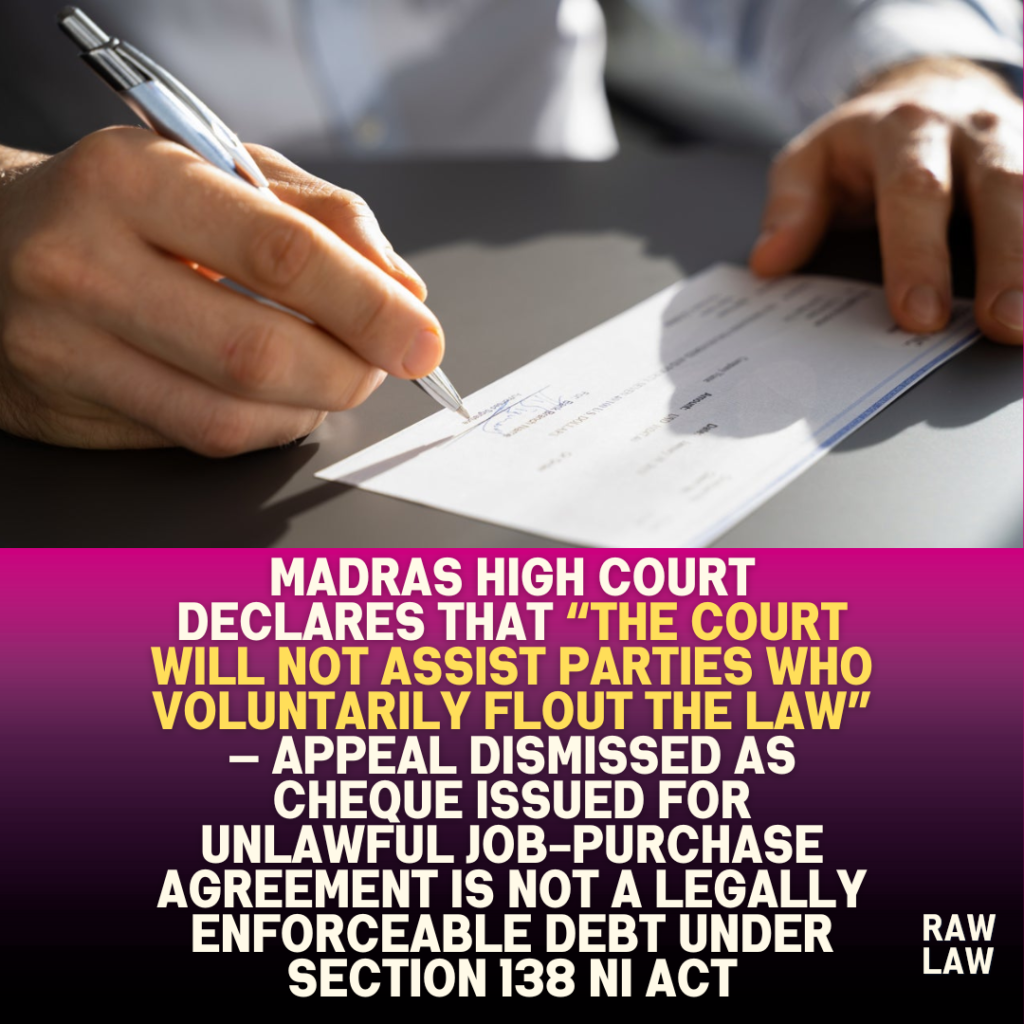
The Madras High Court dismissed the appeal filed by the Petitioner challenging the acquittal of the Respondent in proceedings under Section 138 of the Negotiable Instruments Act. After examining the evidence and the legal principles governing enforceability of consideration, the Court held that the cheque was issued not for a lawful liability but for returning money paid for securing a government job, which is an unlawful object. The Court relied heavily on Section 23 of the Contract Act, the doctrine of in pari delicto, and the Delhi High Court’s reasoning in Virender Singh v. Laxmi Narain, holding that no person can enforce a cheque arising from an agreement that is void from inception due to illegality.
The High Court observed that the Petitioner admitted paying money to obtain employment in a public corporation, thereby participating in an unlawful transaction. Under such circumstances, criminal prosecution under Section 138 cannot be maintained because the existence of a legally enforceable debt is a mandatory ingredient of the offence. The Court also found no error in the Magistrate’s conclusion that the cheque did not meet the statutory threshold of enforceability. Consequently, the appeal was dismissed, and the acquittal was confirmed.
Facts
The prosecution originated when the Petitioner claimed to have paid a substantial sum to the Respondent in expectation of being provided employment within a government corporation. According to the allegations, the payment was made after assurances that the Respondent held influence through labour union connections and could arrange a conductor post. When the promised employment did not materialise despite repeated follow-ups, the Petitioner demanded repayment. The Respondent allegedly issued a cheque, which was dishonoured, stating insufficient funds. A statutory notice was sent, but no payment followed. The Petitioner then initiated prosecution under Section 138 NI Act.
During trial, the Petitioner testified regarding the purpose of the payment, reiterating that the funds were given specifically for securing employment. Another witness supported this account. However, both acknowledged that the underlying transaction involved payment of money to obtain a public job. This acknowledgment formed the central issue before the Court: whether a cheque issued to return money arising from an illegal agreement amounts to a legally enforceable debt. The trial court acquitted the Respondent, finding that the underlying consideration violated public policy. The Petitioner challenged this finding before the High Court.
Issues
- Whether the cheque issued by the Respondent constituted a legally enforceable debt or liability under Section 138 NI Act.
- Whether an agreement to secure a public job in exchange for money is void for illegality under Section 23 of the Indian Contract Act.
- Whether criminal liability can arise when both parties participate in an unlawful transaction, invoking the doctrine of in pari delicto.
- Whether the trial court erred in concluding that the prosecution failed to satisfy the mandatory ingredients of Section 138 NI Act.
Petitioner’s arguments
The Petitioner argued that the cheque was issued as repayment of money and therefore constituted a liability enforceable under Section 138 NI Act. It was contended that while the origin of the payment may have related to a job advertisement, the prosecution was based solely on the dishonoured cheque and not on the underlying agreement. The Petitioner maintained that the second cheque created an independent cause of action unrelated to the earlier arrangement. The Petitioner also submitted that the Respondent admitted liability during cross-examination, strengthening the case that the cheque represented a valid enforceable debt.
The Petitioner further asserted that the trial court gave undue emphasis to the purpose of the initial payment instead of analysing the effect of issuing a subsequent cheque. The Petitioner claimed that once a cheque is voluntarily issued, the presumption of legally enforceable debt under Section 139 NI Act arises, and the Respondent failed to rebut it through evidence. Therefore, the Petitioner argued that the acquittal was legally unsound and the ingredients of the offence were fully satisfied.
Respondent’s arguments
The Respondent contended that the cheque was issued solely to return money obtained in an illegal transaction, namely payment of a bribe for securing government employment. Such a transaction is void under Section 23 of the Contract Act and cannot create a legally enforceable debt. The Respondent argued that both parties knowingly participated in an unlawful objective and therefore could not seek relief in a court of law.
Relying on precedent, the Respondent asserted that the doctrine of in pari delicto prevents courts from enforcing obligations arising from illegal agreements. The Respondent maintained that Section 138 NI Act cannot apply when the underlying transaction is illegal. It was also submitted that the presumption under Section 139 NI Act stands rebutted when the evidence clearly shows the cheque was issued in the context of an agreement contrary to public policy.
Analysis of the law
The Court emphasised that Section 138 NI Act requires the existence of a legally enforceable debt or liability. This requirement is not procedural but foundational. If the underlying transaction is void, no prosecution can stand. Section 23 of the Indian Contract Act voids agreements whose object or consideration is unlawful, including those opposed to public policy. Agreements involving payments to secure government employment fall squarely within this category.
The Court also relied on the principle that parties to an illegal agreement cannot seek judicial enforcement of obligations arising from it. This doctrine ensures the legal system does not support or legitimise transactions that undermine public institutions. The High Court reinforced that the presence of Section 139 NI Act presumption does not override statutory illegality and can easily be rebutted where the complainant’s own evidence discloses an unlawful consideration.
Precedent analysis
The Court cited Virender Singh v. Laxmi Narain, where the Delhi High Court held that money paid for securing a public job is an unlawful object and cannot give rise to enforceable debt. In that case, the cheque issued to return such money was held outside the ambit of Section 138 NI Act.
The Court also considered Supreme Court jurisprudence on Section 23 Contract Act and the doctrine of restitution under Section 65, clarifying that restitution applies only where a contract becomes void later, not where it was void from inception. Thus, the illegality in the present case barred any remedy through criminal prosecution.
Court’s reasoning
The Court reasoned that the Petitioner’s own testimony established that the payment was for securing employment. Such an agreement is void ab initio and cannot create enforceable rights. The Court stressed that it could not assist parties who voluntarily engaged in illegal conduct. The principle of in pari delicto potior est conditio possidentis barred the Petitioner from obtaining relief.
The Court further held that the issuance of a subsequent cheque does not cleanse the illegality of the original transaction. Since the cheque represented an unlawful consideration, its dishonour did not trigger criminal liability. Finding no error in the trial court’s reasoning, the High Court dismissed the appeal.
Conclusion
The High Court reaffirmed that Section 138 NI Act cannot be used to enforce illegal agreements. Since the transaction involved payment to secure a job, no legally enforceable debt existed. The acquittal of the Respondent was upheld, and the appeal was dismissed as devoid of merit.
Implications
This judgment strengthens the legal position that cheques issued in furtherance of unlawful transactions cannot form the basis for criminal prosecution. It warns individuals against participating in job-purchase schemes and reinforces that courts will not intervene in disputes arising from illegal bargains. It also clarifies the interplay between Section 138 NI Act, Section 23 Contract Act, and the doctrine of in pari delicto, providing clear guidance for future litigation involving illegal consideration.


