

Delhi High Court Upholds AFT’s Refusal to Let Army Doctors Apply for NEET PG 2026 Under Superseded Ten-Year Rule
Facts:
Major Jayati Chandra and Major Eshaan Segan, medical officers serving in the Armed Forces Medical Services, filed separate writ petitions before the Delhi High Court challenging orders passed by the Principal Bench of the Armed Forces Tribunal.
Under the Training Rules for Medical/Non-Technical Officers of the Armed Forces Medical Services, 2018, Short Service Commission officers could apply for postgraduate medical courses after completing four years and up to ten years of physical service.
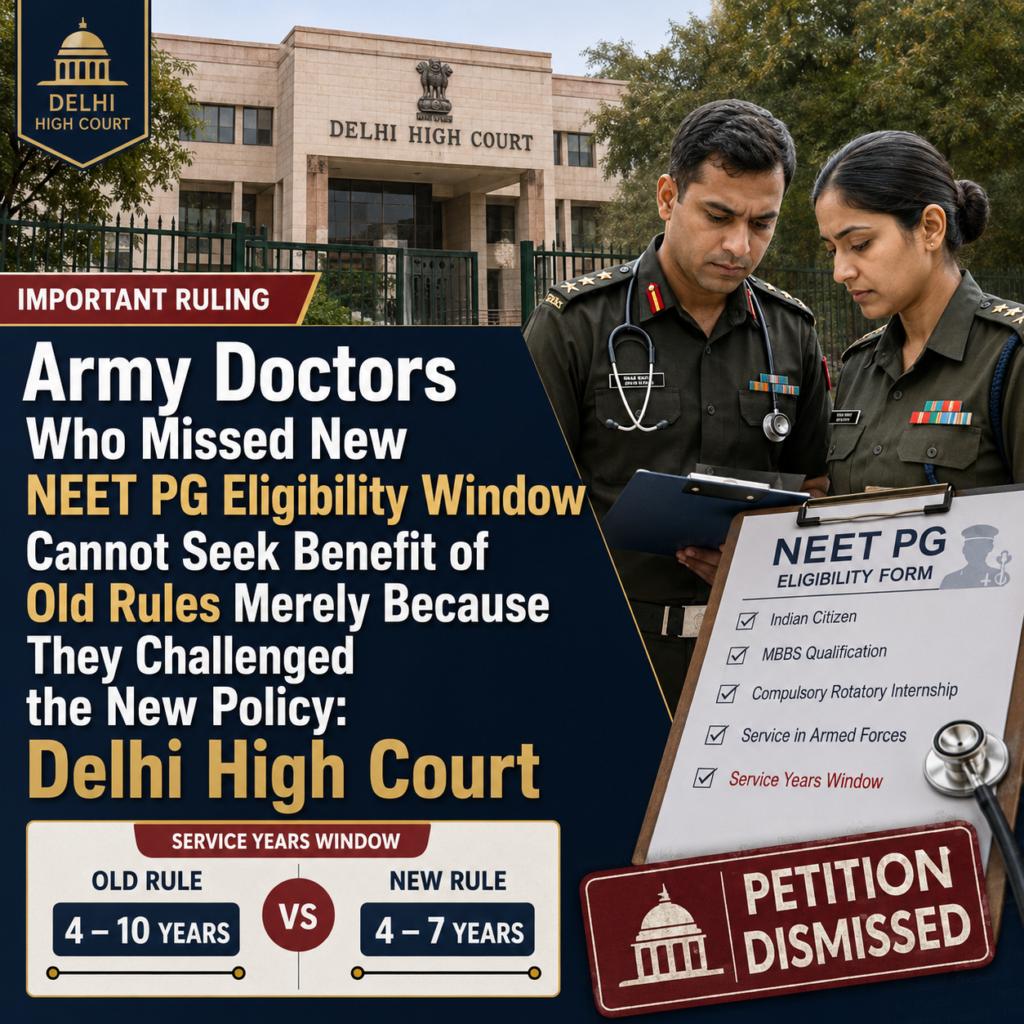
The 2018 Rules were subsequently replaced by the Training and Professional Progression Rules for Medical/Non-Technical Officers of the Armed Forces Medical Services, 2025. Rule 7.2 of the 2025 Rules reduced the eligibility period for Short Service Commission officers from 4–10 years to 4–7 years of physical service.
The petitioners, who had been in service since 2017 and 2018 respectively, sought permission to apply for and appear in the NEET PG Examination, 2026, by claiming the benefit of the longer eligibility period under the 2018 Rules.
They had approached the Armed Forces Tribunal through O.A. No. 1416/2026 and O.A. No. 1119/2026. By orders dated 27 May 2026 and 21 May 2026, the Tribunal refused to grant them interim permission to apply for or appear in NEET PG 2026.
The petitioners consequently approached the Delhi High Court under Article 226 of the Constitution. The matter was urgent because the last date for submitting the NEET PG 2026 application form was 30 June 2026.
Issues
- Whether the Delhi High Court should interfere with the Armed Forces Tribunal’s refusal to grant interim relief to the petitioners.
- Whether the petitioners’ pending challenge to the 2025 Training Rules entitled them, at the interim stage, to apply for NEET PG 2026 under the earlier 4–10-year eligibility period.
- Whether permitting the petitioners to appear in NEET PG 2026 would effectively suspend the operation of the 2025 Rules before their validity was finally decided by the Tribunal.
Petitioner’s Arguments
The petitioners argued that under Rule 14(a)(ii) of the 2018 Training Rules, Short Service Commission officers were eligible to apply for postgraduate medical courses between four and ten years of physical service.
They contended that the subsequent 2025 Rules had reduced this eligibility window to seven years and adversely affected their opportunity to pursue postgraduate medical education.
Since the deadline for submitting the NEET PG 2026 application was 30 June 2026, they requested the Court to grant immediate interim permission to apply for and appear in the examination, subject to the final outcome of their cases before the Armed Forces Tribunal.
Respondent’s Arguments
The Union of India and the other respondents submitted that the 2025 Training Rules had been notified in November 2025 and that the petitioners had been aware of the revised eligibility conditions since then.
They maintained that the Armed Forces Tribunal had correctly refused interim relief and that no ground existed for interference with its orders.
The respondents further argued that even if the petitioners ultimately succeeded in establishing their entitlement under the 2018 Rules, they would still have an opportunity to appear in the NEET PG examination until 2028. Therefore, refusal of permission for the 2026 examination would not cause irreversible prejudice.
Analysis of the Law
The Court examined the matter as one concerning the grant of interim relief while the substantive challenge to the 2025 Training Rules remained pending before the Armed Forces Tribunal.
The Court distinguished between merely challenging a policy and establishing a sufficient basis for suspending or bypassing that policy at the interim stage. A rule or policy that is presently in force continues to operate unless it is stayed, suspended or set aside by a competent court or tribunal.
The Court held that the filing of a challenge against the 2025 Rules did not, by itself, create a prima facie entitlement in favour of the petitioners to be governed by the superseded 2018 Rules.
It further observed that granting permission to apply for NEET PG 2026 under the earlier eligibility conditions would effectively suspend the operation of the 2025 Rules in favour of the petitioners, even though the validity and applicability of those Rules had not yet been finally adjudicated.
The Court also considered whether refusal of interim relief would result in immediate and irreversible prejudice. Since the petitioners could still appear in a subsequent examination if they ultimately succeeded before the Tribunal, the Court found no sufficient basis for granting exceptional interim protection.
Precedent Analysis
The judgment does not cite or analyse any earlier judicial precedent.
The decision was based principally on:
- The eligibility conditions contained in the 2018 and 2025 Training Rules;
- The findings recorded by the Armed Forces Tribunal;
- The continued operation of the 2025 Rules;
- The petitioners’ earlier opportunities to appear in NEET PG; and
- The consequences of granting interim relief before final adjudication.
Accordingly, the judgment is primarily an application of settled interim-relief principles to the facts of the petitioners’ service eligibility dispute rather than a precedent-based examination of the validity of the 2025 Rules.
Court’s Reasoning
The Court noted that the petitioners had joined service in 2017 and 2018 respectively. Since officers became eligible to appear in NEET PG after completing four years of service, the petitioners had been eligible from 2022 and 2023 respectively.
The Armed Forces Tribunal had recorded that the petitioners had not secured postgraduate seats either because they had chosen not to apply earlier or because they had been unsuccessful in the examination process.
The High Court agreed with the Tribunal that merely challenging the 2025 policy did not establish a prima facie case for interim relief.
The Court emphasised that the 2025 Rules were presently operational. Allowing the petitioners to apply under the earlier 2018 Rules would effectively suspend the application of the new Rules before the Tribunal had finally determined their legality.
The substantive proceedings were already listed before the Armed Forces Tribunal on 28 August 2026. The Court also accepted the respondents’ submission that if the petitioners ultimately succeeded, they would have further opportunities to appear in NEET PG until 2028.
On these considerations, the Court found no error in the Tribunal’s refusal to grant interim relief.
Conclusion
The Delhi High Court dismissed both writ petitions and upheld the Armed Forces Tribunal’s orders refusing interim permission to the petitioners to apply for and appear in NEET PG 2026.
The Court held that a pending challenge to the 2025 Training Rules was not sufficient to permit the petitioners to claim the benefit of the superseded 2018 Rules at the interim stage. Granting such relief would effectively suspend the presently operative Rules before final adjudication.
The pending applications were also dismissed.
The Court did not finally decide the validity of the 2025 Rules or whether the petitioners were legally entitled to the longer eligibility period under the 2018 Rules. Those substantive questions remained pending before the Armed Forces Tribunal.
Case Details
Case: Major Jayati Chandra v. Union of India & Ors.; Major Eshaan Segan v. Union of India & Ors.
Court: High Court of Delhi at New Delhi
Case Number: W.P.(C) 8370/2026 with CM APPL. 39344/2026; W.P.(C) 8372/2026 with CM APPL. 39348/2026
Judge: Justice Mini Pushkarna and Justice Vinod Kumar
Date: 29 June 2026
Result: Writ petitions and pending applications dismissed; Armed Forces Tribunal’s refusal of interim NEET PG 2026 permission upheld.

Read Also: Recovery Suit Fails as Seller Could Not Prove Outstanding Dues Despite Proving Supply