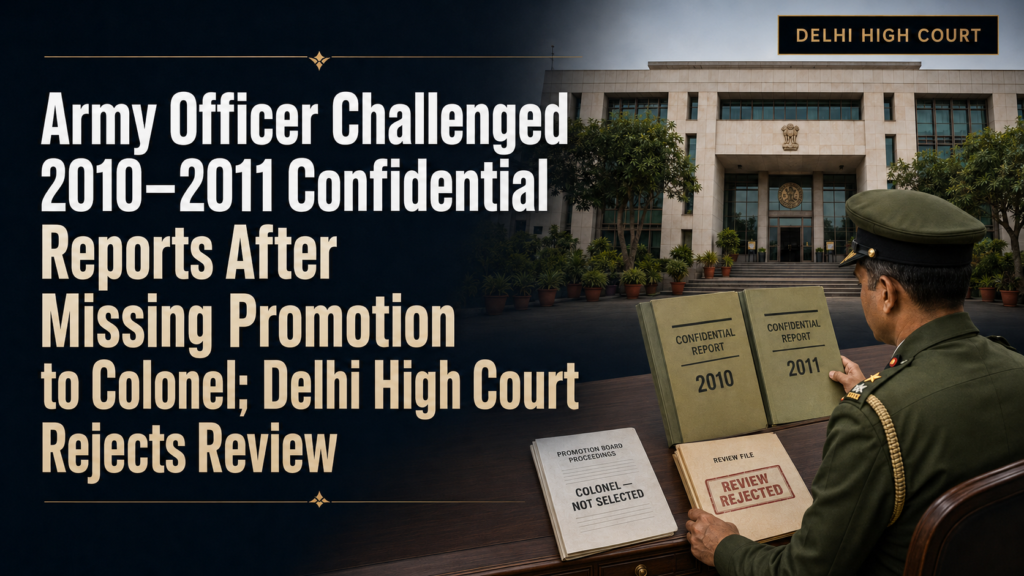
Lieutenant Colonel Sought Reopening of Promotion Case Over Allegedly Invalid Confidential Reports; Delhi High Court Refuses
Facts
Lieutenant Colonel Bharat Singh, a Sena Medal recipient, challenged the validity of his Confidential Reports for 2010 and 2011. The disputed reports had a bearing on his consideration for promotion to the rank of Colonel.
He initially approached the Armed Forces Tribunal, questioning the technical validity of the reports and seeking consequential promotion. On July 26, 2024, the Tribunal rejected his challenge.
The Tribunal found that the petitioner had himself filled in and authenticated the relevant Confidential Report forms and service records. His allegations of forged signatures and incorrect appointment details were not established.
Regarding the 2011 report, the Tribunal held that the mandatory requirement of 90 days of physical service had been satisfied. It also found that the report did not become invalid merely because it ultimately operated as a “one-man report”—that is, an assessment completed without the usual endorsement by an additional reviewing officer.
The petitioner challenged the Tribunal’s decision before the Delhi High Court in W.P.(C) 14626/2024.
On May 16, 2026, the High Court dismissed the writ petition. It held that:
- The Tribunal consisted of domain experts.
- It had examined the rival contentions and relevant records.
- Its conclusions represented a plausible view.
- The High Court’s jurisdiction under Articles 226 and 227 was supervisory, not appellate.
- Comparative merit, assessment of Confidential Reports and empanelment for military promotion primarily belonged to expert military authorities.
- The petitioner had already been considered multiple times for promotion and had not established mala fides, arbitrariness or procedural illegality.
Lieutenant Colonel Bharat Singh then filed the present review petition under Section 114 read with Order XLVII Rule 1 of the Code of Civil Procedure, 1908.
He sought reconsideration of the May 16 judgment, arguing that the Court had committed factual and legal errors while upholding the Confidential Reports.
Issues
- Whether the judgment dated May 16, 2026, contained an error apparent on the face of the record.
- Whether the High Court failed to consider the alleged violation of Paragraph 16(c) of Army Order 45/2001/MS.
- Whether inconsistencies between the petitioner’s actual appointment, the appointment recorded in the Confidential Reports and the appointment shown in form IAFF-3008 invalidated the reports.
- Whether the Court incorrectly treated the petitioner as having accepted the appointment recorded in the Paramount Card.
- Whether the petitioner’s signatures could be relied upon when he claimed to have been on sanctioned leave or attending an official course on the relevant dates.
- Whether a challenge to the Confidential Reports could validly be raised after declaration of the Selection Board results.
- Whether the absence of a Senior Reviewing Officer endorsement invalidated the 2011 report as a one-man report.
- Whether the review petition sought correction of an obvious error or an impermissible rehearing of the original dispute.
Petitioner’s Arguments
The petitioner argued that the Court had wrongly upheld the Confidential Reports for 2010 despite an alleged violation of Paragraph 16(c) of Army Order 45/2001/MS.
According to him, three separate appointment descriptions did not correspond:
- The appointment against which he was officially posted.
- The appointment for which the Confidential Reports were initiated.
- The appointment reflected in IAFF-3008.
He submitted that the discrepancy went to the technical validity of the reports and had not been properly addressed.
The petitioner also challenged the finding that he had accepted the appointment recorded in the Paramount Card. The card described him as “Company Second-in-Command,” but he maintained that he had disputed that description.
He argued that the Court placed undue reliance on his signatures appearing on the reports and service records. According to him, he was either on sanctioned leave or attending an official course on the dates when the signatures were allegedly obtained.
The petitioner maintained that he was legally entitled to challenge the technical validity of the reports even after the Selection Board results were declared. Therefore, the timing of his objection should not have been used against him.
Regarding the 2011 report, he argued that the Court did not return a specific finding on Paragraph 12 of the “Important Instructions” in the prescribed report form. According to him, the required Senior Reviewing Officer endorsement was absent, resulting in an impermissible one-man report.
He therefore contended that these omissions and factual errors justified review of the earlier judgment.
Respondent’s Arguments
The Union of India opposed the petition and argued that no error apparent on the face of the record had been demonstrated.
It submitted that the High Court had delivered a detailed and reasoned judgment after examining:
- The disputed Confidential Reports.
- The relevant service records.
- The Paramount Card.
- The petitioner’s signatures and authentication.
- The applicable Army Order.
- The 90-day service requirement.
- The Senior Reviewing Officer endorsement.
- The timing of the petitioner’s challenge.
- His claim for promotion.
According to the respondents, the petitioner was merely repeating arguments already considered in the writ proceedings.
The Union maintained that the petitioner wanted the Court to reassess documents, reinterpret the applicable Army instructions and reach a different conclusion on the same material. Such an exercise belonged to appellate jurisdiction and could not be undertaken in review proceedings.
Analysis of the Law
Scope of review jurisdiction
Section 114 and Order XLVII Rule 1 of the Code of Civil Procedure permit review on limited grounds, including:
- Discovery of new and important evidence which, despite due diligence, could not be produced earlier.
- A mistake or error apparent on the face of the record.
- Another sufficient reason analogous to the recognised grounds.
Review is not a second opportunity to argue the merits. It does not permit a party to seek a fresh assessment merely because it disagrees with the result.
Error apparent on the record
An error apparent must be self-evident. It should be identifiable by looking at the record without a prolonged process of argument or interpretation.
Where establishing the alleged error requires:
- Detailed re-examination of documents.
- Competing interpretations of rules.
- Reassessment of evidentiary value.
- Lengthy reasoning on questions where two views are possible,
the alleged mistake is not an error apparent.
Review and appeal
An appellate court may correct errors of fact and law after reconsidering the merits. A court exercising review jurisdiction cannot perform that function.
An allegedly incorrect decision is not automatically reviewable. The proper remedy against an error on merits ordinarily lies through an appeal, if available.
Judicial review of Armed Forces Tribunal decisions
Under Articles 226 and 227, the High Court supervises the legality of the Tribunal’s decision-making process. It does not ordinarily substitute its own assessment for that of a specialist body.
Interference may be justified where the Tribunal’s decision is:
- Arbitrary.
- Mala fide.
- Perverse.
- Based on no evidence.
- Contrary to a mandatory legal provision.
- Vitiated by procedural unfairness.
Where the Tribunal’s conclusion is plausible and supported by the record, the High Court does not reassess the evidence merely because another view is possible.
Military promotions and Confidential Reports
Assessment of comparative merit and suitability for promotion in the Armed Forces involves professional and institutional evaluation.
Courts ordinarily defer to expert military authorities unless the officer establishes mala fides, arbitrariness or a material violation of the governing procedure.
Review proceedings provide an even narrower scope for intervention because the Court has already examined the original challenge.
Precedent Analysis
Meera Bhanja v. Nirmala Kumari Choudhury, (1995) 1 SCC 170
The Supreme Court held that review proceedings are not appeals and must remain confined to Order XLVII Rule 1.
An error apparent must be visible on a straightforward examination of the record. An error requiring lengthy reasoning or admitting two possible opinions cannot ordinarily be corrected through review.
Aribam Tuleshwar Sharma v. Aribam Pishak Sharma, (1979) 4 SCC 389
The Supreme Court recognised that High Courts possess the power to review their writ decisions to prevent miscarriage of justice or correct grave and palpable errors.
However, the power has definite limits. Review may address new evidence, an apparent mistake or an analogous ground, but cannot correct a decision merely because it is allegedly erroneous on its merits.
Shivdeo Singh v. State of Punjab, AIR 1963 SC 1909
This decision recognised the High Court’s inherent power to review its orders under Article 226 where necessary to prevent injustice.
The Delhi High Court applied that principle subject to the strict limitations governing review jurisdiction.
Satyanarayan Laxminarayan Hegde v. Mallikarjun Bhavanappa Tirumale, AIR 1960 SC 137
The Supreme Court explained that an error requiring a long process of reasoning, especially on a point where two views are possible, is not an error apparent on the face of the record.
The petitioner’s challenges required detailed reinterpretation of Army instructions and reassessment of documents, placing them outside review jurisdiction.
Parison Devi v. Sumitri Devi, (1997) 8 SCC 715
The Supreme Court held that an erroneous decision cannot be reheard and corrected through review. A review petition has a limited purpose and cannot operate as an appeal in disguise.
Lily Thomas v. Union of India, (2000) 6 SCC 224
The Supreme Court reiterated that review cannot be treated as an appeal. The mere possibility of another view is not a ground for reopening a judgment.
Court’s Reasoning
The High Court found that every material issue raised in the review petition had already been addressed in the original judgment.
The alleged violation of Paragraph 16(c) of Army Order 45/2001/MS was not overlooked. Paragraphs 35 to 41 of the earlier judgment considered the petitioner’s appointment, entries in the reports, Paramount Card and contemporaneous service records.
The Court had accepted the Tribunal’s finding that the petitioner authenticated the relevant records and failed to prove any illegality or forgery. His demand for a separate or more elaborate discussion of Paragraph 16(c) did not reveal an apparent error.
The Paramount Card issue had also been considered. The original judgment examined the petitioner’s authentication of that document along with the connected service records.
Likewise, the allegation that the petitioner was absent from his unit on the dates when the signatures were made had been considered. The Court had found no cogent evidence proving that the signatures were forged or that the official records were unreliable.
Reassessing the authenticity and evidentiary value of those documents would amount to a fresh appreciation of evidence, which was impermissible in review.
The Court clarified that an officer may challenge the technical validity of a Confidential Report at a later stage. However, the petitioner’s conduct remained relevant.
He had authenticated the contemporaneous records, availed the authority and benefits associated with the appointments and did not challenge the reports until he was denied empanelment for promotion to Colonel. The Armed Forces Tribunal was entitled to consider that conduct.
The issue concerning the Senior Reviewing Officer endorsement had also been addressed in the original judgment. The High Court accepted the Tribunal’s view that the 90-day requirement had been fulfilled and that the report did not become invalid merely because it operated as a one-man report.
The petitioner had already been considered multiple times for promotion and was not selected. Comparative merit and promotion assessment were matters for the expert military authorities, and no mala fides or arbitrariness had been established.
The review petition therefore sought reconsideration of the same documents, arguments and conclusions rather than correction of any self-evident error.
Conclusion
The Delhi High Court held that Lieutenant Colonel Bharat Singh failed to establish any error apparent on the face of the May 16, 2026 judgment.
His objections concerning Army Order 45/2001/MS, appointment descriptions, the Paramount Card, disputed signatures, timing of the challenge and the Senior Reviewing Officer endorsement had already been considered.
Dissatisfaction with the Court’s reasoning or the extent of discussion on a particular issue could not justify review. A different interpretation of the documents or Army instructions would require appellate reconsideration, which was impermissible under Order XLVII Rule 1.
The review petition was dismissed along with all pending applications. The earlier judgment upholding the Armed Forces Tribunal’s decision and rejecting the challenge to the 2010–2011 Confidential Reports remained in force.
Case Details
Case: Lieutenant Colonel Bharat Singh, Sena Medal v. Union of India and Others
Court: High Court of Delhi at New Delhi
Case Number: Review Petition 277/2026 in W.P.(C) 14626/2024
Judge: Justice Anil Kshetarpal and Justice Amit Mahajan
Date: July 16, 2026
Result: Review petition dismissed; earlier judgment upholding the 2010–2011 Confidential Reports and declining interference with the petitioner’s non-empanelment for promotion to Colonel remained undisturbed.