


Court’s decision
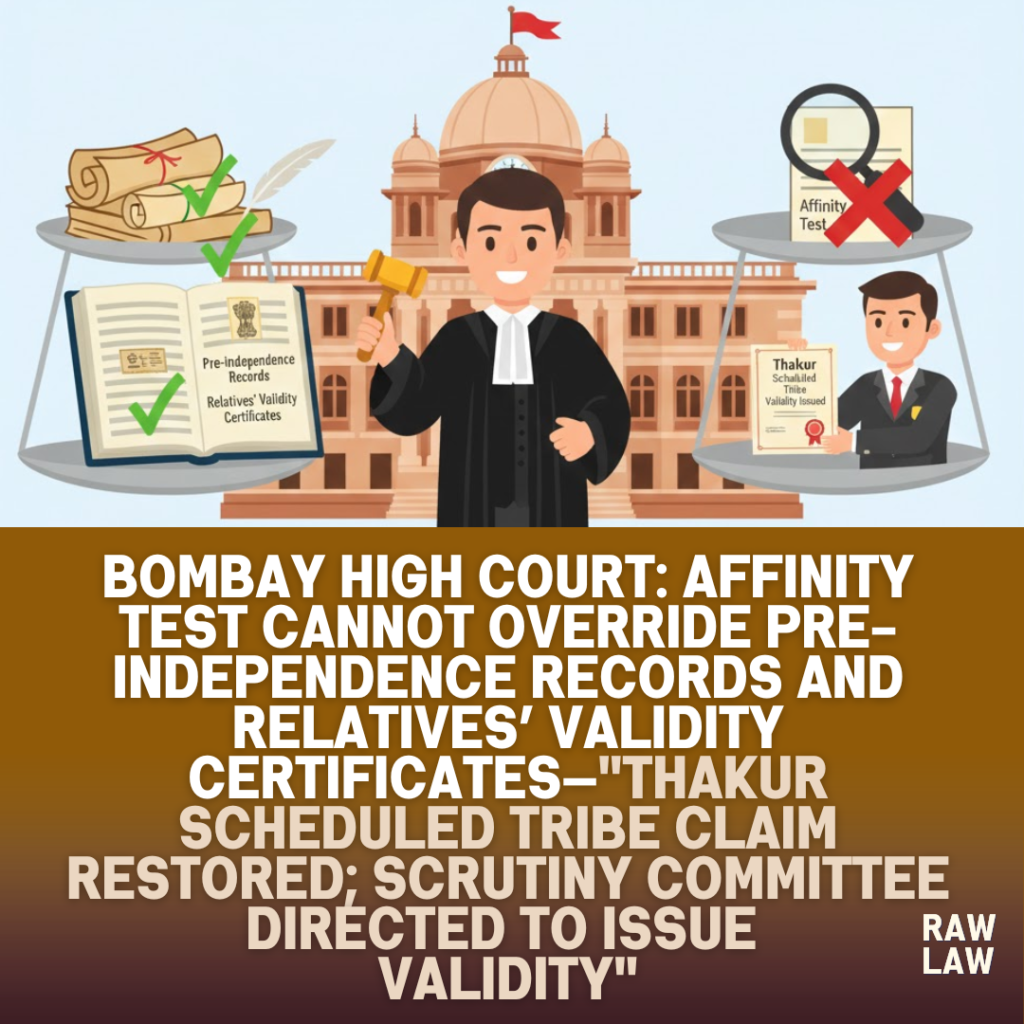
The Bombay High Court set aside the order of the Scheduled Tribe Certificate Scrutiny Committee, Nashik Division, which had invalidated the Tribe claim of two brothers as belonging to “Thakur – Scheduled Tribe.” The Court held that the Committee erred in disregarding pre-constitutional documentary evidence and multiple caste validity certificates issued to close blood relatives.
Declaring that the affinity test is not a litmus test and cannot displace strong documentary proof, the Division Bench directed the Scrutiny Committee to issue Caste Validity Certificates forthwith. The petitioner was held entitled to continue in service on a Scheduled Tribe reserved post.
Facts
The petitioners challenged the decision dated 4 May 2019 of the Scheduled Tribe Certificate Scrutiny Committee invalidating their claim to the “Thakur” Scheduled Tribe. One of the petitioners had been appointed as a Sales Tax Inspector against a reserved Scheduled Tribe post, subject to submission of a validity certificate.
The petitioners relied upon extensive documentary evidence, including a 1917 school record of their grandfather recording caste as “Thakur,” school records of their father and paternal uncles, and validity certificates issued to their real brother and cousin brothers by competent Scrutiny Committees.
Despite a favourable vigilance verification confirming these entries, the Committee invalidated the claim on grounds of failure in the affinity test and alleged area restriction.
Issues
The principal issue before the Court was whether the Scrutiny Committee erred in invalidating the petitioners’ Scheduled Tribe claim despite pre-independence documentary evidence and existing validity certificates of close blood relatives.
A related issue was whether failure in the affinity test, by itself, could override documentary evidence establishing tribal status.
Petitioner’s arguments
The petitioners contended that the impugned order ignored overwhelming documentary evidence, including a 1917 pre-constitutional school record and validity certificates issued to their real brother and cousin brothers. They argued that the genealogy establishing blood relationship was undisputed and that there was no allegation of fraud or misrepresentation in issuance of earlier validity certificates.
It was submitted that once validity certificates are granted to close blood relatives after due inquiry, the Committee cannot take a contrary view unless fraud is established. The petitioners relied on settled precedent holding that the affinity test is not conclusive and cannot supersede documentary evidence.
Respondent’s arguments
The State supported the impugned order, contending that the petitioners failed to establish cultural and anthropological affinity with the Thakur Scheduled Tribe. It was argued that the affinity test revealed inconsistencies in traditional practices and traits, justifying invalidation.
The State further submitted that surname “Thakur” is used by communities other than Scheduled Tribes and that documentary entries alone cannot automatically establish tribal status.
Analysis of the law
The High Court examined the principles laid down in Madhuri Patil v. Commissioner, Tribal Development, which recognized the high probative value of pre-constitutional documents in caste verification matters.
The Court further relied upon the Supreme Court decision in Maharashtra Adiwasi Thakur Jamat Swarakshan Samiti v. State of Maharashtra, which clarified that the affinity test is not a litmus test and must be applied only where documentary evidence is insufficient.
The Court reiterated that where validity certificates are issued to blood relatives after lawful inquiry, the Scrutiny Committee must ordinarily follow them unless fraud or procedural illegality is established.
Precedent analysis
In Madhuri Patil v. Commissioner, Tribal Development, the Supreme Court laid down the procedural framework for caste verification and emphasized the evidentiary value of old records.
In Maharashtra Adiwasi Thakur Jamat Swarakshan Samiti v. State of Maharashtra, the Supreme Court held that the affinity test is not decisive and that strong documentary evidence can outweigh anthropological discrepancies.
The High Court also relied upon Division Bench rulings in Apoorva Vinay Nichale v. Divisional Caste Scrutiny Committee, Krishna Balaji Kolewad v. State of Maharashtra, and Sneha Digambar Mochewad v. State of Maharashtra, which held that validity certificates of close relatives cannot be ignored in absence of fraud.
Applying these principles, the Court found that the Committee had misdirected itself.
Court’s reasoning
The Court observed that the petitioners produced a 1917 school record of their grandfather recording caste as “Thakur,” which is a pre-independence document carrying significant evidentiary weight. This document was not discredited by the Committee.
Further, multiple validity certificates had been issued to close blood relatives, including a real brother and cousins, after due inquiry. There was no finding that these certificates were obtained by fraud or issued without jurisdiction.
The Committee, however, invalidated the claim solely on affinity test findings and area restriction. The Court held that such reasoning runs contrary to settled law. Once blood relationship and lawful issuance of earlier validity certificates are established, the Committee cannot reach a contradictory conclusion on identical facts.
The Court concluded that documentary evidence clearly established the petitioners’ claim to the Thakur Scheduled Tribe.
Conclusion
The Bombay High Court allowed both writ petitions, quashed the impugned order dated 4 May 2019, and directed the Scrutiny Committee to issue Caste Validity Certificates forthwith.
The petitioner appointed as Sales Tax Inspector was held entitled to continue in service as a Scheduled Tribe candidate upon submission of the validity certificate. The interim application seeking service benefits was disposed of accordingly.
Implications
This ruling reinforces three critical principles in caste verification jurisprudence:
- Pre-constitutional documents have high probative value.
- Validity certificates issued to close blood relatives cannot be ignored in absence of fraud.
- The affinity test is not conclusive and cannot override strong documentary evidence.
The judgment strengthens legal certainty for genuine Scheduled Tribe claimants and curbs mechanical reliance on anthropological tests in disregard of documentary proof.
Case law references
- Madhuri Patil v. Commissioner, Tribal Development (1994) 6 SCC 241
Laid down guidelines for caste verification; emphasized probative value of old records. - Maharashtra Adiwasi Thakur Jamat Swarakshan Samiti v. State of Maharashtra (2023) 16 SCC 415
Held that affinity test is not a litmus test and cannot override documentary evidence. - Apoorva Vinay Nichale v. Divisional Caste Scrutiny Committee (2010 (6) Mh.L.J. 401)
Held that validity certificates of blood relatives must ordinarily be followed. - Krishna Balaji Kolewad v. State of Maharashtra (WP No. 10303/2017)
Reaffirmed that absence of fraud binds subsequent Scrutiny Committees. - Sneha Digambar Mochewad v. State of Maharashtra (WP No. 10349/2017)
Held that stray contradictory entries cannot outweigh pre-constitutional documents and relatives’ validity certificates.
FAQs
1. Can a caste claim be rejected solely on the affinity test?
No. The affinity test is not conclusive. Strong documentary evidence, especially pre-constitutional records, can outweigh affinity discrepancies.
2. What is the value of relatives’ caste validity certificates?
Validity certificates issued to close blood relatives after lawful inquiry carry significant weight and cannot be ignored unless fraud is proved.
3. Are old school records important in caste verification?
Yes. Pre-independence records are considered highly reliable evidence in determining caste status.