


1. Court’s decision
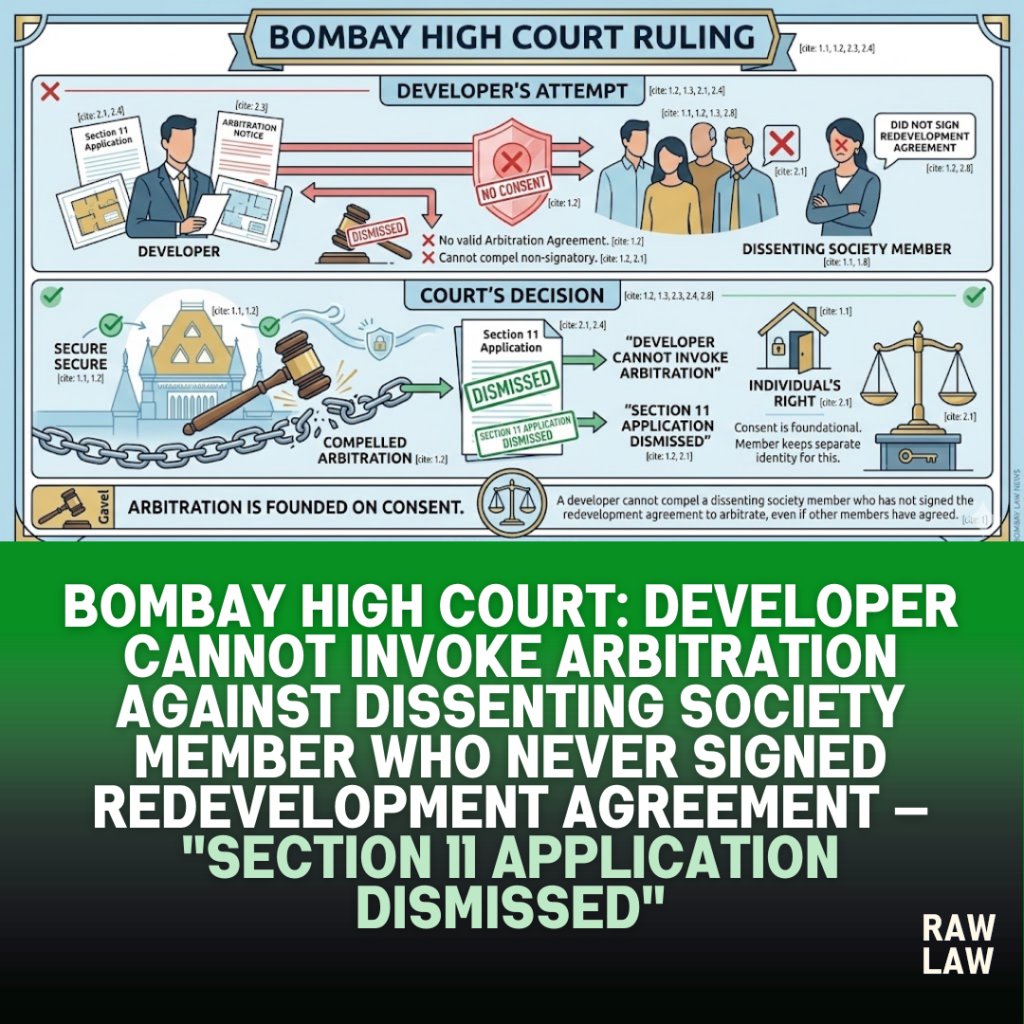
The Bombay High Court rejected an application filed by a developer seeking appointment of an arbitrator against a dissenting member of a cooperative housing society in relation to a redevelopment project.
The Court ruled that arbitration could not be invoked against a society member who had not signed the redevelopment agreement containing the arbitration clause.
It further held that although the member had subsequently signed a Permanent Alternate Accommodation Agreement, the disputes raised by the developer arose from the redevelopment agreement itself. Therefore, the arbitration clause in that agreement could not bind the non-signatory member.
2. Facts
The dispute arose from a redevelopment project undertaken by a cooperative housing society consisting of eleven members in Mumbai.
The society decided to redevelop its ageing building and entered into a redevelopment agreement with a developer in July 2021. A memorandum of understanding had earlier been executed in February 2020 after negotiations between the society and the developer.
Nine members of the society signed the redevelopment agreement along with the society. However, one member refused to sign the agreement and opposed the redevelopment process.
The dissenting member allegedly resisted vacating his flat, forcing the developer to initiate legal proceedings seeking possession of the premises for redevelopment.
3. Issues
The Court considered several key legal questions.
First, whether a developer could invoke an arbitration clause contained in a redevelopment agreement against a cooperative society member who had not signed the agreement.
Second, whether the member could nevertheless be treated as a “veritable party” or beneficiary under the contract, thereby binding him to the arbitration clause.
Third, whether execution of a Permanent Alternate Accommodation Agreement containing an arbitration clause could enable arbitration of disputes arising from the earlier redevelopment agreement.
4. Petitioner’s arguments
The developer argued that the dissenting member was effectively a beneficiary of the redevelopment agreement because the agreement governed the rights and obligations of all society members.
It was contended that the member’s participation in the redevelopment process and his later execution of a Permanent Alternate Accommodation Agreement established sufficient connection with the redevelopment agreement to subject him to arbitration.
The developer further argued that the redevelopment agreement and the accommodation agreement formed part of a composite transaction and therefore disputes relating to redevelopment should be referred to arbitration even if the member had not signed the initial agreement.
5. Respondent’s arguments
The dissenting member argued that he had never signed the redevelopment agreement and therefore was not bound by the arbitration clause contained in that document.
He contended that the arbitration clause applied only to the parties who executed the redevelopment agreement, namely the society and the developer.
The member further submitted that he had consistently opposed the redevelopment process and had deliberately refused to sign the agreement. Therefore, no consent to arbitration could be inferred from his conduct.
6. Analysis of the law
The Court examined the requirements for a valid arbitration agreement under the Arbitration and Conciliation Act, 1996.
Under Section 7 of the Act, arbitration is based on consent and arises from an agreement between parties to submit disputes to arbitration.
The Court emphasised that arbitration is fundamentally consensual. A person who has not agreed to arbitrate cannot ordinarily be compelled to participate in arbitration proceedings unless specific legal doctrines justify such inclusion.
The Court therefore analysed whether the dissenting member could nevertheless be treated as a party to the arbitration agreement despite not signing the redevelopment agreement.
7. Precedent analysis
The Court examined several decisions of the Supreme Court of India on arbitration involving non-signatories.
In Cox and Kings Ltd. v. SAP India Pvt. Ltd., the Supreme Court recognised that non-signatories may sometimes be bound by arbitration agreements under doctrines such as the “group of companies” principle or the concept of a “veritable party.”
However, the Court emphasised that such doctrines apply only when the non-signatory has played a substantial and active role in negotiating or performing the contract.
The High Court also relied on earlier decisions such as Daman Singh v. State of Punjab which held that individual members generally act through the cooperative society rather than independently.
8. Court’s reasoning
The Court observed that the dissenting member had consciously refused to sign the redevelopment agreement and had actively opposed the redevelopment process.
The Court found that the arbitration clause in the redevelopment agreement was intended to govern disputes between the developer and the society or its signatory members.
It also noted that the developer’s claim for damages related to delays caused by the member’s refusal to vacate the premises before redevelopment began. Such claims arose from obligations under the redevelopment agreement itself.
Since the member had not agreed to the terms of that agreement, the arbitration clause could not be invoked against him.
9. Conclusion
The Bombay High Court held that the dissenting member could not be compelled to arbitrate disputes arising under the redevelopment agreement because he was not a signatory to that agreement.
The Court therefore dismissed the developer’s application seeking appointment of an arbitrator under Section 11 of the Arbitration and Conciliation Act.
It clarified that the disputes raised by the developer must be pursued through other appropriate legal remedies rather than arbitration.
10. Implications
The ruling provides significant clarity on arbitration disputes arising from redevelopment projects involving cooperative housing societies.
It confirms that arbitration clauses in redevelopment agreements cannot automatically bind dissenting members who have not signed the agreement.
The judgment also underscores the principle that arbitration remains fundamentally consent-based, even in complex redevelopment arrangements involving multiple stakeholders.
For developers, the ruling highlights the need to ensure that arbitration clauses are carefully structured and that participation of all stakeholders is secured where arbitration is intended to govern disputes.
Case Law References
- Cox and Kings Ltd. v. SAP India Pvt. Ltd. (2024)
The Supreme Court held that non-signatories may sometimes be bound by arbitration agreements if they are closely connected to the contract and its performance. - Daman Singh v. State of Punjab (1985)
The Court held that members of a cooperative society generally act collectively through the society, and individual rights are often subsumed within the society’s decisions.
FAQs
1. Can a developer initiate arbitration against a dissenting member of a housing society?
Generally, no. If the member has not signed the redevelopment agreement containing the arbitration clause, the developer cannot compel arbitration against that member.
2. Are non-signatories ever bound by arbitration agreements?
Yes, but only in limited circumstances. Courts may bind non-signatories where they are closely involved in negotiating or performing the contract or where legal doctrines like “group of companies” apply.
3. What remedies are available if arbitration cannot be invoked?
The aggrieved party may pursue civil litigation or other legal remedies depending on the nature of the dispute.