


Court’s decision
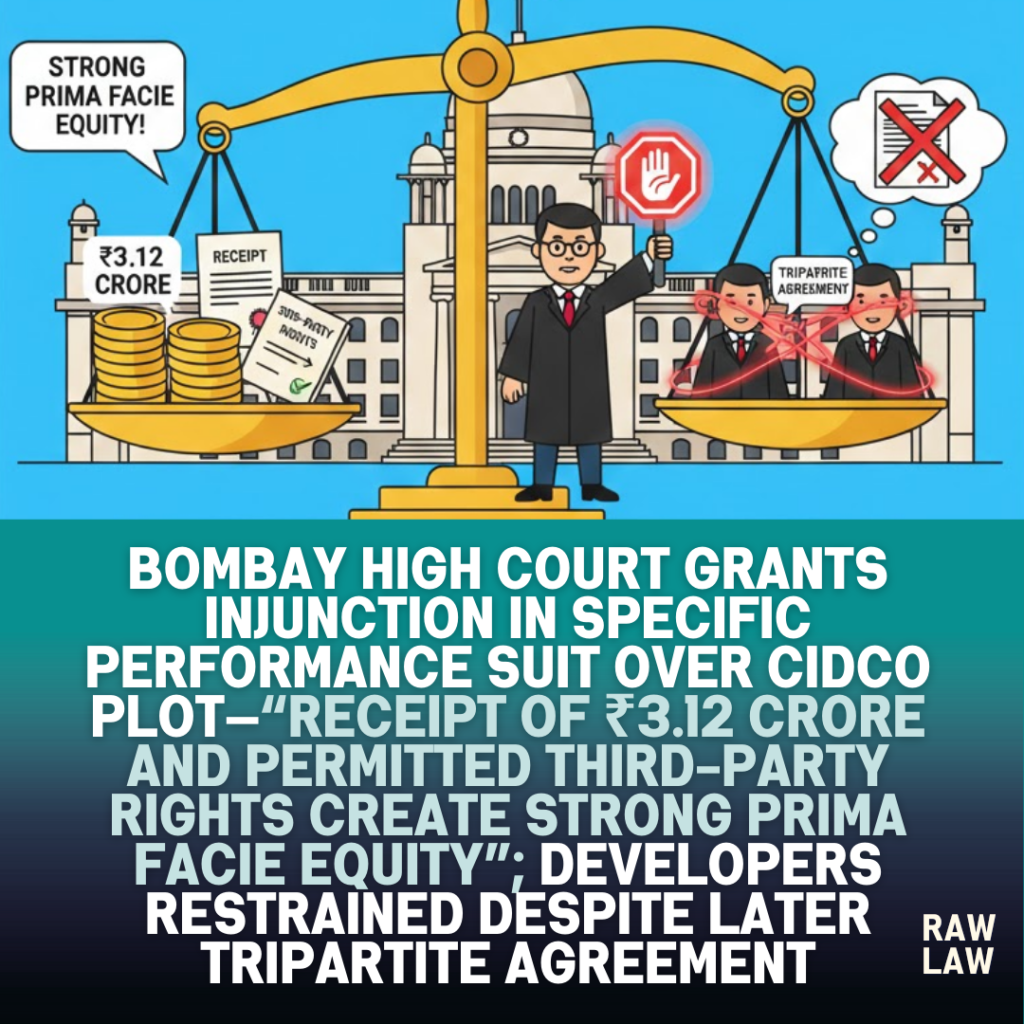
The Bombay High Court allowed an Appeal from Order and set aside the trial court’s refusal to grant interim injunction in a suit for specific performance concerning a CIDCO-allotted plot at Ulwe. The Court held that the plaintiffs had made out a strong prima facie case based on substantial payments made over several years pursuant to twin agreements and the original landowners’ conduct in permitting creation of third-party rights. It ruled that the trial court had adopted an unduly narrow approach by focusing only on the absence of signatures of original owners on a subsequent memorandum of understanding, while ignoring overwhelming material showing receipt of consideration and consent to third-party dealings. The Court restored the injunction and restrained the subsequent developers from dealing with the land until disposal of the suit.
Facts
The dispute arose out of a CIDCO plot initially proposed to be allotted to a group of original landowners under the 12.5% Government scheme. In December 2007, CIDCO issued a letter of intent and willingness to allot a specific plot, later corrected by a corrigendum substituting the final plot number. In February 2010, the original landowners executed an agreement with two intermediaries, permitting them to deal with and further transfer rights in the proposed plot for a total consideration of ₹2.25 crore, though only ₹8 lakh was paid as earnest money at that stage.
In February 2013, those intermediaries executed a memorandum of understanding in favour of the plaintiffs, who were partners of a development firm. Between 2013 and 2020, the plaintiffs paid approximately ₹3.12 crore to the original landowners and intermediaries through bank transfers and cheques. Despite these payments, no conveyance was executed, as the physical allotment of the plot by CIDCO materialised only in 2022. Thereafter, in April 2023, the original landowners entered into a tripartite agreement with CIDCO and new developers, prompting the plaintiffs to file a suit for specific performance and seek interim injunction.
Issues
The principal issues before the High Court were whether the plaintiffs had established a prima facie case for interim injunction in a specific performance suit, whether substantial payment of consideration and contractual permission to create third-party rights prior to formal allotment could create enforceable equitable interests, and whether subsequent developers claiming under a later tripartite agreement could resist injunction by asserting bona fide purchaser status. An allied issue was whether the trial court had correctly applied the tests of prima facie case, balance of convenience, and irreparable injury.
Petitioners’ arguments
The plaintiffs argued that the 2010 agreement expressly permitted the intermediaries to create third-party rights and that the 2013 memorandum of understanding was a continuation of that arrangement. They emphasised that they had paid ₹3.12 crore—far exceeding the original agreed consideration—over a period of seven years, and that these payments were evidenced by bank statements and not denied in substance by the original landowners. It was submitted that the denial of receipt in pleadings was false on the face of documentary evidence.
The plaintiffs contended that the trial court erred by treating the 2013 memorandum in isolation and ignoring the cumulative effect of the two agreements and the conduct of the parties. They argued that allowing the subsequent developers to proceed would irreversibly prejudice their rights after having waited for years for CIDCO’s allotment to fructify, a delay beyond their control.
Respondents’ arguments
The subsequent developers contended that the 2010 agreement was speculative, executed before the land was physically allotted, and therefore incapable of creating enforceable rights. They argued that the 2013 memorandum was not executed by the original landowners and thus lacked privity. Relying on Section 54 of the Transfer of Property Act, it was submitted that mere receipt of consideration does not create any right or interest in immovable property without a registered conveyance.
They further argued that the plaintiffs’ pleadings were vague regarding payments and that the developers had lawfully entered into a tripartite agreement with the original landowners and CIDCO after allotment and lease, thereby acquiring valid rights as bona fide purchasers.
Analysis of the law
The High Court reiterated that at the stage of interim injunction, the court is concerned with prima facie evaluation rather than final adjudication of title. It emphasised that agreements executed in anticipation of allotment are not per se void, particularly where the planning authority had already conceived the allotment and issued letters of intent years earlier. The Court noted that the contractual framework expressly permitted creation of third-party rights and that the plaintiffs’ claim was grounded in equity arising from substantial consideration paid and accepted.
The Court also clarified that Section 54 of the Transfer of Property Act, which requires a registered conveyance to transfer title, does not preclude a court from protecting equitable rights at the interim stage in a suit for specific performance, especially where the conduct of the vendors is questionable.
Precedent analysis
The respondents relied on a recent Supreme Court decision emphasising that receipt of consideration alone does not confer title. The High Court distinguished that precedent on the ground that it arose after full trial and concerned final adjudication, whereas the present case involved interlocutory relief. The Court reaffirmed settled principles that at the interim stage, courts may preserve property to prevent frustration of the suit where plaintiffs demonstrate strong equity and credible contractual claims.
Court’s reasoning
The Court found it “intriguing and shocking” that the original landowners had allegedly received ₹3.12 crore over several years and yet denied any transaction. It held that such denial could not be accepted prima facie, particularly when intermediaries admitted the agreements and payments. The Court criticised the trial court for adopting a parochial approach by focusing solely on the absence of signatures on the 2013 memorandum and ignoring the larger factual matrix.
The Court further held that the subsequent developers failed to demonstrate due diligence before entering into the tripartite agreement. Given the magnitude of payments, the plaintiffs’ long wait, and the questionable conduct of the original landowners, the balance of convenience and irreparable harm overwhelmingly favoured the plaintiffs.
Conclusion
The Bombay High Court quashed the trial court’s order rejecting interim relief and allowed the plaintiffs’ application for temporary injunction. It directed continuation of status quo and restrained the subsequent developers from dealing with or creating third-party rights in the suit land until disposal of the specific performance suit.
Implications
This ruling underscores that courts will not permit subsequent transactions to defeat long-standing contractual claims backed by substantial consideration, even where formal allotment or conveyance occurs later. It reinforces the principle that equity and conduct play a decisive role at the interim stage in specific performance suits, particularly in large-scale development transactions involving public authorities like CIDCO.
Case law references
- Supreme Court decision on Section 54 of the Transfer of Property Act (distinguished): Held that receipt of consideration alone does not transfer title, but distinguished as applicable at final adjudication, not at interim stage.
- Settled principles on interim injunctions in specific performance suits: Applied to emphasise preservation of property where strong prima facie equity exists.
FAQs
Can interim injunction be granted in a specific performance suit without a registered conveyance?
Yes. Courts can grant interim protection where the plaintiff shows a strong prima facie case, substantial consideration paid, and risk of irreparable harm, even though title has not yet passed.
Do agreements executed before CIDCO’s final allotment create enforceable rights?
They can create equitable and contractual rights, especially where allotment was already conceived and parties acted upon the agreements by making and accepting payments.
Are later developers automatically protected as bona fide purchasers?
No. Developers must show due diligence. If prior agreements and payments exist, bona fide purchaser protection may not be available at the interim stage.