


1. Court’s decision
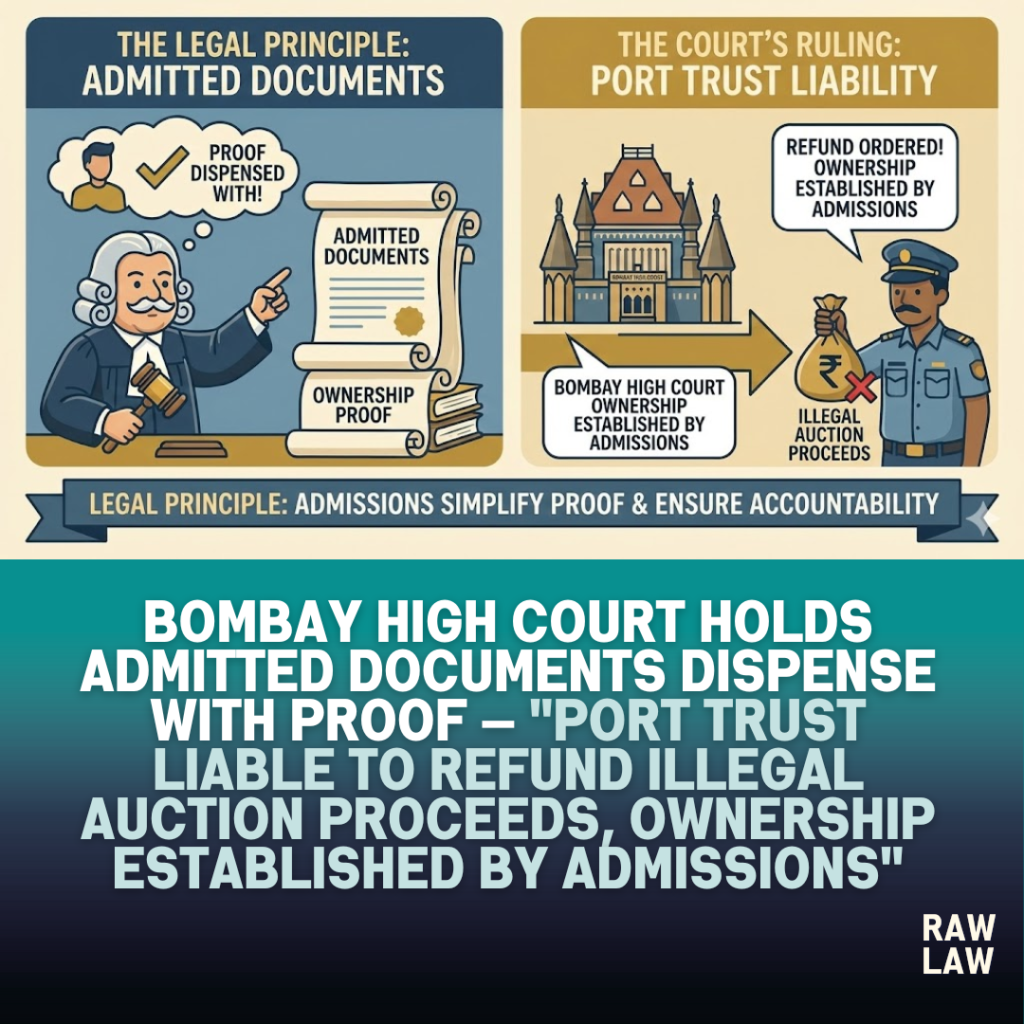
The Bombay High Court partly allowed a first appeal filed by a foreign exporter and set aside the dismissal of its money suit by the Bombay City Civil Court. The Court held that once a document and its contents are admitted under Order XII of the Code of Civil Procedure, the trial court cannot insist on further proof unless it expressly exercises discretion under the proviso to Order XII Rule 2-A. It ruled that the Port Trust, having conducted an auction contrary to the Major Port Trusts Act, 1963, was not entitled to retain the sale proceeds, and that ownership of the goods stood proved by admissions and surrounding circumstances.
2. Facts
The appellant, a United Kingdom–based company, sold goods in 1993–94 to an Indian buyer under the trade name “M/s Blackwell Enterprises.” When the buyer abandoned the consignment, the goods remained at the Bombay Port and were sought to be re-exported. Despite payment of charges through the local agent, the Board of Trustees of the Port of Bombay auctioned the goods on 8 August 1994 and realised ₹18.30 lakh. Within three months, the appellant filed a suit claiming the auction proceeds as owner of the goods. The Trial Court held the auction illegal under the Major Port Trusts Act but dismissed the suit on the ground that the plaintiff failed to prove ownership. This finding was challenged in appeal.
3. Issues
The principal issues were whether the plaintiff had proved ownership of the auctioned goods, whether admitted documents (including their contents) required further proof, and whether the Port Trust could retain sale proceeds of an auction held contrary to Sections 61 and 62 of the Major Port Trusts Act, 1963.
4. Appellant’s arguments
The appellant contended that ownership was clearly established through a letter dated 5 September 1994 written by its advocate to the Port Trust, asserting ownership and challenging the auction. This document and its contents were admitted without objection by the plaintiff on a notice to admit issued by the defendant, and were exhibited during evidence. It was argued that, in such circumstances, the trial court misapplied Order XII Rule 2-A by insisting on proof. The appellant also relied on the principle of preponderance of probabilities and the fact that no one else had claimed ownership for nearly three decades.
5. Respondent’s arguments
The Port Trust argued that it had denied ownership in the written statement and that most documents stood in the name of “M/s Blackwell Enterprises,” which allegedly had a different address. It submitted that even admitted documents must be proved, relying on prior Bombay High Court precedent, and contended that under Section 63 of the Major Port Trusts Act, unclaimed sale proceeds could be appropriated for statutory purposes.
6. Analysis of the law
The Court undertook a detailed analysis of Order XII Rules 2 and 2-A CPC and Section 58 of the Evidence Act. It clarified that admissions are intended to eliminate the need for proof, and that the phrase “saving all just exceptions” operates in favour of the party called upon to admit documents. Where a document and its contents are admitted and the court does not invoke the proviso requiring proof, the document stands proved. The Court also held that Section 63 of the Major Port Trusts Act applies only to lawful auctions, and cannot legitimise retention of proceeds from an illegal sale.
7. Precedent analysis
The Court distinguished Hiren P. Doshi v. State of Maharashtra, holding that it dealt with a situation where contents were not admitted. It relied on Narayan Ganesh Dastane v. Sucheta Narayan Dastane to reiterate that civil cases are decided on preponderance of probabilities, and noted that admissions and conduct can decisively tilt that balance.
8. Court’s reasoning
The Court found that the letter dated 5 September 1994—admitted with its contents—clearly asserted the appellant’s ownership and was never replied to by the Port Trust. The trial court failed to record reasons or exercise discretion under the proviso to Order XII Rule 2-A to require proof. The evidence of the appellant’s managing director sufficiently explained that “M/s Blackwell Enterprises” was merely a trade name. The Court also emphasised that the appellant had challenged the auction from inception, that no third party had claimed ownership for decades, and that retention of the proceeds would amount to unjust enrichment by the Port Trust.
9. Conclusion
The Bombay High Court set aside the trial court’s finding on ownership, held the appellant entitled to the auction proceeds (with adjustments), and directed refund of amounts deposited along with interest at 6% per annum as specified. The appeal was partly allowed, and a decree directed to be drawn accordingly.
10. Implications
The judgment is significant on civil procedure and admissions, clarifying that once documents and contents are admitted, courts cannot insist on proof without expressly invoking statutory discretion. It also reinforces accountability of statutory authorities, holding that public bodies cannot retain monies from illegal actions under colour of statute. The ruling provides guidance on the evidentiary value of admissions and limits on post-hoc challenges to ownership.
Case Law References
- Narayan Ganesh Dastane v. Sucheta Narayan Dastane – Applied to reaffirm the standard of preponderance of probabilities in civil cases.
- Hiren P. Doshi v. State of Maharashtra – Distinguished; held inapplicable where document contents are expressly admitted.
- Canara Bank v. Eastern Mechanical Works – Referred on proof and evidentiary treatment of documents.
FAQs
Q1. Does admission of a document dispense with proof in civil cases?
Yes. If a document and its contents are admitted under Order XII CPC and the court does not require proof under the proviso, further proof is unnecessary.
Q2. Can a Port Trust retain auction proceeds from an illegal auction?
No. Sale proceeds from an auction conducted contrary to the Major Port Trusts Act cannot be retained and must be refunded to the owner.
Q3. How is ownership proved in civil suits involving documents?
Ownership can be established through admitted documents, surrounding circumstances, conduct of parties, and the standard of preponderance of probabilities.