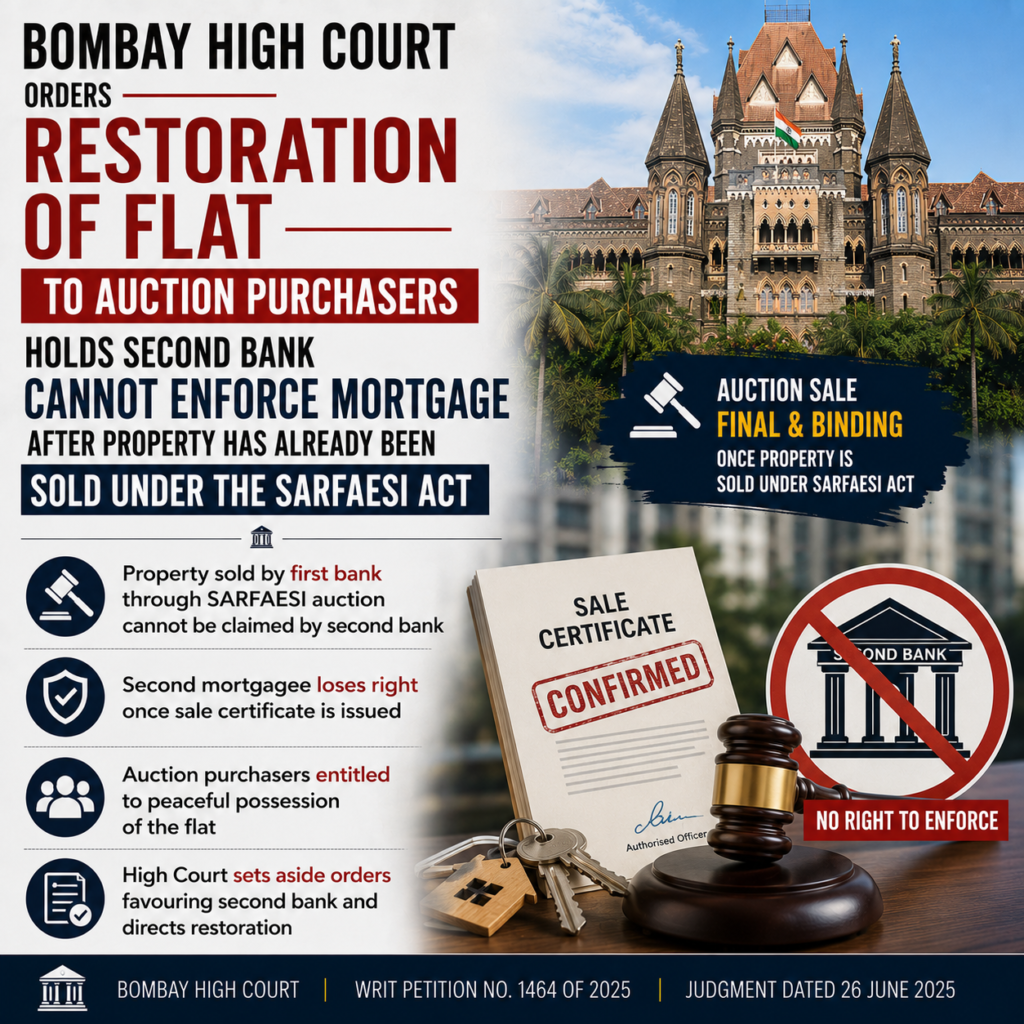
Bombay High Court Orders Restoration of Flat to Auction Purchasers, Holds Second Bank Cannot Enforce Mortgage After Property Has Already Been Sold Under the SARFAESI Act
Bona Fide Auction Purchasers Cannot Be Evicted by Another Bank After Sale Under the SARFAESI Act, Bombay High Court Orders Restoration of Possession
Facts
The dispute concerned Flat No. 202 in New Jamali Co-operative Housing Society Limited, Andheri (East), Mumbai. The original borrower had purchased the flat in 1985 and subsequently offered the same property as security to two different banks.
In 2004, the borrower’s proprietorship concern obtained credit facilities of approximately ₹3.23 crore from the State Bank of India. A mortgage was stated to have been created in SBI’s favour on 25 September 2004, and SBI’s security interest was registered with the Central Registry of Securitisation Asset Reconstruction and Security Interest of India on 21 March 2012.
In February 2012, Saraswat Co-operative Bank separately sanctioned an overdraft facility to the borrower. The housing society issued a letter stating that there was no encumbrance over the flat and that it had no objection to its mortgage. The borrower thereafter deposited title documents with Saraswat Bank, which sanctioned a further cash-credit facility of ₹50 lakh.
Saraswat Bank classified the borrower’s account as a non-performing asset and issued a notice under Section 13(2) of the Securitisation and Reconstruction of Financial Assets and Enforcement of Security Interest Act, 2002. It took symbolic possession of the flat on 12 April 2013 but did not take any further effective steps for approximately eleven years.
SBI also initiated proceedings under the SARFAESI Act. It took symbolic possession in December 2013, obtained an order under Section 14 from the competent Magistrate in July 2014 and took physical possession of the flat on 29 November 2014.
SBI thereafter conducted an e-auction on 28 April 2017. The petitioners emerged as successful bidders for ₹66.45 lakh. A registered sale certificate was issued in their favour on 9 August 2017, following which they took possession and resided in the flat with their family for approximately eight years.
In 2024, Saraswat Bank approached the Magistrate under Section 14 of the SARFAESI Act. An order for taking physical possession was passed on 17 January 2025. Acting on that order, the Court Commissioner, with police assistance, dispossessed the petitioners and their family members on 20 August 2025. The flat was sealed while their personal belongings remained inside.
The petitioners approached the Bombay High Court seeking restoration of possession and an order restraining Saraswat Bank from auctioning or otherwise dealing with the flat. During the pendency of the petition, the Court restrained Saraswat Bank from alienating the property.
Issues
- Whether the writ petition was maintainable despite the remedy available under Section 17 of the SARFAESI Act before the Debts Recovery Tribunal.
- Whether Saraswat Bank could proceed under Section 14 against the flat after SBI had already enforced its security interest, conducted an auction and transferred the property to the petitioners.
- Whether the petitioners acquired valid rights over the flat under Section 13(6) of the SARFAESI Act pursuant to the registered auction-sale certificate.
- Whether the dispute regarding the competing claims and priority of SBI and Saraswat Bank had to be resolved through arbitration under Section 11 of the SARFAESI Act.
- Whether questions concerning the validity of SBI’s mortgage and the title derived by the petitioners could be adjudicated by the DRT.
Petitioner’s Arguments
The petitioners contended that they were bona fide auction purchasers who had paid ₹66.45 lakh and had obtained a registered sale certificate from SBI after an auction conducted under the SARFAESI Act. They had remained in lawful and peaceful possession for eight years and could not have been summarily dispossessed by another bank.
They relied upon Section 13(6) of the SARFAESI Act to argue that once SBI took possession and transferred the secured asset, all rights in the property vested in the petitioners as though the transfer had been made directly by the original owner.
It was submitted that SBI’s security interest had been created in 2004 and registered with CERSAI in March 2012, before Saraswat Bank extended its credit facilities. Saraswat Bank therefore advanced the loan subject to SBI’s pre-existing security interest and at its own risk.
The petitioners argued that Saraswat Bank had taken symbolic possession in April 2013 but thereafter remained inactive for approximately eleven years. During this period, SBI took physical possession, conducted the auction and transferred the flat to the petitioners. Saraswat Bank could not revive its proceedings after the secured asset had already been transferred.
According to the petitioners, any dispute regarding the priority or validity of the competing charges was essentially a dispute between SBI and Saraswat Bank. Such a dispute had to be referred to arbitration under Section 11 of the SARFAESI Act and could not be enforced against innocent auction purchasers.
They further submitted that the DRT could examine the legality of measures taken under the SARFAESI Act but could not adjudicate complicated questions of title or declare a mortgage or registered sale certificate illegal. Such questions fell within the jurisdiction of a competent civil court.
The petitioners maintained that once the secured asset had been sold in accordance with the SARFAESI Act, the asset itself stood exhausted for enforcement purposes. Saraswat Bank could, at best, assert a claim against the sale proceeds held by SBI, but it could not pursue the property in the hands of the auction purchasers.
Respondent’s Arguments
Saraswat Co-operative Bank
Saraswat Bank raised a preliminary objection that the petitioners had an efficacious statutory remedy under Section 17 of the SARFAESI Act and were required to approach the DRT. It argued that the High Court should not exercise writ jurisdiction in view of the alternate remedy.
The Bank claimed that the original title deeds and share certificate were in its possession. SBI had allegedly acted only on colour photocopies of the documents. According to Saraswat Bank, the deposit of photocopies could not create a valid equitable mortgage in SBI’s favour.
It was argued that since SBI had no valid mortgage, its subsequent possession proceedings, auction and sale certificate were void. SBI could not transfer a better title than it possessed, and the registered sale certificate could not confer valid ownership upon the petitioners.
Saraswat Bank also contended that whether a mortgage had been validly created in SBI’s favour involved disputed questions of fact and law that could not be adjudicated in writ jurisdiction.
According to the Bank, the matter was not a dispute concerning priority between two valid secured creditors because no legally enforceable security interest had been created in SBI’s favour. Consequently, Section 11 of the SARFAESI Act was inapplicable.
It further argued that accepting SBI’s mortgage would allow borrowers and creditors to act in collusion and defeat the rights of genuine secured creditors holding the original title documents.
State Bank of India
SBI supported the petitioners and maintained that possession had been handed over to them after valid proceedings under the SARFAESI Act. It opposed Saraswat Bank’s contention that its mortgage and enforcement proceedings were illegal.
State of Maharashtra
The State was treated as a formal party and left the matter for determination by the Court.
Analysis of the Law
Transfer of the secured asset under Section 13(6)
Section 13(6) provides that when a secured creditor transfers a secured asset after taking possession under Section 13(4), all rights in the asset vest in the transferee as though the transfer had been made by the owner.
The petitioners had acquired the flat through an auction conducted by SBI and held a registered sale certificate. Therefore, the statutory effect of Section 13(6) was that the rights of the original borrower in the property stood transferred to them.
Sale proceeds under Section 13(7)
Under Section 13(7), the secured creditor holds the money received from the enforcement of the secured asset in trust. The amount is to be applied towards enforcement expenses, discharge of the secured creditor’s dues and payment of the residue to the person entitled to it.
The Court observed that Saraswat Bank’s claim, even if superior to that of SBI, could be asserted against the sale proceeds held by SBI. The petitioners could not be deprived of the property merely because two banks disputed their respective entitlement to those proceeds.
Disputes between secured creditors under Section 11
Section 11 mandates conciliation or arbitration where a dispute concerning securitisation, reconstruction or non-payment of an amount arises between banks, financial institutions, asset reconstruction companies or qualified buyers.
The Court held that the real dispute was between SBI and Saraswat Bank regarding priority over the security and entitlement to the auction proceeds. This dispute was required to be resolved through arbitration under Section 11.
A formal arbitration agreement was unnecessary because Section 11 statutorily creates a deemed agreement between the specified parties.
Scope of the DRT’s jurisdiction
The Court acknowledged the general principle that a person aggrieved by measures taken under the SARFAESI Act should ordinarily approach the DRT under Section 17.
However, Saraswat Bank’s action was found to be wholly without authority because the secured asset had already been enforced and transferred by SBI. The petitioners were therefore not required to challenge an unauthorised second enforcement action before the DRT.
The Court also observed that the DRT, being a statutory tribunal, could not decide questions of title or declare a mortgage or registered conveyance invalid. Such disputes would fall within the jurisdiction of a competent civil court.
Exhaustion of the security interest
Once SBI completed the enforcement proceedings, took possession, conducted the auction and issued a registered sale certificate, the flat ceased to be available for repeated enforcement by another creditor.
Permitting successive creditors to pursue the same property even after its transfer would destroy the certainty and finality required in statutory auctions and would deter genuine purchasers from participating in them.
Precedent Analysis
Indian Overseas Bank v. Deputy Commissioner of State Tax
The Bombay High Court had held that once a secured creditor enforces its security interest and sells the asset, the same asset cannot again be pursued in the hands of the purchaser by another creditor.
The Court applied this principle and concluded that after SBI sold the flat to the petitioners, Saraswat Bank could not separately enforce its alleged security against the same property.
The Court observed that permitting repeated enforcement would lead to an absurd situation in which an auction purchaser would remain perpetually exposed to successive claims by different creditors.
Bank of India v. Sri Nangli Rice Mills Private Limited
The Supreme Court held that Section 11 of the SARFAESI Act is mandatory where disputes arise between banks or financial institutions regarding competing claims over the same secured asset.
The provision creates a deemed arbitration agreement even in the absence of an express written agreement. Disputes regarding priority of charges arising from the borrower’s default are intrinsically connected with non-payment of amounts and fall within Section 11.
Applying this judgment, the High Court held that Saraswat Bank’s remedy lay against SBI through arbitration and not against the petitioners or the flat.
The Cosmos Co-operative Bank Ltd. v. Central Bank of India
This decision explained that an equitable mortgage depends upon the intention to create security and may arise even where there is no formal agreement or where only part of the title documents is deposited.
The High Court referred to this judgment while rejecting the proposition that the absence of all original title documents necessarily meant that no mortgage could have been created in SBI’s favour.
The Court nevertheless left the final determination of the validity and priority of the competing mortgages open for adjudication in appropriate proceedings.
Central Bank of India v. Prabha Jain
The Supreme Court held that the DRT, being a creature of statute, cannot adjudicate title disputes or declare a mortgage deed or conveyance illegal.
The High Court applied this principle to hold that Saraswat Bank could not insist that the petitioners approach the DRT for adjudication of the validity of SBI’s mortgage or the petitioners’ registered title.
United Bank of India v. Satyawati Tondon and Celir LLP v. Bafna Motors
Saraswat Bank relied upon these authorities to contend that High Courts should ordinarily refuse to entertain writ petitions where a remedy under Section 17 of the SARFAESI Act is available.
The Court distinguished them because Saraswat Bank’s action was found to be without authority of law. The property had already ceased to be available as a secured asset after SBI’s auction, and therefore the petitioners were not required to invoke Section 17.
K.J. Nathan v. S.V. Maruthi Rao
Saraswat Bank relied upon this judgment to argue that the creation of an equitable mortgage involved mixed questions of fact and law.
The Court did not conclusively determine the rival banks’ mortgage priorities. Instead, it held that such disputes could be decided between the banks through arbitration under Section 11 or, where title adjudication was necessary, before the competent civil court.
Stressed Assets Stabilization Fund v. West Bengal Small Industries Development Corporation
Saraswat Bank relied on this decision to question the title conveyed by SBI. The High Court held that the reliance was misplaced because Saraswat Bank could no longer proceed against the property itself after the security interest had been exhausted through SBI’s auction.
Court’s Reasoning
The Court found it significant that SBI’s credit facilities and mortgage dated back to 2004 and that its security interest was registered with CERSAI in March 2012. Saraswat Bank advanced credit facilities subsequently.
Although Saraswat Bank took symbolic possession first, in April 2013, it took no further meaningful action for approximately eleven years. SBI, on the other hand, promptly obtained an order under Section 14, took physical possession in 2014 and completed the auction in 2017.
The petitioners paid substantial consideration, received a registered sale certificate and remained in possession for eight years. The sale certificate had never been challenged or set aside.
The Court held that the auction conducted by SBI exhausted the flat as a secured asset. After the transfer, Saraswat Bank could no longer invoke Section 14 and proceed against the same property. Its remedy, if any, was to claim priority over the auction proceeds or seek relief against SBI.
The Court strongly disapproved of Saraswat Bank’s conduct in remaining inactive for eleven years and then dispossessing the petitioners from their home. Its delay operated at its own peril, particularly because third-party rights had crystallised during the intervening period.
The fact that Saraswat Bank claimed possession of the original title deeds did not authorise it to evict the petitioners. Questions concerning the validity or priority of the competing mortgages were disputes between the two banks and could not be resolved by dispossessing bona fide auction purchasers.
The Court also noted that there was no allegation that the petitioners had colluded with SBI or the original borrower. They were innocent purchasers who had become victims of a dispute between two secured creditors.
It held that declining relief on the ground of alternate remedy would result in a travesty of justice. The petitioners had been removed from their home without a sustainable legal basis, and the writ court was required to intervene to restore possession.
Conclusion
The Bombay High Court allowed the writ petition and held that Saraswat Bank had no authority to enforce its alleged security interest against the flat after SBI had already completed enforcement proceedings and transferred the property to the petitioners through a registered auction sale.
The Court directed Saraswat Bank to restore possession of the flat to the petitioners within four weeks and return all their personal belongings.
Saraswat Bank was restrained from dealing with or alienating the flat.
The Court granted Saraswat Bank liberty to invoke arbitration under Section 11 of the SARFAESI Act against SBI for adjudication of their competing claims. The respective rights and contentions of both banks regarding priority and entitlement to the auction proceeds were expressly kept open.
Case: Mariyam Rangwala and Another v. State of Maharashtra, Through Registrar, CMM and Others
Court: High Court of Judicature at Bombay, Civil Appellate Jurisdiction
Case Number: Writ Petition No. 11618 of 2025
Judge: Justice Manish Pitale and Justice Shreeram V. Shirsat
Date: 30 June 2026
Result: Writ petition allowed; Saraswat Co-operative Bank directed to restore possession of the flat within four weeks and restrained from dealing with the property, with liberty to pursue arbitration against SBI under Section 11 of the SARFAESI Act.