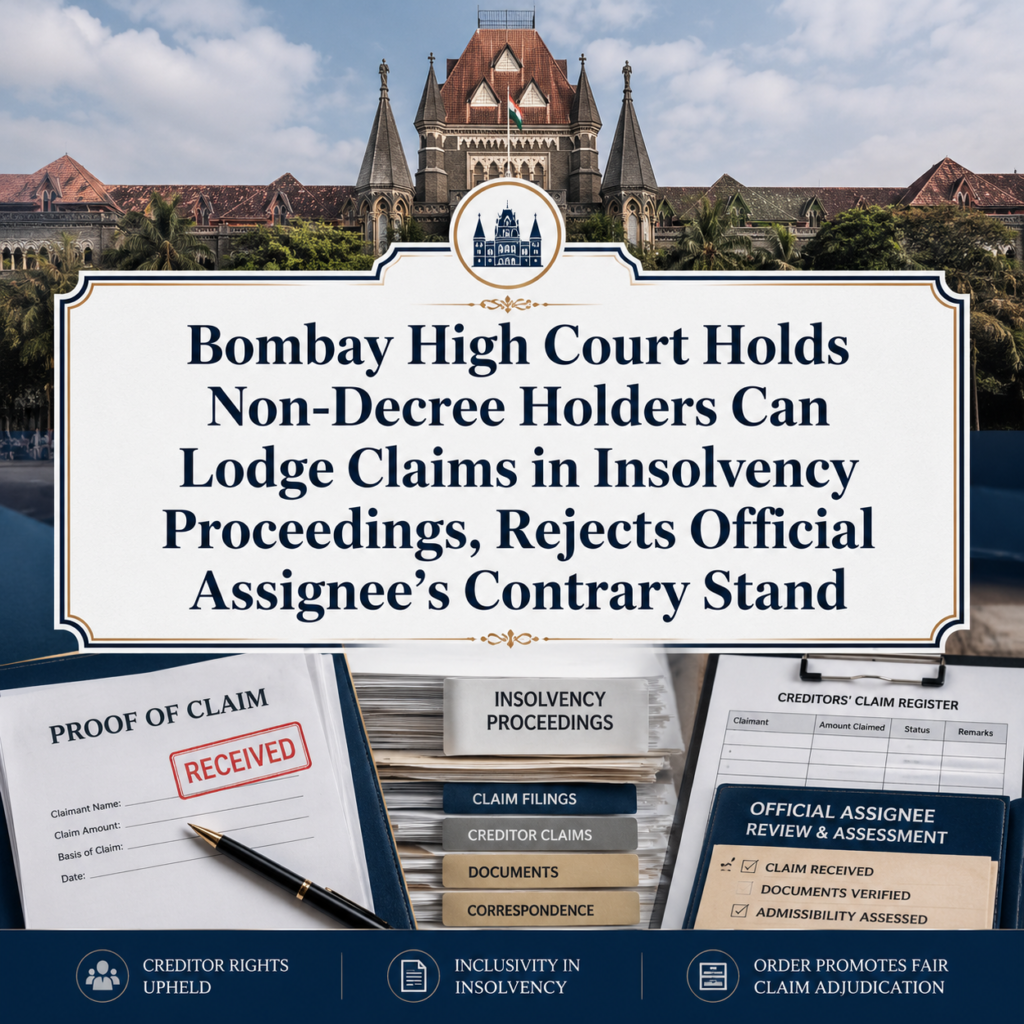
Bombay High Court Holds Official Assignee Cannot Insist on Decree Before Entertaining Creditor’s Claim in Insolvency Proceedings
Facts
The matter arose before the Bombay High Court in its insolvency jurisdiction in two connected Official Assignee Reports concerning Insolvency Petition No. 28 of 2001 and Insolvency Petition No. 82 of 2002. The controversy arose when a creditor lodged a claim before the Official Assignee after the concerned persons had been declared insolvent. The Official Assignee, relying on earlier orders of the Court, took the position that unless the creditor’s claim was already adjudicated by a court or competent authority, the claim could not be considered. This position was objected to by counsel appearing for the insolvent.
In this backdrop, the Court framed the question whether the Official Assignee is required to satisfy a creditor’s claim only on the basis of a decree or order of a court, or whether such claim can be considered on the basis of documents submitted by the claimant after a person is declared insolvent, even without any decree or final adjudication order.
Issues
The principal issue before the Court was whether a creditor must necessarily possess a decree or final adjudication order before lodging a claim with the Official Assignee in insolvency proceedings under the Presidency-Towns Insolvency Act, 1909.
The Court also considered the connected question of how claims should be dealt with in two situations: first, where no legal proceedings had been initiated by the creditor before the adjudication order; and second, where proceedings were pending but had not culminated in a decree or final adjudication order on the date of insolvency adjudication.
Petitioner’s Arguments
Counsel appearing for the insolvent submitted that no decree is required for making a claim before the Official Assignee. It was argued that the definitions of “creditor” and “debt” under Sections 2(a) and 2(b) of the Presidency-Towns Insolvency Act are inclusive and wide enough to cover all creditors, not merely decree-holders.
It was further submitted that various provisions of the Act repeatedly use the expressions “debt”, “creditor”, “liability” and “proof of debt”, and do not make a decree a mandatory condition. Reliance was placed on Sections 6, 9, 12, 13, 17, 24, 46, 48, 49, 68, 69 and 72 of the Act to show that the Official Assignee has power to examine, verify, admit or reject claims based on proof, and not merely on decrees.
It was also argued that if a non-decree-holder creditor can file an insolvency petition, it would be illogical to say that such creditor cannot lodge a claim after the adjudication order is passed.
Respondent’s Arguments
The Official Assignee had taken the position that a claim cannot be considered unless it is first adjudicated by a court or competent authority. The concern was that the Official Assignee should not be required to decide claims which had not already been crystallised by a decree, order, or final determination.
However, this position was resisted on the ground that such an interpretation would defeat the scheme of the Insolvency Act, because once a person is adjudged insolvent, creditors are restrained from independently proceeding against the insolvent or the insolvent’s property except with leave of the Court.
Analysis of the Law
The Court analysed the scheme of the Presidency-Towns Insolvency Act, 1909 and held that insolvency proceedings are not meant only for decree-holders. Once a person is adjudicated insolvent, the property vests in the Official Assignee for realisation and distribution among creditors. The Act contemplates proof of debts, examination of claims and distribution of dividends among creditors generally, and not merely among decree-holders.
The Court held that the definition of “creditor” includes a decree-holder but is not restricted to a decree-holder. Similarly, “debt” and “liability” are broad expressions. If the legislature intended that only decree-holders could lodge claims, the statute would have expressly said so.
The Court further held that insisting upon a decree at the stage of lodging a claim would convert the Insolvency Court into an execution court, which is not the object of insolvency law. The Court also held that such an approach would make the rights of non-decree-holder creditors illusory, especially because after adjudication, they cannot freely institute or proceed with legal proceedings except with leave of the Court.
Precedent Analysis
The Court considered several precedents including Official Receiver, Kanpur v. Abdul Shakoor, In Re: Khushalchand B. Daga, Mandvi Co-operative Bank Ltd. v. Anant V. Hegade, In Re: Ramavatar Kunjilal Gupta, and Akshay D. Thakkar v. Kotak Mahindra Bank Ltd. These authorities supported the proposition that insolvency proceedings enure for the benefit of all creditors and not merely the original petitioning creditor or decree-holders.
The Court also referred to Jugalkishore Saraf v. Raw Cotton Co. Ltd. and the Madras High Court decision in Enforcement Directorate (FEMA) v. T.T.V. Dhinakaran, where the inclusive nature of the words “creditor”, “debt” and “debtor” under the Presidency-Towns Insolvency Act was recognised.
The amicus curiae relied on Swiss Ribbons Pvt. Ltd. v. Union of India to draw a comparison with the IBC framework and to support the proposition that once insolvency proceedings are triggered, the process is for the benefit of the general body of creditors. The Court accepted this reasoning to the extent that an insolvency adjudication order operates for the benefit of all creditors.
Court’s Reasoning
The Court divided the issue into two situations. In Situation A, where the creditor had not initiated any legal proceedings before the insolvency adjudication order, the Court held that such creditor can still lodge a claim before the Official Assignee. The Official Assignee is then required to independently examine the proof, verify the claim, and either admit or reject it by a reasoned order.
In Situation B, where legal proceedings were already pending but had not resulted in a decree or final order on the date of adjudication, the Court held that the Official Assignee cannot insist upon a decree at the stage of lodging the claim. The creditor must disclose the pending proceedings, and once the competent forum finally adjudicates the claim, the creditor may place that order before the Official Assignee for consideration during dividend distribution.
The Court clarified that the Official Assignee is not a trial court and cannot take over or decide complex disputes pending before other forums. If the claim requires a detailed trial or adjudication, the matter may have to proceed before the competent forum. However, this does not mean that the creditor must already possess a decree at the time of lodging the claim.
Conclusion
The Bombay High Court held that the Official Assignee cannot insist upon a decree or final adjudication order as a pre-condition for lodging a claim in insolvency proceedings. A creditor who does not possess a decree may still submit documents and proof of debt before the Official Assignee.
However, the Official Assignee must independently examine such claims and pass a reasoned order admitting or rejecting them. In cases where proceedings are pending before another forum or where detailed adjudication is required, final determination by the competent authority may be necessary at the stage of distribution of dividend, but not at the initial stage of lodging the claim.
Case Details
Case: Uttamchand Devichand Shah / Suraj Prakash Khemchand matters concerning Bansi Jairamdas Jaising, Ravi Bansi Jaising and Avinash Bansi Jaising
Court: Bombay High Court, Ordinary Original Civil Jurisdiction, Insolvency Jurisdiction
Case Number: Official Assignee Report No. 46 of 2025 in Insolvency Petition No. 28 of 2001 with Official Assignee Report No. 47 of 2025 in Insolvency Petition No. 82 of 2002
Judge: Justice Jitendra Jain
Date: 2 July 2026
Result: Question answered in favour of non-decree-holder creditors; Official Assignee cannot insist on a decree or final order at the stage of lodging a claim.