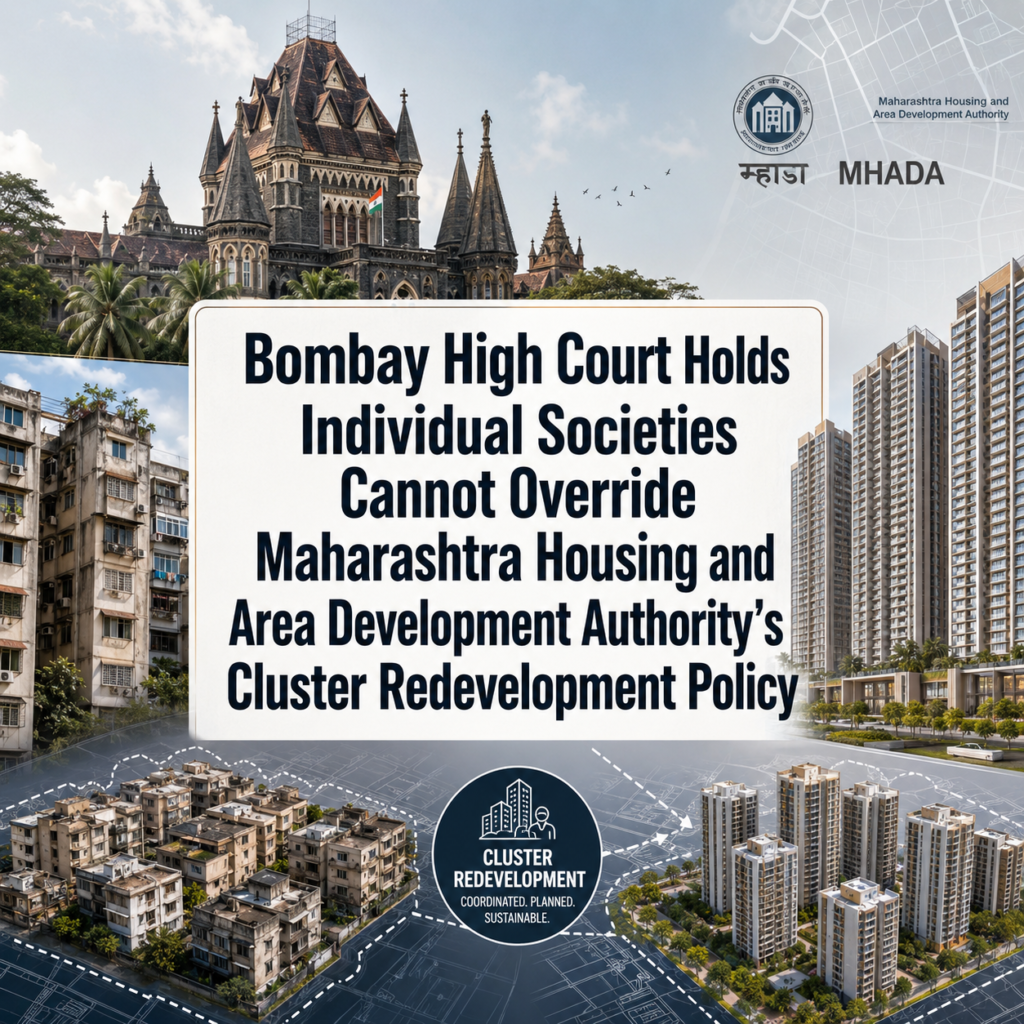
Bombay High Court Holds Individual Societies Cannot Override Maharashtra Housing and Area Development Authority’s Cluster Redevelopment Policy

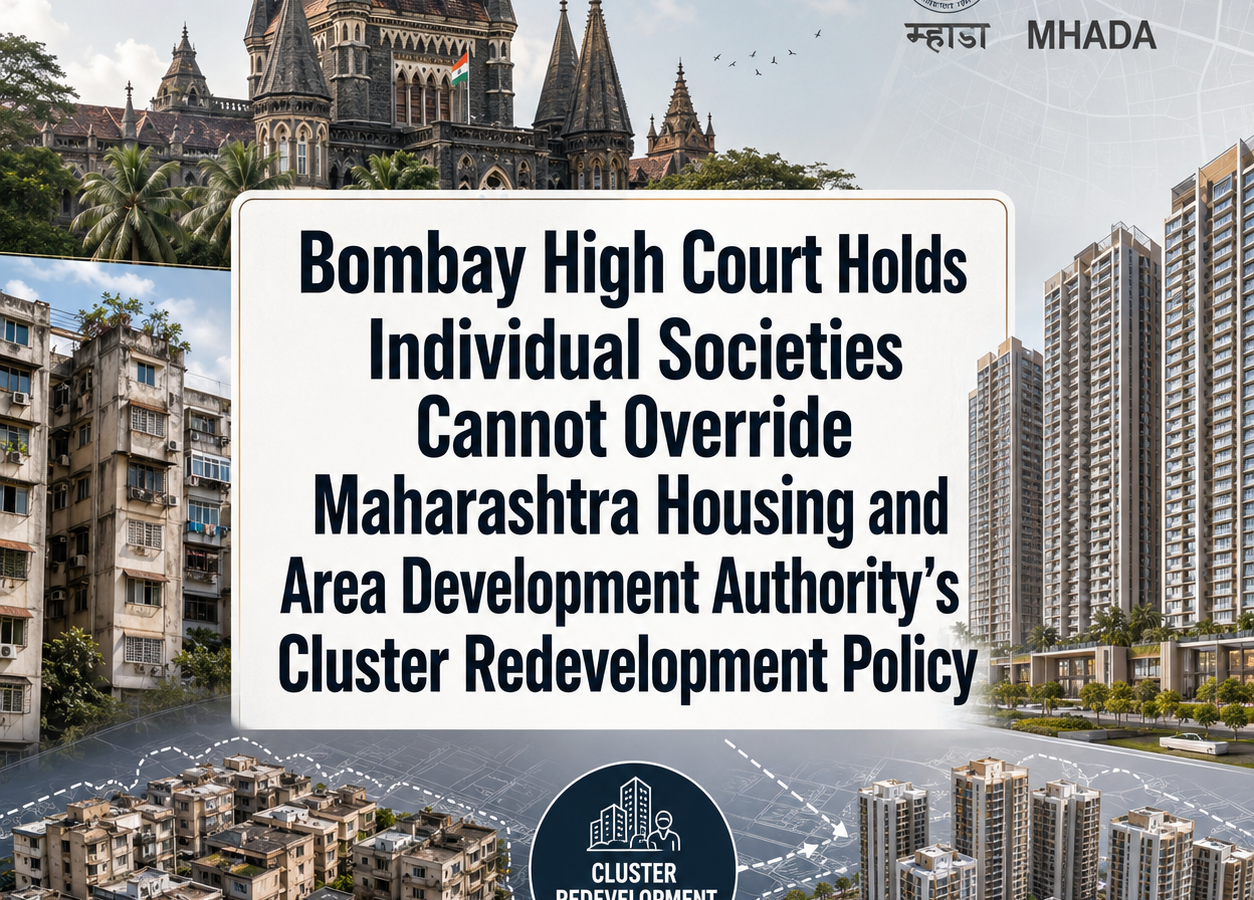
Bombay High Court Upholds MHADA’s Integrated Redevelopment of Adarsh Nagar and Bandra Reclamation Layouts; Holds Individual Societies Cannot Override Larger Public Planning Policy
Facts
A batch of writ petitions was filed by several co-operative housing societies from the Adarsh Nagar, Worli and Bandra Reclamation MHADA layouts, challenging the State Government’s decision to undertake integrated/cluster redevelopment of the layouts through MHADA and a Construction and Development Agency. The lead matter was filed by M.I.G. Adarsh Nagar Co-operative Housing Society Limited, which challenged the Government Resolutions dated 25 April 2025 and 15 December 2025, as well as the tender floated in April 2026 for appointment of a Construction and Development Agency for integrated redevelopment.
The petitioner societies claimed that they were owners of their respective buildings and sub-lessees of the land, and therefore possessed valuable redevelopment rights during the subsistence of their leases. They contended that MHADA could not compel them to become part of a cluster redevelopment without their consent, particularly when they intended to undertake independent redevelopment of their own properties.
MHADA and the State, on the other hand, justified the integrated redevelopment as a policy decision aimed at planned redevelopment, better infrastructure, uniform urban planning, creation of housing stock, and redevelopment of old MHADA layouts in public interest.
Issues
The principal issue before the Bombay High Court was whether the State Government and MHADA could lawfully undertake integrated/cluster redevelopment of MHADA layouts under Regulation 33(5) and Regulation 33(9) of DCPR 2034, without permitting individual societies to proceed with separate standalone redevelopment.
The Court also considered whether the impugned Government Resolutions and tender violated the petitioners’ rights under Articles 14, 21 and 300A of the Constitution of India, the Transfer of Property Act, the Maharashtra Co-operative Societies Act, the MHADA Act, the MRTP Act and DCPR 2034.
Petitioner’s Arguments
The petitioners argued that they were owners of their buildings and sub-lessees of the land, and that such rights included the right to use, occupy, enjoy and redevelop the property during the subsistence of the lease. According to them, the impugned Government Resolutions interfered with their independent redevelopment rights and amounted to deprivation of property without authority of law, in violation of Article 300A of the Constitution.
They submitted that executive instructions or Government Resolutions could not override statutory rights under the MRTP Act, DCPR 2034, the Transfer of Property Act, or the Maharashtra Co-operative Societies Act. The petitioners further contended that compulsory inclusion in cluster redevelopment would effectively merge different societies, dilute their independent identity, alter lease terms, and deprive them of FSI and redevelopment benefits.
The petitioners also raised concerns regarding the tender conditions, including the consent mechanism, lack of individual consultation, alleged ambiguity in commercial terms, uncertainty regarding rehabilitation units, adequacy of transit rent, corpus fund, and loss of planning control.
Respondent’s Arguments
The State and MHADA argued that the redevelopment was not a private redevelopment exercise but a public planning exercise concerning large MHADA layouts. They submitted that MHADA was the superior lessor, statutory housing authority and planning authority, and that the petitioners’ rights were subject to MHADA’s statutory powers and regulatory framework.
It was argued that redevelopment under Regulation 33(5) and cluster redevelopment under Regulation 33(9) were permissible, and that the impugned Government Resolutions merely operationalised the statutory framework. MHADA further submitted that the redevelopment would provide rehabilitation benefits, corpus amounts, shifting charges, brokerage, Permanent Alternative Accommodation Agreements, defect liability protection, performance security and better civic infrastructure.
The respondents also submitted that permitting every individual society to independently redevelop its property would defeat integrated planning, infrastructure development, road planning, fire access, drainage, water supply, parking, open spaces and long-term urban planning.
Analysis of the Law
The Court held that the impugned Government Resolutions were issued in furtherance of the statutory powers available to the State Government and MHADA. The Court found that MHADA’s object includes planning, execution and redevelopment of housing schemes and layouts for public housing purposes.
The Court held that Regulation 33(5) of DCPR 2034 permits redevelopment of MHADA layouts and that the impugned Government Resolutions merely operationalised the power already available under Regulation 33(5)(2.2). The Court rejected the contention that sub-regulations under Regulation 33(5) conferred an independent vested right on every society to insist upon standalone redevelopment.
The Court further held that the choice between individual redevelopment and integrated redevelopment is a matter of planning and policy, falling within the domain of the State Government and MHADA. Unless a policy decision is shown to be patently illegal, mala fide, arbitrary or contrary to statute, the writ court would not interfere.
Precedent Analysis
The Court relied significantly on the earlier decision in the Motilal Nagar redevelopment case, where MHADA’s authority to undertake holistic redevelopment through an agency while retaining control over the project had been recognised. The Court noted that the challenge to the Motilal Nagar decision had been dismissed by the Supreme Court.
The Court also relied on principles laid down in MIG Cricket Club v. Abhinav Sahakar Education Society, BALCO Employees Union v. Union of India, and Motilal Nagar to reiterate that courts ordinarily do not interfere in matters of town planning, economic policy and redevelopment policy unless the decision is contrary to statute or the Constitution.
On the issue of individual rights yielding to larger public interest, the Court referred to Haryana Urban Development Authority v. Abhishek Gupta and State of Haryana v. Vinod Oil and General Mills. On Article 300A, the Court considered Jilubhai Nanbhai Khachar v. State of Gujarat, K.T. Plantation Pvt. Ltd. v. State of Karnataka and Rajiv Sarin v. State of Uttarakhand, and held that the proposed rehabilitation and benefits satisfied the constitutional requirement where the petitioners did not possess absolute and unfettered proprietary rights.
Court’s Reasoning
The Court held that MHADA layouts such as Adarsh Nagar and Bandra Reclamation could not be treated as isolated parcels available for separate private redevelopment by individual societies. The redevelopment formed part of a larger housing policy framework involving rehabilitation entitlements, public housing stock, income-group distribution, infrastructure planning and balanced urban development.
The Court observed that if every society in a MHADA layout was permitted to undertake piecemeal redevelopment, the very purpose of integrated planning, infrastructure development and coordinated redevelopment would be defeated. The Court found that the Government Resolutions were intra vires Regulation 33(5) of DCPR 2034 and legally valid.
The Court also held that MHADA, as planning authority and superior lessor, retained authority to regulate redevelopment in accordance with law and policy. The petitioners could not claim unilateral redevelopment rights so as to override public planning policy.
The Court further accepted that integrated redevelopment would provide planned road networks, fire access, drainage, water supply, parking, open spaces, better amenities, uniform infrastructure and long-term planning benefits. It held that such matters fall within the expertise of planning authorities and that the Court should not substitute its own view for the policy wisdom of the State and MHADA.
Conclusion
The Bombay High Court dismissed the writ petitions, holding that the impugned Government Resolutions and tender for integrated redevelopment of MHADA layouts were valid, lawful and issued in larger public interest. The Court held that the petitioner societies did not possess an absolute right to insist on independent redevelopment and could not override MHADA’s statutory planning authority by claiming unilateral redevelopment rights.
The Court recorded the assurances given by the respondents in their affidavits and held that the rights of bona fide occupants were safeguarded under the integrated redevelopment framework. The writ petitions were dismissed with no order as to costs, and Rule was discharged.
Case Details
Case: M.I.G. Adarsh Nagar Co-operative Housing Society Limited v. State of Maharashtra & Ors. along with connected writ petitions
Court: Bombay High Court, Ordinary Original Civil Jurisdiction
Case Number: Writ Petition (L) No. 16257 of 2026 with connected writ petitions
Judge: Justice M. S. Karnik and Justice S. M. Modak
Date: 2 July 2026
Result: Writ petitions dismissed; MHADA’s integrated redevelopment policy upheld; Rule discharged with no order as to costs.