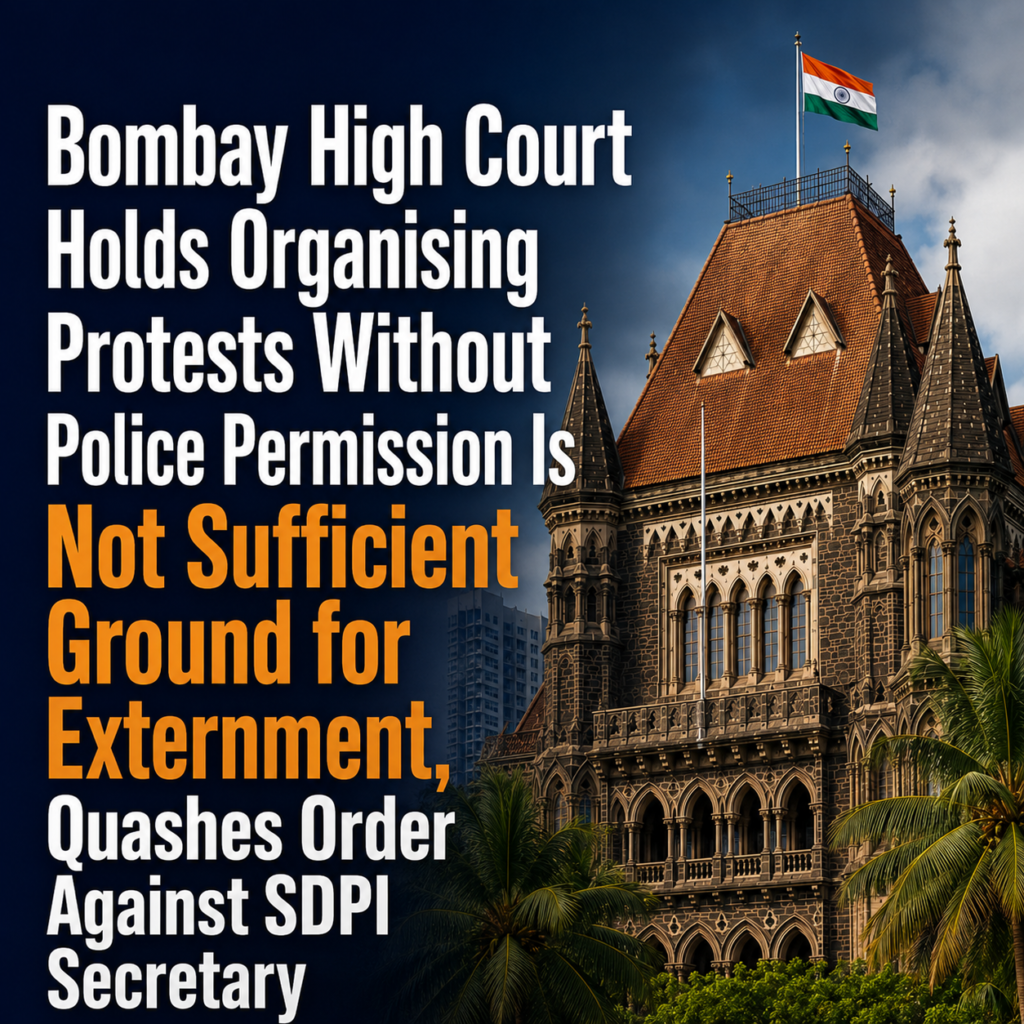
Bombay High Court Quashes Externment Order Against SDPI Secretary; Holds Political Protest and Section 188 IPC Cases Cannot Justify Externment Without Material Showing Harm or Violence
Facts
The petitioner, Saeed Ahmad Abdul Wahid Chaudhary, challenged an externment order dated 3 December 2025 passed by the Deputy Commissioner of Police, Zone-6, Chembur, Mumbai, as well as the appellate order dated 27 March 2026 passed by the Divisional Commissioner, Konkan Division. The externment order had been passed under Section 56(1)(a) and 56(1)(b) of the Maharashtra Police Act.
The petitioner was the Secretary of the Social Democratic Party of India, a political party registered with the Election Commission of India under Section 29A of the Representation of the People Act, 1951. The FIRs relied upon against him mainly related to agitations, morchas and dharnas organised by him or his political party opposing certain decisions of the Government of India. Most of the offences referred to in the externment proceedings were under Section 188 of the Indian Penal Code for allegedly holding protests without police permission.
The petitioner contended that the externment proceedings were politically motivated and that there was no material to show that his movements or acts caused alarm, danger or harm to persons or property.
Issues
The principal issue before the Bombay High Court was whether an externment order under Section 56(1)(a) and 56(1)(b) of the Maharashtra Police Act could be sustained merely on the basis that the petitioner had organised protests, morchas or dharnas without permission.
The Court also considered whether cases mainly under Section 188 IPC could justify externment when there was no material showing violence, danger to public safety, harm to property, or commission of offences involving force or violence.
Another issue was whether the externment order violated the petitioner’s fundamental rights to freedom of speech and expression, free movement, and dignity under Articles 19 and 21 of the Constitution.
Petitioner’s Arguments
The petitioner argued that he was being targeted because he and his political party had opposed certain decisions of the Government of India through protests and agitations. It was submitted that the FIRs relied upon in the externment order were mostly under Section 188 IPC, which deals with disobedience of an order duly promulgated by a public servant.
The petitioner submitted that merely organising morchas, dharnas or protests could not justify externment unless the statutory requirements under Section 56 of the Maharashtra Police Act were satisfied. It was argued that there was no material to show that his acts caused or were likely to cause alarm, danger or harm to persons or property.
The petitioner further contended that the externment order was passed without proper subjective satisfaction and was mala fide. Reliance was placed on Anuradha Bhasin v. Union of India and Mohmmad Kaleem Taufiq Ahmed Siddiqui v. State of Gujarat.
Respondent’s Arguments
The State opposed the petition and relied on the affidavit filed by the Deputy Commissioner of Police and the reasons recorded in the externment orders. The State submitted that the petitioner and other protesters had raised certain slogans and had organised morchas, dharnas and agitations despite refusal of permission by the police authorities.
It was argued that the petitioner’s conduct justified preventive action under the Maharashtra Police Act and that the externment order was passed in accordance with law.
Analysis of the Law
The Court examined Section 56(1)(a) of the Maharashtra Police Act, which permits externment when the movements or acts of a person are causing or are calculated to cause alarm, danger or harm to person or property. The Court also considered Section 56(1)(b), which applies where there are reasonable grounds to believe that the person is engaged or is about to be engaged in offences involving force or violence, or offences under Chapters XII, XVI or XVII of the IPC.
The Court held that the statutory threshold for externment is high. There must be material showing danger, alarm, harm, violence or likelihood of commission of serious offences. Mere violation of prohibitory orders or holding protests without permission, resulting in Section 188 IPC cases, cannot by itself justify externment.
The Court noted that Section 188 IPC carries a maximum punishment of simple imprisonment of one month in such circumstances and cannot be treated as a sufficient basis for externment under Section 56 of the Maharashtra Police Act.
Precedent Analysis
The Court referred to Deepak s/o Laxman Dongre v. State of Maharashtra, where the Supreme Court held that an externment order is an extraordinary measure because it deprives a citizen of the fundamental right of free movement throughout the territory of India.
The Court relied on Anuradha Bhasin v. Union of India, where the Supreme Court held that powers such as those under Section 144 CrPC cannot be used to suppress legitimate expression of opinion, grievance or democratic rights.
The Court also relied on Mohmmad Kaleem Taufiq Ahmed Siddiqui v. State of Gujarat, where the Gujarat High Court set aside an externment order passed against a person who had protested against a decision of the Union Government, holding that a citizen cannot be externed merely for raising grievances against the Government.
Court’s Reasoning
The Court found that the FIRs relied upon against the petitioner primarily alleged that he had organised protests, morchas and dharnas opposing certain decisions of the Government of India and that such protests were allegedly held without police permission.
The Court held that there was no material showing that the petitioner’s movements or acts caused alarm, danger or harm to persons or property. There was also no material to show that he was engaged in or about to be engaged in offences involving force or violence, or offences against the human body.
The Court held that the subjective satisfaction recorded by the externing authority was unsupported by material and was therefore vitiated. The Court also accepted the petitioner’s contention that the action appeared mala fide.
The Court further observed that externing the petitioner merely for opposing decisions of the Government of India affected his fundamental rights to freedom of speech and expression and to live with dignity under Articles 19 and 21 of the Constitution.
Conclusion
The Bombay High Court allowed the writ petition and quashed both the externment order dated 3 December 2025 passed by the Deputy Commissioner of Police, Zone-6, Chembur, Mumbai, and the appellate order dated 27 March 2026 passed by the Divisional Commissioner, Konkan Division.
The Court held that political protest, slogans, morchas or dharnas, even if held without permission and attracting Section 188 IPC, cannot justify externment unless there is material showing danger, harm, alarm, violence or serious criminal activity as required under Section 56 of the Maharashtra Police Act.
Case Details
Case: Saeed Ahmad Abdul Wahid Chaudhary v. State of Maharashtra & Anr.
Court: Bombay High Court, Criminal Appellate Jurisdiction
Case Number: Writ Petition No. 1700 of 2026
Judge: Justice Madhav J. Jamdar
Date: 2 July 2026
Result: Writ petition allowed; externment order and appellate order quashed and set aside.