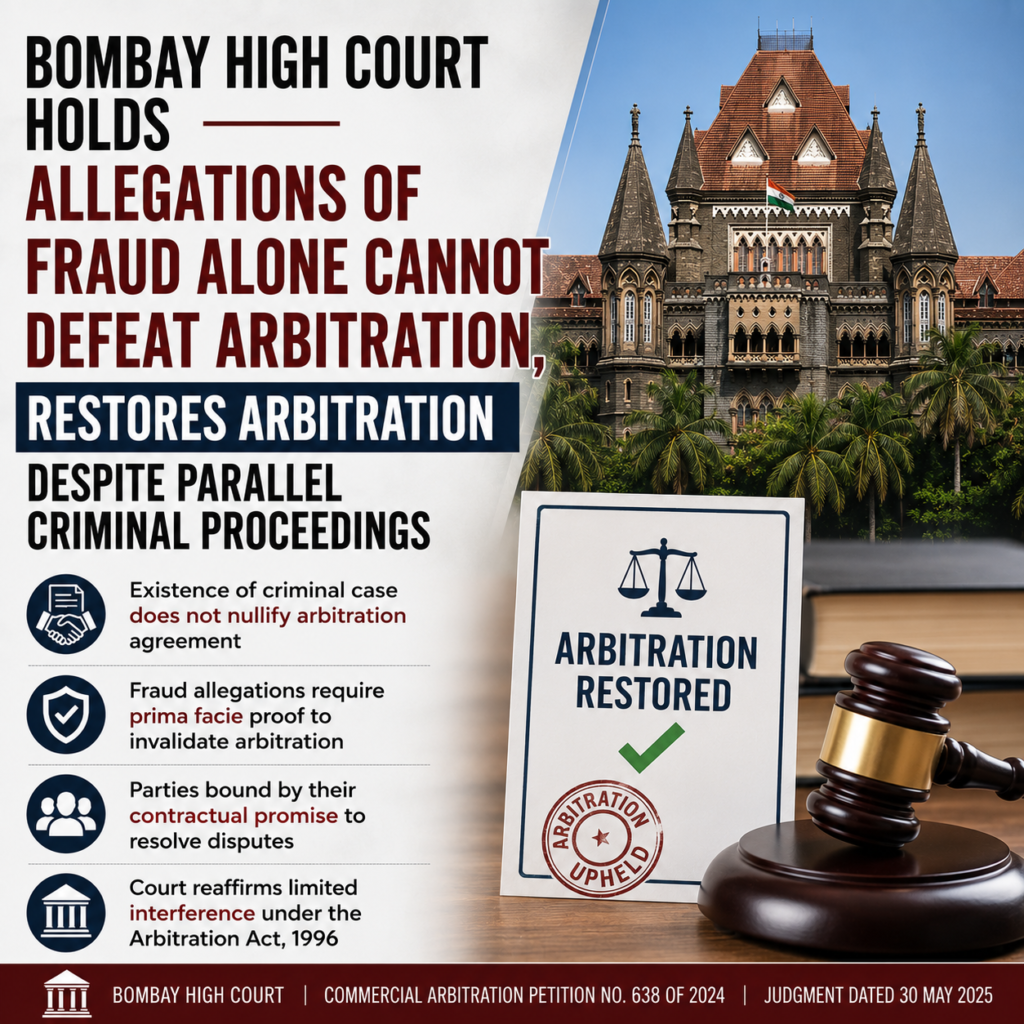
Bombay High Court Restores Arbitration in ₹600 Crore Commercial Dispute, Holds Contractual Claims Remain Arbitrable Despite Allegations of Fraud and Criminal Investigation
Facts
The respondent, Dentsu Communications India Private Limited, had obtained orders from different State Governments for supplying food grains under mid-day meal programmes. For procuring the food grains, it allegedly had an arrangement with Suumaya Agro, an entity belonging to the Suumaya Group.
The respondent approached Capalpha Trade Private Limited for short-term trade financing of the supplies proposed to be made by Suumaya Agro. On 5 March 2021, the respondent’s Corporate Social Responsibility division issued a Letter of Intent to the petitioner for the purchase of food grains worth approximately ₹600 crore over 20 months.
Under the alleged commercial arrangement:
- the respondent would issue purchase orders to the petitioner;
- the petitioner would place corresponding purchase orders on Suumaya Agro at a lower price;
- Suumaya Agro would directly supply the goods to the respondent or to locations specified by it;
- the respondent would issue written confirmations certifying delivery and receipt of the goods;
- only after receiving such confirmations would the petitioner release funds to Suumaya Agro; and
- the respondent would pay the petitioner’s invoices within 30 days, extendable by 15 days.
Between February and September 2021, the respondent allegedly paid approximately ₹175 crore to the petitioner. Thereafter, payment defaults occurred. The respondent informed the petitioner that employees handling its CSR division had resigned and later alleged that fraudulent transactions had been carried out by its former employees in collusion with Suumaya Group entities and other persons.
The petitioner invoked arbitration for recovery of the amounts due under the purchase orders and initially filed an application under Section 9 of the Arbitration and Conciliation Act, 1996. During those proceedings, the parties agreed to refer the disputes to arbitration, and the Section 9 application was treated as an application under Section 17 before the arbitral tribunal.
The petitioner filed its statement of claim on 20 July 2022, and the respondent filed its statement of defence on 2 November 2022. After the proceedings had progressed, the respondent filed an application under Section 16 contending that the dispute was non-arbitrable because it involved serious allegations of fraud, forgery, collusion and conspiracy involving third parties.
The petitioner stated before the arbitrator that, for the purpose of the arbitration, it would proceed on the assumption that:
- no goods were actually delivered by Suumaya Agro;
- the lorry receipts and invoices issued by Suumaya Agro were bogus;
- the respondent’s former employees may have acted fraudulently in collusion with third parties; and
- the petitioner itself was not involved in the alleged fraud.
The petitioner limited its arbitral claim to the respondent’s contractual and vicarious liability.
By an order dated 3 August 2023, the sole arbitrator allowed the respondent’s Section 16 application. Although the arbitration agreement was held to be valid, the arbitrator concluded that it would be more appropriate and convenient for the dispute to be adjudicated by a civil court because third parties and allegations of serious fraud were involved.
The petitioner challenged that order before the Bombay High Court under Section 37 of the Arbitration Act.
Issues
- Whether the contractual dispute between the petitioner and respondent became non-arbitrable merely because allegations of fraud, forgery and collusion involving third parties had been made.
- Whether the civil consequences of transactions alleged to be fraudulent could be adjudicated in arbitration while criminal proceedings concerning the same transactions remained pending.
- Whether the absence of third parties from the arbitration rendered the reference incapable of effective adjudication.
- Whether convenience, consolidation of proceedings or the possibility of summoning numerous third-party witnesses constituted valid grounds for declining arbitral jurisdiction.
- Whether the respondent’s objection under Section 16 was barred because it was raised after the statement of defence had been filed.
- Whether the arbitrator’s order declining jurisdiction was sustainable under the tests governing non-arbitrability laid down by the Supreme Court.
Petitioner’s Arguments
The petitioner submitted that its claim was a straightforward contractual claim for recovery of amounts due under purchase orders and invoices. It had not sought any relief against Suumaya Agro, the respondent’s former employees or any other third party.
It argued that references to fraud in its pleadings were only in response to the respondent’s defence. The petitioner was not asking the arbitrator to determine the criminal liability of any person.
The petitioner further submitted that it had expressly agreed, for the limited purpose of arbitration, not to dispute:
- that the goods were not delivered;
- that the lorry receipts and underlying invoices were bogus; and
- that the respondent’s former employees may have acted fraudulently with third parties.
The only issue requiring adjudication was whether the respondent remained contractually or vicariously liable to pay the petitioner.
It was contended that the award would operate only between the petitioner and respondent and would neither bind nor affect the rights of third parties. Therefore, it would have no erga omnes effect.
The petitioner argued that serious allegations of fraud render a dispute non-arbitrable only when:
- the fraud permeates and invalidates the arbitration agreement itself; or
- the allegations enter the public law domain, such as allegations of arbitrary, fraudulent or mala fide conduct against the State or its instrumentalities.
Neither test was satisfied because the respondent did not challenge the validity of the arbitration agreement.
The petitioner also contended that inconvenience in summoning witnesses, production of voluminous documents or the possibility of separate proceedings against third parties could not nullify a valid arbitration agreement.
It further argued that the Section 16 application was filed belatedly, after the statement of defence and after substantial arguments on the Section 17 application. According to the petitioner, the respondent had submitted to the tribunal’s jurisdiction and could not later raise a jurisdictional objection.
Respondent’s Arguments
The respondent contended that the transactions relied upon by the petitioner were sham, bogus and fraudulent and had been brought about through collusion between the petitioner, Suumaya Group entities and the respondent’s former employees.
It submitted that the dispute could not be decided merely by interpreting the purchase orders. The tribunal would necessarily have to examine allegations concerning:
- fabricated invoices and lorry receipts;
- non-delivery of goods;
- conspiracy and collusion;
- misappropriation of funds;
- criminal breach of trust; and
- the role of Suumaya Group entities and former employees.
The respondent relied on the criminal complaints, investigation by the Economic Offences Wing, seizure of electronic and documentary material, statements of numerous witnesses and filing of a charge-sheet to contend that the allegations were serious and had criminal implications.
It argued that the third parties involved in the alleged fraud were not parties to the arbitration agreement and could not be compelled to participate in the arbitral proceedings. The respondent would therefore be prejudiced if it had to establish its defence by summoning such persons merely as witnesses.
The respondent submitted that a civil court would provide a more effective forum because all necessary parties could be impleaded and the entire controversy could be collectively resolved in one proceeding.
It also argued that the petitioner had not abandoned its right to institute civil proceedings against third parties. Parallel proceedings in a private arbitral forum and a public court could therefore lead to inconsistent findings concerning the same transactions.
Regarding the timing of the Section 16 application, the respondent contended that the jurisdictional objection had already been indicated in its defence and that further material concerning the fraud emerged later. It therefore had not waived the objection.
Analysis of the Law
Arbitrability of civil disputes involving fraud
The Court held that allegations of fraud do not automatically render a civil or commercial dispute non-arbitrable.
The criminal prosecution of fraud, forgery, conspiracy or breach of trust remains within the sovereign domain of the State. However, civil consequences arising from the same conduct—including contractual payment claims, damages, misrepresentation and deceit—may still be adjudicated through arbitration.
The mere possibility that the same facts may give rise to both criminal and civil proceedings does not oust arbitral jurisdiction.
Tests for serious fraud
The Court applied the two tests governing non-arbitrability on the ground of fraud:
- whether the plea of fraud permeates the entire contract, particularly the arbitration agreement, and renders it void; and
- whether the allegations transcend the parties’ private contractual relationship and enter the public law domain.
The first test was not satisfied because the arbitrator expressly held that the arbitration agreement was valid.
The second test was also not satisfied because the dispute was between two private commercial entities and related to enforcement of contractual payment obligations. No allegation of arbitrary, mala fide or fraudulent conduct was made against the State or any State instrumentality.
Fourfold test under Vidya Drolia
The Court examined whether the dispute:
- concerned an action in rem;
- affected third-party rights or had an erga omnes effect;
- concerned sovereign or public-interest functions of the State; or
- was expressly or by necessary implication made non-arbitrable by statute.
It found that none of these conditions was fulfilled.
The petitioner’s claim was in personam and sought recovery only against the respondent. The tribunal was not required to determine the civil or criminal liability of non-parties.
Presence of third parties
The requirement of examining third-party evidence does not make a dispute non-arbitrable. Third parties may be summoned as witnesses, and relevant documents may be produced during the arbitral proceedings.
A distinction must be drawn between:
- adjudicating the rights and liabilities of third parties, which an arbitral tribunal cannot do; and
- receiving evidence from third parties to determine the contractual rights of parties bound by the arbitration agreement.
In the present case, no relief was claimed against the third parties, and the arbitrator himself had recognised that they could be summoned as witnesses.
Convenience is not a test of jurisdiction
The Court held that an otherwise valid arbitration agreement cannot be nullified merely because a civil court may provide a more convenient or consolidated forum.
Convenience, the volume of evidence, the number of witnesses and the possibility of parallel proceedings are not recognised grounds of non-arbitrability.
The tribunal must exercise jurisdiction unless the dispute falls within a legally recognised category of non-arbitrable matters.
Parallel criminal proceedings
The Court held that arbitral and criminal proceedings may proceed simultaneously.
A future criminal conviction may have consequences for enforcement of an award if it invalidates the underlying contract. Conversely, an acquittal may eliminate the basis for disputing the transaction. These possibilities do not justify stopping arbitration at the threshold.
The seriousness of the punishment attached to the alleged offences, including possible life imprisonment, was not by itself sufficient to transform the contractual dispute into a non-arbitrable matter.
Timing of the Section 16 objection
The Court rejected the petitioner’s contention that the jurisdictional objection could not have been entertained after the statement of defence.
It recognised that Section 16 ordinarily requires a jurisdictional plea to be raised no later than the submission of the statement of defence, but the tribunal may admit a later plea where the delay is justified.
On the facts, the jurisdictional objection was sufficiently reflected in the respondent’s pleadings and supporting material. The Court therefore did not set aside the order on the ground of delay. It interfered because the arbitrator’s substantive reasoning on non-arbitrability was legally unsustainable.
Precedent Analysis
A. Ayyasamy v. A. Paramasivam
The Supreme Court recognised that mere allegations of fraud do not exclude arbitration. Only exceptionally serious fraud, affecting the arbitration agreement itself or requiring adjudication in the public domain, may render a dispute non-arbitrable.
The High Court held that the arbitrator had relied upon isolated observations from the judgment without correctly applying its governing principles favouring enforcement of arbitration agreements.
Rashid Raza v. Sadaf Akhtar
This decision formulated two working tests:
- whether fraud permeates the contract and arbitration agreement; and
- whether the allegations remain internal to the parties or have public implications.
The Court found that the allegations in the present case did not invalidate the arbitration agreement and remained connected to the parties’ commercial relationship.
Avitel Post Studioz Ltd. v. HSBC PI Holdings
The Supreme Court clarified that even serious allegations of fraud, misrepresentation or deceit may be adjudicated in arbitration when they concern civil consequences between contracting parties.
Parallel criminal proceedings do not make an otherwise arbitrable dispute non-arbitrable.
The High Court relied substantially on this principle.
Vidya Drolia v. Durga Trading Corporation
The fourfold test for non-arbitrability was applied. The Court concluded that the dispute was not an action in rem, did not have an erga omnes effect, did not concern sovereign functions and was not statutorily excluded from arbitration.
The Court emphasised that complexity alone is not a ground for refusing arbitration.
Managing Director, Bihar State Food and Civil Supply Corporation Ltd. v. Sanjay Kumar
The Supreme Court reiterated that allegations of serious fraud must be assessed contextually. Fraud becomes non-arbitrable where its criminal implications transcend the parties’ inter se dispute and have public ramifications affecting governance, public distribution, national safety or non-parties.
No comparable public ramifications were demonstrated in the present case.
N.N. Global Mercantile Pvt. Ltd. v. Indo Unique Flame Ltd.
This decision recognised that civil commercial disputes—including disputes concerning whether the substantive contract is voidable—may be resolved through arbitration.
The Court relied on it to distinguish arbitrable civil consequences from non-arbitrable criminal prosecution.
Nilesh Shejwal v. Agrowon Agrotech Industries Pvt. Ltd.
The Bombay High Court had referred parties to arbitration despite allegations of forgery and criminal proceedings.
It held that the existence of a criminal prosecution does not by itself render the connected contractual dispute non-arbitrable. The same reasoning applied to the present matter.
Simran Sodhi v. Sandeep Singh
The arbitrator had relied upon this Delhi High Court decision. The Bombay High Court distinguished it because the reliefs sought there directly affected third-party rights and the alleged fabricated document had public-law and penal implications.
In the present matter, no relief was claimed against third parties, and the arbitrator acknowledged that the award would not have an erga omnes effect.
Bentwood Seating Systems v. Airports Authority of India
The dispute in that case was held non-arbitrable because the fraud allegedly permeated the entire contract, including the arbitration agreement.
The Court distinguished it because the arbitration agreement between Capalpha and Dentsu was admittedly valid.
Baban Piraji Ghadge v. Amit Sheth
That case involved allegations of forgery and fabrication affecting the very validity of the partnership deed containing the arbitration clause.
Since no comparable challenge was raised to the arbitration agreement in the present case, the precedent did not assist the respondent.
MSP Infrastructure Ltd. v. Madhya Pradesh Road Development Corporation
The Supreme Court held that jurisdictional objections ordinarily must be raised before or with the statement of defence.
The High Court nevertheless held that, in the present circumstances, the objection had been sufficiently raised and the tribunal could consider it. The petitioner’s challenge succeeded on merits rather than on delay.
ONGC v. Discovery Enterprises Pvt. Ltd.
This decision requires appellate courts under Section 37 to accord due deference to an arbitrator’s decision on jurisdiction.
The High Court observed that such deference does not make the tribunal’s decision conclusive. Where the tribunal applies an incorrect legal test and declines jurisdiction merely on considerations of convenience, appellate interference is justified.
Court’s Reasoning
The Court found that the arbitrator’s own findings undermined the conclusion of non-arbitrability.
The arbitrator had expressly held that:
- the arbitration agreement was valid;
- the award would not necessarily have an erga omnes effect;
- the rights and liabilities of third parties need not be affected;
- complexity and voluminous evidence were not barriers to arbitration;
- third parties could be summoned as witnesses; and
- allegations of fraud could be examined in arbitration if the relevant persons were available.
Despite these findings, the arbitrator declined jurisdiction principally because a civil court would be more convenient for consolidated resolution of all disputes.
The High Court held that convenience is not a lawful ground for rendering a valid arbitration agreement ineffective.
The petitioner sought relief only against the respondent under the purchase orders. The respondent’s defence that the transactions were fraudulent did not convert the contractual claim into an action in rem or into a public-law dispute.
The arbitrator did not record any clear finding explaining:
- how the award would bind or prejudice third parties;
- why an effective and enforceable award could not be passed;
- how the dispute implicated governance, public service, national safety or any sovereign function;
- how the alleged fraud invalidated the arbitration agreement; or
- why the matter fell within any recognised category of non-arbitrable disputes.
The pendency of criminal proceedings, filing of a charge-sheet and severity of the offences were insufficient. The arbitrator was required to identify how those criminal allegations transformed the inter se contractual claim into a dispute having public implications.
Since no such legal basis was demonstrated, the order under Section 16 could not be sustained.
Conclusion
The Bombay High Court allowed the petitioner’s appeal under Section 37 of the Arbitration and Conciliation Act.
It set aside the sole arbitrator’s order dated 3 August 2023, which had held that the disputes were non-arbitrable.
The Court dismissed the respondent’s application under Section 16 and restored the arbitration proceedings from the stage at which the jurisdictional application had been filed.
The Court held that:
- allegations of fraud do not automatically render a contractual dispute non-arbitrable;
- parallel criminal proceedings do not prevent arbitration of civil consequences;
- third parties may be summoned as witnesses without being made parties to the reference;
- the dispute did not have an erga omnes effect or involve sovereign or public-law functions; and
- a valid arbitration agreement cannot be nullified merely because adjudication by a civil court may appear more convenient.
Case: Capalpha Trade Private Limited v. Dentsu Communications India Private Limited
Court: High Court of Judicature at Bombay, Ordinary Original Civil Jurisdiction
Case Number: Commercial Arbitration Petition No. 183 of 2025
Judge: Justice Gauri Godse
Date: 30 June 2026
Result: Appeal allowed; the order declaring the dispute non-arbitrable was set aside, the respondent’s Section 16 application was dismissed, and the arbitration proceedings were restored.