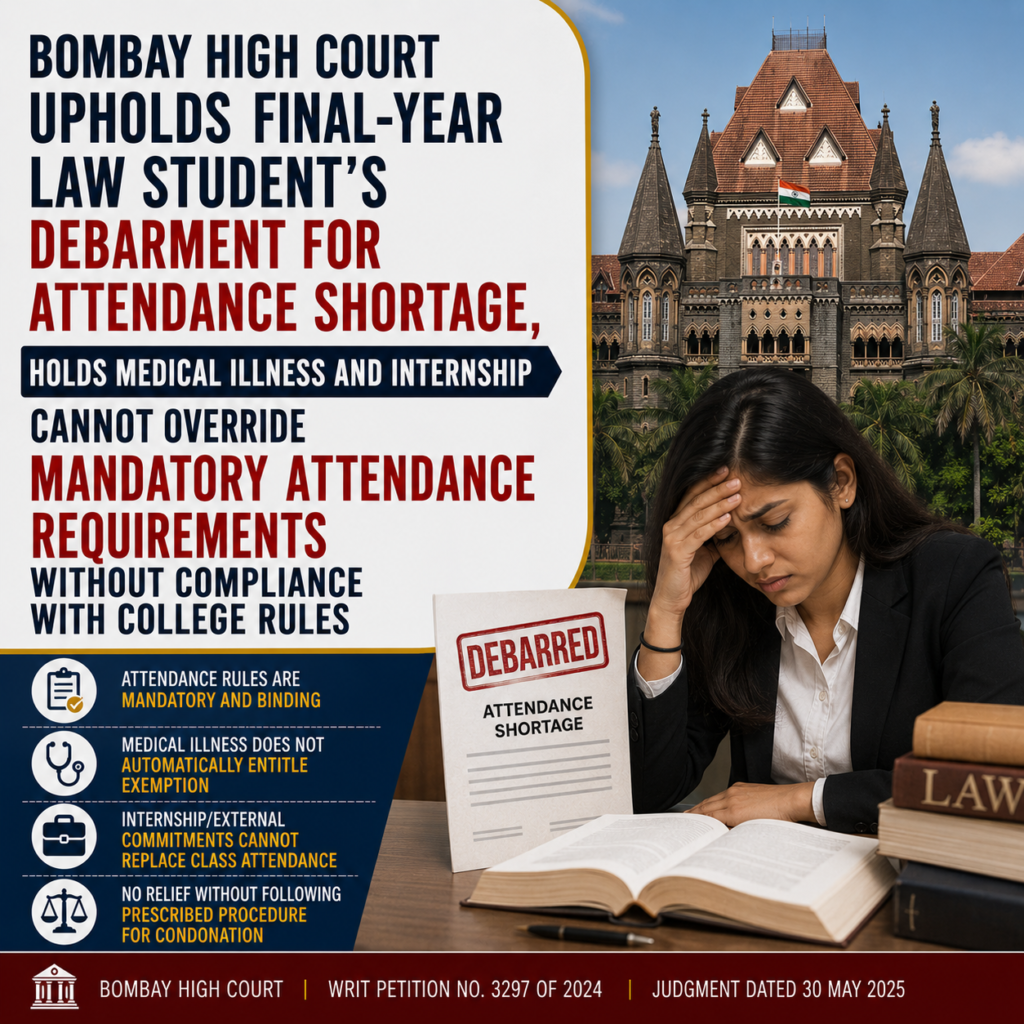
Bombay High Court Upholds Final-Semester Law Student’s Debarment for Low Attendance, Holds Medical Illness and Internship Cannot Override Mandatory Attendance Rules

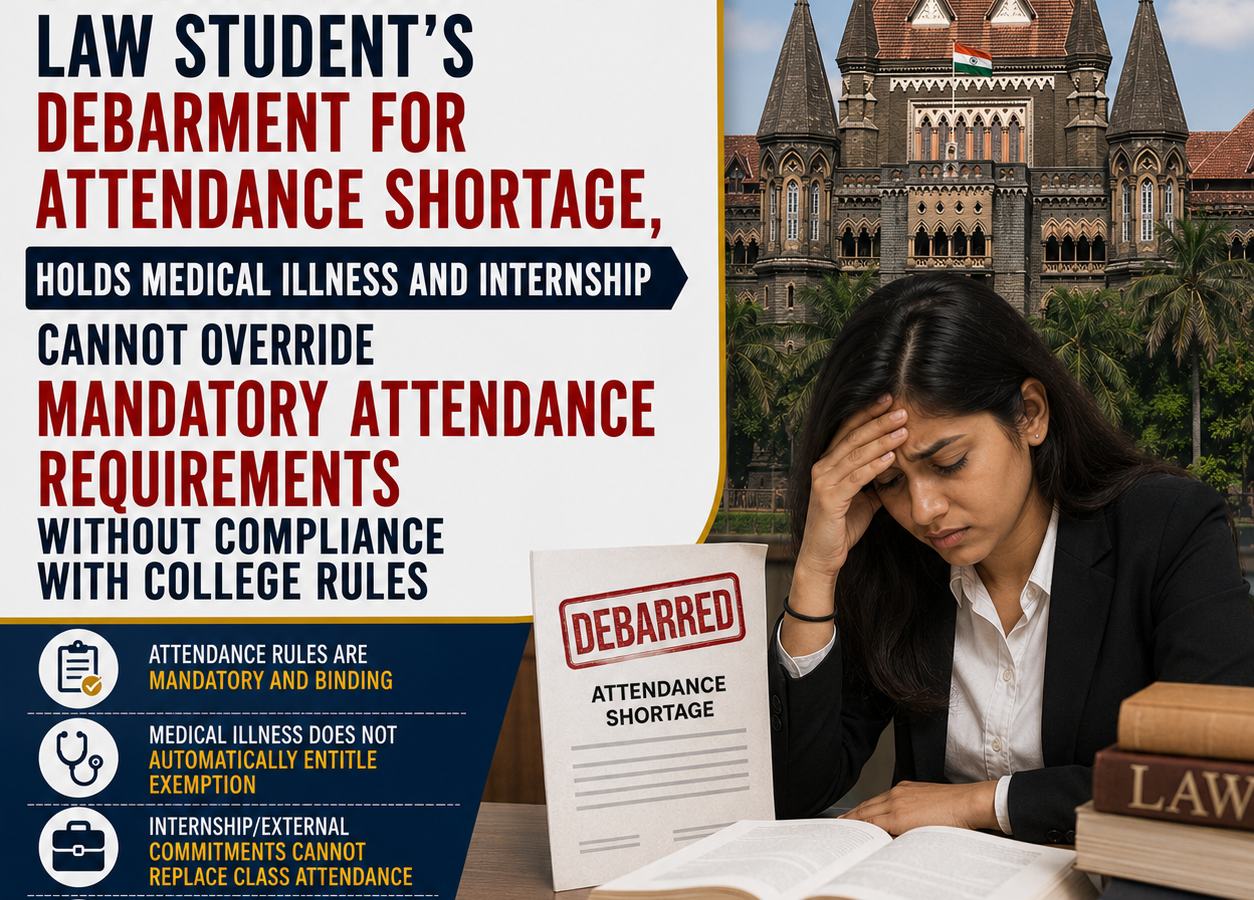
Bombay High Court Refuses Relief to Final-Semester Law Student Debarred for Low Attendance, Holds Medical Leave Must Comply With College Policy
Facts
The petitioner was a final-semester student in the B.B.A. LL.B. programme at Kirit P. Mehta School of Law, a constituent institution of SVKM’s Narsee Monjee Institute of Management Studies University.
Semester X commenced on 2 January 2026. The petitioner claimed that he contracted chickenpox and was advised complete bed rest, due to which he remained absent from college between 4 February and 17 February 2026.
The Law College’s Attendance Policy dated 20 January 2026 required students to maintain at least 70% attendance in every subject. It also prescribed a procedure for seeking medical leave: supporting medical records had to be submitted either before availing leave or within five days thereafter, depending upon the circumstances.
The petitioner did not submit his medical documents within the prescribed period. The Law College’s records indicated that he first disclosed his medical condition on 27 April 2026, after he had been informed that he was debarred from appearing in the Semester X examinations.
The petitioner’s final subject-wise attendance was:
| Subject | Attendance |
| Mediation and Conciliation Law | 84.44% |
| Competition Law | 60% |
| Direct Taxation | 53.33% |
| Foreign Direct Trade and Investment | 62.22% |
| Special Contracts in Business | 71.11% |
The petitioner contended that if the 14-day medical absence and the period during which he undertook an internship were regularised, he would satisfy the attendance requirement.
On 20 April 2026, the Law College informed the petitioner’s parents that he had been provisionally debarred because of shortage of attendance. By an email dated 27 April 2026, the petitioner was finally debarred from appearing in the examinations scheduled to commence on 4 May 2026.
The petitioner approached the Bombay High Court. By an interim order dated 5 May 2026, the Court directed a specially constituted Committee to consider his representation and whether exceptional relaxation could be granted.
The Committee granted him a personal hearing and examined his medical explanation, attendance record and academic circumstances. It found that:
- the petitioner had remained absent for approximately 53 days during the semester;
- the medically explained absence accounted for only about 14 days;
- even after considering the medical period, his attendance would remain below the prescribed threshold in several subjects;
- the medical documents had not been submitted within the stipulated period; and
- the petitioner had continued to remain absent while pursuing other academic and extracurricular activities.
The Committee therefore recommended against granting exceptional relaxation. The Vice-Chancellor accepted the recommendation on 7 May 2026.
The petitioner amended the writ petition and challenged the debarment communications as well as the Committee’s report.
Issues
- Whether the Law College’s decision debarring the petitioner for shortage of attendance was contrary to the Delhi High Court’s judgment in Re: Courts on its Own Motion in Re: Suicide Committed by Sushant Rohilla.
- Whether paragraph 249 of the Delhi High Court judgment, which directed that law students should not be barred from examinations solely for shortage of attendance, continued to govern the petitioner’s case after the Supreme Court prospectively stayed its operation.
- Whether the petitioner was entitled to regularisation of his attendance shortage on medical grounds.
- Whether the period spent undertaking an internship could be counted towards or exempted from mandatory classroom attendance.
- Whether the decision-making process of the Law College, the Committee and the Vice-Chancellor suffered from arbitrariness, mala fides, perversity, discrimination, statutory illegality or violation of natural justice.
- Whether the High Court could exercise equitable jurisdiction under Article 226 to permit a final-semester student to appear for examinations despite non-compliance with attendance requirements.
Petitioner’s Arguments
The petitioner principally relied upon the Delhi High Court’s judgment in Sushant Rohilla, particularly paragraph 249, which directed that no student enrolled in a recognised law college or university should be prevented from appearing in examinations or progressing academically merely because of shortage of attendance.
He submitted that the impugned debarment decision was taken before the Supreme Court’s order dated 26 May 2026 prospectively staying paragraph 249. According to him, on the date when the Law College acted, the Delhi High Court’s directions remained operative and binding.
The petitioner argued that the prospective stay could not retrospectively validate a debarment that was allegedly contrary to the law prevailing when the decision was made.
He also relied upon an email dated 10 November 2025 issued by the Law College, under which provisional debarments had been revoked following the Delhi High Court judgment. This, according to the petitioner, demonstrated that the institution had accepted and implemented the Delhi High Court’s directions.
The petitioner further relied upon a response issued by the Bar Council of India under the Right to Information Act, arguing that recognised law colleges were expected to comply with the Sushant Rohilla judgment until a contrary order was passed by a superior court.
On the facts, the petitioner argued that his absence was caused by genuine chickenpox, which was contagious and required isolation. He relied upon an email issued by the Law College advising students suffering from chickenpox to remain at home.
He submitted that if the 14 days of medical leave were regularised, his attendance position would improve sufficiently to permit him to appear in the examinations.
The petitioner also claimed that his internship from December 2025 to March 2026 contributed to his absence and ought to be considered while calculating attendance.
He emphasised that he was in his final semester and that denial of permission to appear in the examinations would seriously affect his academic and professional career. The High Court, according to him, possessed wide equitable powers under Article 226 to mould relief in his favour.
Respondent’s Arguments
The Law College and University submitted that the petitioner’s academic relationship was governed by the Student Resource Book and the Attendance Policy applicable for the academic year 2025–2026.
They argued that the applicable academic regulations required minimum attendance in each subject and that the petitioner’s attendance was substantially deficient in three subjects.
The respondents pointed out that the petitioner and his parents were repeatedly informed of his attendance position through the University’s automated attendance system. Attendance reports were communicated on several dates throughout the semester and expressly warned that failure to satisfy the prescribed requirement would result in debarment.
It was submitted that the petitioner failed to disclose these repeated communications in the writ petition and had presented an incomplete account of the events.
Regarding medical leave, the respondents argued that the petitioner neither sought prior permission nor submitted medical documents within five days, as required by the Attendance Policy. His medical claim was raised only after the debarment communication.
They also submitted that the petitioner’s total absence extended to approximately 53 days, while the medical explanation covered only 14 days. Even after granting full credit for the medically explained period, the petitioner would remain deficient in several subjects.
The respondents contended that no rule permitted internship periods to be counted as classroom attendance or treated as an exemption from mandatory lectures.
On the legal issue, they argued that the Delhi High Court judgment under Article 226 did not bind educational institutions situated outside its territorial jurisdiction.
They further submitted that paragraph 249 of the judgment had been stayed by the Supreme Court and that the Supreme Court had expressly permitted High Courts to decide pending attendance matters on their own merits.
According to the respondents, the prospective nature of the stay protected matters that had already attained finality but did not confer a vested right upon students whose cases were still pending.
They also pointed out that neither Rule 12 of the Bar Council of India Legal Education Rules, 2008 nor the Law College’s Attendance Policy had been challenged by the petitioner.
The respondents maintained that the petitioner’s representation had been duly considered by a competent Committee after a personal hearing. Therefore, there was no arbitrariness, denial of natural justice or procedural illegality warranting interference.
Analysis of the Law
Scope of judicial review in academic matters
The Court reiterated that educational institutions and academic bodies possess specialised expertise in prescribing attendance requirements, academic standards and examination eligibility.
A writ court does not sit in appeal over academic decisions merely because another view is possible or because the consequences may appear harsh.
Interference is ordinarily justified only where the decision-making process is shown to suffer from:
- arbitrariness;
- mala fides;
- perversity;
- discrimination;
- violation of statutory provisions; or
- breach of natural justice.
The Court held that hardship alone cannot authorise it to rewrite academic regulations or create an exception not contemplated by the governing framework.
Effect of the Supreme Court’s prospective stay
The Supreme Court had stayed the operation of paragraph 249 of the Delhi High Court’s Sushant Rohilla judgment prospectively. At the same time, it expressly clarified that High Courts remained free to decide pending attendance matters on their own merits.
The Bombay High Court regarded this clarification as significant. It held that if all pending matters were still required to be mechanically decided under paragraph 249, there would have been no need for the Supreme Court to preserve the High Courts’ power to independently decide cases.
The petitioner therefore could not rely upon paragraph 249 as an automatic or independent ground for relief. He was required to establish, on the facts of his own case, that the debarment decision was legally unsustainable.
Medical leave and procedural compliance
The Court accepted that institutional requirements for timely submission of medical records serve legitimate purposes, including:
- contemporaneous verification of medical claims;
- accurate maintenance of attendance records; and
- timely consideration of requests for exemption.
A medical certificate submitted only after a student is debarred does not create an automatic right to condonation.
The Court did not decide whether the petitioner’s medical condition was genuine. It held that, even assuming genuineness, the prescribed procedure had not been followed.
More importantly, the Committee had nevertheless considered the medical material and found that the medical absence did not account for the full attendance deficiency.
Internship and attendance
The Court held that internships may contribute to professional development, but they do not automatically substitute for classroom instruction.
No rule, regulation or provision was shown which permitted a student to claim attendance credit or exemption for lectures missed during an internship.
The internship therefore could not cure the petitioner’s attendance shortage.
Natural justice
The petitioner was given a personal hearing by the Committee. His medical explanation, academic record, attendance reports and submissions were considered.
The Committee prepared a reasoned recommendation, which was accepted by the Vice-Chancellor.
The Court therefore held that the principles of natural justice had been complied with.
Precedent Analysis
Re: Courts on its Own Motion in Re: Suicide Committed by Sushant Rohilla
The Delhi High Court had directed that law students should not be prevented from appearing in examinations solely for shortage of attendance and had suggested alternative measures such as reduction of grades and remedial requirements.
The petitioner treated this judgment as the principal basis for relief.
The Bombay High Court held that paragraph 249 had subsequently been stayed by the Supreme Court, which also permitted High Courts to decide pending matters independently. Consequently, the Delhi High Court judgment did not compel the Bombay High Court to grant relief.
SVKM’s Narsee Monjee Institute of Management Studies v. Bar Council of India
In the proceedings arising from the Delhi High Court judgment, the Supreme Court prospectively stayed paragraph 249 and clarified that High Courts could decide pending attendance disputes on their merits.
The Bombay High Court treated this clarification as permitting an independent examination of the petitioner’s case under the governing attendance regulations.
Kusum Ingots and Alloys v. Union of India
The respondents relied upon this decision for the territorial scope of writ jurisdiction and to argue that a judgment of one High Court under Article 226 does not necessarily bind authorities located outside its territorial jurisdiction.
Although the Court’s dismissal ultimately rested substantially upon the Supreme Court’s subsequent stay and the merits of the petitioner’s case, the decision supported the respondents’ objection to treating the Delhi High Court’s directions as universally binding.
Kavya Agarwal v. University Grants Commission
The Bombay High Court had previously declined to interfere where a student was barred from examinations for shortage of attendance despite medical circumstances.
It held that a writ court cannot rewrite academic regulations or create exemptions beyond the governing framework.
The Court found that the same reasoning squarely applied to the petitioner’s case.
Aman Jaiswal, Aniruddha Gaurav Gursal and Vinayak Krishna Thorat
These decisions had followed the Delhi High Court’s Sushant Rohilla judgment while paragraph 249 remained fully operative.
The Court distinguished them because they were decided before the Supreme Court’s order dated 26 May 2026.
They therefore could not be treated as establishing an inflexible rule requiring identical relief after the subsequent legal development.
Dayan Varsi v. Vice-Chancellor, National Law School of India University
The petitioner relied upon this decision to argue that marginal attendance shortages should not result in debarment.
The Court found the decision distinguishable because the petitioner’s attendance shortage was substantial, not marginal, particularly in subjects where attendance was approximately 53%, 60% and 62%.
Dwarka Nath v. Income Tax Officer and Ananya Yogesh Patki v. State of Maharashtra
These decisions recognised the wide and equitable powers of the High Court under Article 226.
The Court accepted the general principle but held that equitable jurisdiction could not be exercised to override valid academic regulations in the absence of arbitrariness or illegality.
Court’s Reasoning
The Court first held that the petitioner could not obtain relief merely by relying upon paragraph 249 of the Delhi High Court judgment. The Supreme Court had stayed that paragraph and expressly authorised High Courts to decide pending matters independently.
The petitioner’s attendance was substantially below 70% in three subjects:
- 60% in Competition Law;
- 53.33% in Direct Taxation; and
- 62.22% in Foreign Direct Trade and Investment.
The shortage was therefore not marginal.
The Court found that the petitioner had been repeatedly informed of his attendance deficiency through institutional communications. Despite those warnings, the shortage persisted.
The petitioner did not submit the medical documents within the period prescribed under the Attendance Policy. His reliance on the Law College’s general advisory concerning chickenpox did not establish compliance with the medical-leave procedure.
The Court also accepted the Committee’s finding that the petitioner had remained absent for approximately 53 days, while the medical explanation covered only about 14 days. Thus, the shortage could not be attributed entirely to chickenpox.
Even after taking the medical absence into account, his attendance remained below the prescribed minimum in multiple subjects.
The internship could not be treated as attendance because no applicable rule authorised such an adjustment.
The Court further found that the petitioner had been granted a personal hearing and that his representation was considered by a duly constituted Committee. The Committee’s reasoned recommendation was accepted by the Vice-Chancellor.
There was therefore no violation of natural justice or defect in the decision-making process.
The petitioner had also not challenged the validity of Rule 12 of the Legal Education Rules or the Attendance Policy itself. He was effectively seeking an individual exception to otherwise applicable academic regulations.
The Court held that granting such relief would amount to substituting its own view for that of the academic authorities, which was impermissible in writ jurisdiction.
Although the Court acknowledged the petitioner’s medical difficulties and his final-semester status, it held that genuine hardship did not furnish a legal basis for compelling the institution to act contrary to its rules.
Conclusion
The Bombay High Court dismissed the writ petition and declined to interfere with:
- the Law College’s emails dated 20 April and 27 April 2026 debarring the petitioner from the examinations; and
- the Committee’s report and recommendation dated 7 May 2026 refusing exceptional relaxation.
The Court held that:
- the petitioner could not claim automatic relief under the Delhi High Court’s Sushant Rohilla judgment after the Supreme Court’s prospective stay;
- his attendance shortage was substantial in three subjects;
- he had failed to follow the prescribed medical-leave procedure;
- the medical absence did not explain the entire attendance deficiency;
- internship could not substitute classroom attendance;
- he had been repeatedly informed of the shortage;
- his case was duly considered after a personal hearing; and
- no arbitrariness, mala fides, perversity, discrimination, statutory violation or breach of natural justice had been established.
No order as to costs was passed.
Case: Kushagra Vijay Agrawal v. Union of India through Ministry of Education and Social Welfare and Others
Court: High Court of Judicature at Bombay, Ordinary Original Civil Jurisdiction
Case Number: Writ Petition (L) No. 16225 of 2026
Judge: Justice R. I. Chagla and Justice Farhan P. Dubash
Date: 30 June 2026
Result: Writ petition dismissed; the Law College’s decision debarring the petitioner from the Semester X examinations for shortage of attendance was upheld.