


Court’s decision
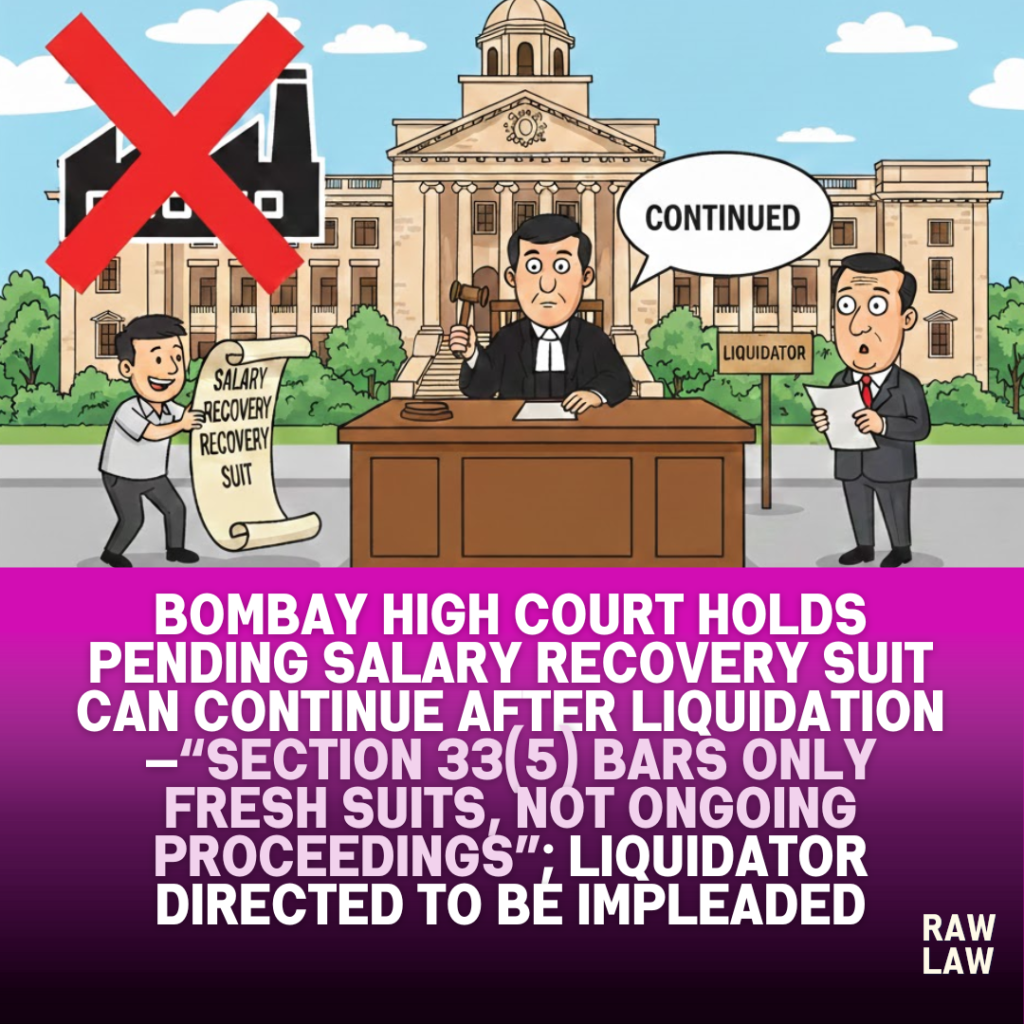
The Bombay High Court set aside an order of the City Civil Court, Mumbai, which had refused to implead the Official Liquidator in a pending salary recovery suit against a company that subsequently went into liquidation. The Court held that Section 33(5) of the Insolvency and Bankruptcy Code, 2016 bars only the institution of fresh suits after a liquidation order and does not prohibit the continuation of suits already filed prior to liquidation. It further ruled that there is no legal embargo on the liquidator being impleaded to defend such pending proceedings. The writ petition was allowed and the chamber summons for impleadment was made absolute.
Facts
The petitioner was a senior management professional who had been employed as Chief Operating Officer by a textile company. Alleging persistent irregularities in payment of salary and allowances, he resigned from service and claimed substantial unpaid dues. After partial payment of gratuity, the petitioner instituted a summary suit in 2017 before the City Civil Court, Mumbai, seeking recovery of unpaid salary and other contractual dues.
During the pendency of the suit, insolvency proceedings were initiated against the employer-company under the Insolvency and Bankruptcy Code. A moratorium was imposed, followed by an order of liquidation passed by the National Company Law Tribunal in 2019. Upon learning of the liquidation, the petitioner filed a chamber summons in the civil suit seeking impleadment of the Official Liquidator as a defendant. The trial court rejected this application, holding that civil court jurisdiction was barred under Section 63 of the IBC and that the petitioner must pursue his claim exclusively before the liquidator.
Issues
The principal issues before the High Court were whether a civil suit for recovery of unpaid salary, instituted prior to the liquidation order, could continue despite liquidation of the defendant-company, whether Section 33(5) of the IBC barred impleadment of the liquidator in such a pending suit, and whether the civil court’s jurisdiction was ousted by Section 63 of the IBC. An allied issue was whether the existence of a claims adjudication mechanism under Sections 38 to 42 of the IBC rendered the pending suit infructuous.
Petitioner’s arguments
The petitioner argued that the trial court had fundamentally misconstrued the scope of the IBC. It was submitted that Section 33(5) prohibits only the institution of new suits after liquidation and does not bar continuation of proceedings already instituted before the liquidation order. The petitioner contended that since the suit was filed in 2017—well before the insolvency and liquidation proceedings—the civil court retained jurisdiction.
It was further argued that if the liquidator is statutorily empowered to institute suits on behalf of the corporate debtor, there is no rational basis to prevent the liquidator from defending pending suits. Reliance was placed on multiple High Court decisions holding that Section 63 of the IBC does not apply to civil suits pending prior to liquidation and that impleadment of the liquidator is legally permissible.
Respondent’s arguments
The liquidator and the company opposed the writ petition, contending that once liquidation is ordered, all claims against the corporate debtor must be channelled through the liquidation process. It was argued that Sections 38 to 42 of the IBC provide a complete code for submission, verification, and adjudication of claims by the liquidator, rendering parallel civil proceedings impermissible.
The respondents further relied on Section 63 of the IBC to argue that civil courts are barred from entertaining matters falling within the jurisdiction of the NCLT. It was also contended that under Section 53 of the IBC, employee and workmen’s dues are accorded priority only for a limited statutory period, and therefore continuation of the suit served no purpose.
Analysis of the law
The High Court undertook a detailed analysis of the scheme of the Insolvency and Bankruptcy Code, particularly contrasting Section 14, which governs moratorium during the corporate insolvency resolution process, with Section 33(5), which applies after liquidation. The Court noted a critical legislative distinction: while Section 14 expressly bars institution and continuation of pending suits, Section 33(5) restricts itself only to institution of suits after liquidation.
The Court also examined Section 35(1)(k) of the IBC, which expressly empowers the liquidator to institute or defend any suit or legal proceeding on behalf of the corporate debtor. Read conjointly with Section 33(5), the provision clearly envisages the liquidator’s participation in pending litigation rather than its abatement.
Precedent analysis
The Court relied on consistent judicial precedent from various High Courts holding that pending proceedings are consciously excluded from the bar under Section 33(5) of the IBC. Earlier decisions had clarified that the objective of liquidation is maximisation of value rather than revival, and therefore the legislature did not intend to freeze all pending adjudicatory processes.
The Court also relied on authority holding that a consent order of the Supreme Court leaving a question of law open does not dilute the precedential value of a High Court judgment that has laid down a legal principle after adjudication. Accordingly, prior Bombay High Court rulings permitting impleadment of liquidators in pending proceedings continued to hold persuasive value.
Court’s reasoning
The High Court found that the trial court had erred in conflating the issue of impleadment with the broader question of maintainability of the suit. While deciding an application for amendment and impleadment, the trial court had prematurely ruled on jurisdiction and maintainability, contrary to settled principles governing procedural amendments.
On merits, the Court held that the petitioner’s suit for recovery of unpaid salary was not a matter falling within the exclusive jurisdiction of the NCLT. The existence of an alternative claims mechanism under the IBC did not automatically extinguish a civil suit that was validly instituted earlier. The Court also clarified that Section 53 of the IBC merely prescribes priority of distribution and does not obliterate substantive claims beyond the priority period.
Conclusion
The Bombay High Court concluded that there was no statutory bar to continuation of the pending salary recovery suit and no legal impediment to impleading the Official Liquidator as a defendant. The impugned order of the City Civil Court was set aside, the chamber summons was allowed, and the petitioner was permitted to amend the plaint to implead the liquidator within a stipulated period.
Implications
This judgment provides significant clarity on the interaction between civil court proceedings and liquidation under the Insolvency and Bankruptcy Code. It reinforces that liquidation does not automatically terminate or render infructuous suits instituted prior to liquidation. The ruling protects employees and other creditors who have already invoked civil remedies and ensures that procedural bars under the IBC are not expanded beyond legislative intent. It also affirms the liquidator’s role as a proper party to defend pending proceedings involving the corporate debtor.
Case law references
- Rajesh Kumar Agarwal v. K.K. Modi: Cited to reiterate that courts should not examine merits or maintainability while deciding applications for amendment or impleadment.
- Urban Infrastructure Trustees Ltd. v. Bhavik Bhimjiyani: Relied upon to hold that Section 33(5) read with Section 35(1)(k) permits impleadment of the liquidator in pending proceedings.
- Elecon Engineering Co. Ltd. v. Energo Engineering Projects Ltd.: Applied to affirm that Section 33(5) does not bar continuation of suits pending prior to liquidation.
- Chennai Metro Rail Ltd. v. Lanco Infratech Ltd.: Cited for the principle that pending proceedings are consciously excluded from the liquidation moratorium.
FAQs
1. Can a civil suit continue after a company goes into liquidation?
Yes. Suits instituted prior to the liquidation order can continue, as Section 33(5) of the IBC bars only fresh suits after liquidation.
2. Can the Official Liquidator be impleaded in a pending civil suit?
Yes. The liquidator can be impleaded to defend pending proceedings on behalf of the corporate debtor under Section 35(1)(k) of the IBC.
3. Does the IBC claims mechanism replace civil court proceedings?
No. The claims mechanism under Sections 38 to 42 of the IBC is an additional remedy and does not automatically extinguish or bar pending civil suits.