


Court’s decision
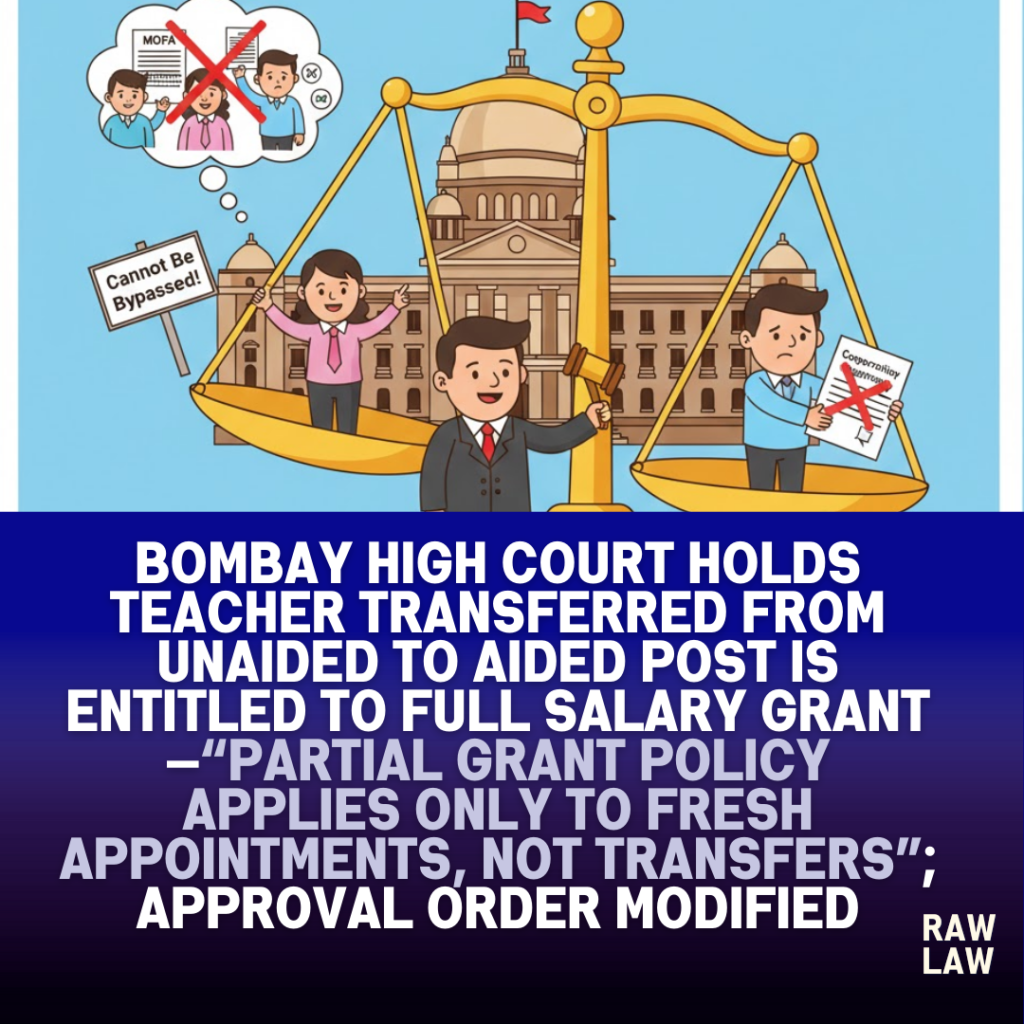
The Bombay High Court (Kolhapur Bench) allowed a writ petition filed by an Assistant Teacher and quashed the Deputy Director of Education’s order granting only staggered, partial salary grant after transfer to a fully aided post. The Court held that where a teacher is transferred from an unaided post to an already sanctioned and vacant fully aided post within the same management, such transfer is not a fresh appointment. Consequently, the policy of releasing salary grant in slabs of 20% per year under the Government Resolution dated 28 June 2016 is inapplicable. The Court directed grant of 100% salary from the date of transfer.
Facts
The petitioner possessed requisite qualifications of M.A. and B.Ed. and was appointed in June 2008 on a sanctioned but unaided post of Assistant Teacher in a secondary school run by a private management. His appointment was duly approved by the education authorities in July 2014.
In 2017, a fully aided post of Assistant Teacher fell vacant in a junior college run by the same management. Invoking Rule 41 of the Maharashtra Employees of Private Schools (Conditions of Service) Rules, 1981, the management transferred the petitioner from the unaided post to the aided post. A proposal seeking approval of the transfer was submitted to the Deputy Director of Education.
By an order dated 25 April 2018, the Deputy Director approved the transfer but sanctioned only 20% grant-in-aid from 1 July 2017. Later, by an order dated 23 August 2023, the authority revised the approval to provide incremental increase of grant by 20% each year, making it 100% only after completion of five years. Aggrieved by denial of full salary grant from the date of transfer, the petitioner approached the High Court.
Issues
The principal issue before the Court was whether a teacher transferred from an unaided post to a fully aided, already sanctioned post within the same management is entitled to 100% salary grant from the date of transfer. An allied issue was whether the State could apply the partial grant policy under the Government Resolution dated 28 June 2016 to such transfers, treating them on par with fresh appointments.
Petitioner’s arguments
The petitioner contended that his transfer was undisputedly legal, effected strictly under Rule 41 of the MEPS Rules, and approved by the education authorities. It was argued that he had already rendered nearly nine years of continuous service on an unaided post and that the aided post to which he was transferred was not a newly created post but an existing sanctioned vacancy.
It was submitted that once the transfer itself was found valid, there was no rational basis to deny full salary grant. The petitioner argued that the partial grant formula prescribed under the 2016 Government Resolution was meant only for fresh appointments against newly sanctioned aided posts and not for transfers of existing employees. Reliance was placed on earlier judgments of the High Court holding that such transfers do not constitute fresh appointments.
Respondent’s arguments
The State opposed the petition by relying upon the Government Resolution dated 28 June 2016, which lays down a policy for granting approval to transfers from unaided to aided posts subject to conditions. It was argued that the Resolution contemplates phased release of salary grant and authorises the education authorities to approve transfers with partial grant initially, increasing gradually over a period of years.
The Assistant Government Pleader submitted that the petitioner’s case should be tested strictly on the basis of the policy framework laid down by the State and that no automatic right to full salary grant could be claimed.
Analysis of the law
The Court analysed Rule 41 of the MEPS Rules, which governs transfers of employees within institutions run by the same management. The Rule expressly permits transfers on administrative grounds or at the request of the employee, subject to the condition that such transfer shall not adversely affect pay, pay scale, or pensionary benefits.
The Court also examined the Government Resolution dated 28 June 2016 and noted that Clause 3(5)(b) thereof prescribes a graded formula of salary grant only where teachers are appointed afresh against newly sanctioned aided posts. The Resolution does not override statutory rules framed under the MEPS Act and cannot be applied mechanically to situations not contemplated by it.
Precedent analysis
The Court relied heavily on earlier Division Bench judgments, particularly Sagar Harichandra Bhande v. State of Maharashtra and Sandip Dilip Thorat v. State of Maharashtra. These decisions consistently held that transfer of a teacher from an unaided post to an aided post within the same management is not a fresh appointment. They clarified that partial grant policies apply only when new aided posts are created and filled by fresh recruitment, and not when existing employees are transferred to fill sanctioned vacancies.
The Court reiterated that executive instructions or government resolutions cannot dilute rights flowing from statutory service rules.
Court’s reasoning
Applying the above principles, the Court held that the petitioner’s case squarely fell outside the scope of the partial grant policy. The aided post was already sanctioned and vacant, and the petitioner had long years of approved service on an unaided post under the same management. Treating such a transfer as a fresh appointment was legally unsustainable.
The Court observed that insisting on an undertaking from the petitioner to accept partial grant, despite his eligibility for full grant, was arbitrary and lacked rational justification. Such an approach would defeat the very object of Rule 41, which protects employees from loss of pay or service benefits upon transfer.
Conclusion
The Bombay High Court quashed the impugned order dated 23 August 2023 granting staggered salary approval. It directed the Deputy Director of Education to issue a fresh approval order within eight weeks, granting full salary grant to the petitioner from the date of his transfer to the fully aided post. The writ petition was accordingly allowed and the rule was made absolute.
Implications
This judgment reinforces a settled principle in service jurisprudence relating to private school teachers in Maharashtra: transfer from an unaided to an aided post within the same management does not amount to fresh appointment. The ruling limits the applicability of the State’s partial grant policy and provides relief to teachers who would otherwise suffer financial loss despite long years of approved service. It is likely to have significant impact on similarly placed teachers awaiting full salary grants after lawful transfers.
Case law references
- Sagar Harichandra Bhande v. State of Maharashtra: Held that transfer from unaided to aided post is not a fresh appointment and does not justify partial grant.
- Sandip Dilip Thorat v. State of Maharashtra: Reaffirmed that partial grant policy applies only to newly sanctioned aided posts filled by fresh recruitment.
FAQs
Is a teacher transferred from an unaided to an aided post entitled to full salary grant?
Yes. If the transfer is to an already sanctioned aided post within the same management, the teacher is entitled to 100% salary grant from the date of transfer.
Does the 2016 Government Resolution allow partial salary grant in all cases?
No. The partial grant formula applies only to fresh appointments against newly sanctioned aided posts, not to transfers under Rule 41 of the MEPS Rules.
Can a transfer under Rule 41 be treated as a fresh appointment?
No. Courts have consistently held that such transfers are not fresh appointments and cannot be subjected to conditions meant for new recruits.