


Court’s decision
The Bombay High Court allowed a first appeal under Section 30 of the Employees’ Compensation Act, 1923, and set aside the Labour Commissioner’s order rejecting compensation to the widow and minor children of a deceased driver.
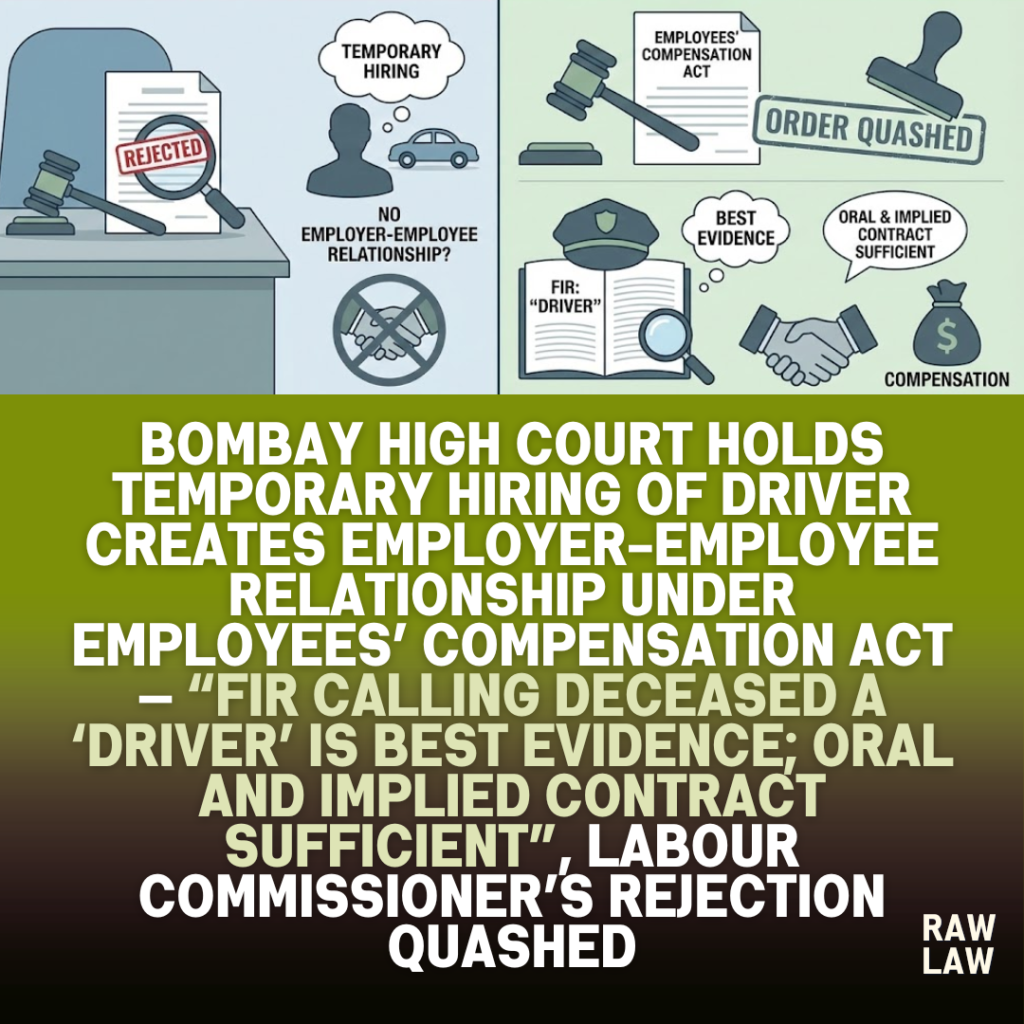
The Court held that temporary hiring of a driver for a short duration constitutes an employer-employee relationship within the meaning of Sections 2(dd) and 2(e) of the Act. Emphasising that the FIR lodged by the vehicle owner described the deceased as a “driver,” the Court ruled that oral and implied contracts are sufficient under welfare legislation. The matter was remitted for computation of compensation within eight weeks.
Facts
The appellants were the widow and minor children of a deceased driver who died in a road accident on 29 March 2009 while driving a Toyota Qualis owned by the first respondent. The vehicle was allegedly travelling to Rajasthan to attend a funeral.
It was undisputed that the deceased was driving the vehicle at the time of the accident and that the owner was also travelling in the same vehicle and sustained injuries.
A claim under the Employees’ Compensation Act was filed before the Labour Commissioner, asserting that the deceased had been hired by the vehicle owner as a driver for the journey. The claim was rejected on 9 May 2012 on the ground that employer-employee relationship was not established.
Issues
The substantial question of law framed by the High Court was whether the Labour Commissioner was justified in rejecting the compensation claim on the ground that the relationship of employer and employee between the deceased and the vehicle owner was not proved.
The case required interpretation of the definitions of “employee” under Section 2(dd), “employer” under Section 2(e), and Schedule II (xxv) of the Employees’ Compensation Act.
Appellants’ arguments
The appellants relied heavily on the FIR lodged by the vehicle owner immediately after the accident. In the statement recorded under Section 154 CrPC, the owner referred to the deceased as a “driver” and explained that he had requested him to drive the vehicle for the journey.
It was argued that the deceased was neither a relative nor a friend of the owner, and therefore the only reasonable inference was that he was hired as a driver. The appellants contended that temporary hiring constitutes recruitment as a driver under Section 2(dd), and no written contract is necessary.
Judicial precedents were cited to show that even casual or short-term employment falls within the ambit of the Act.
Insurance company’s arguments
The insurer opposed the appeal, contending that the applicants failed to prove employer-employee relationship. It was argued that no documentary evidence or written contract was produced to establish employment.
The insurer also suggested that the claim was filed under the Employees’ Compensation Act only because compensation may not have been available before the Motor Accident Claims Tribunal due to alleged negligence of the deceased.
It was submitted that the burden of proof lay on the claimants and that the Labour Commissioner rightly rejected the claim for lack of evidence.
Analysis of the law
The Court reproduced Sections 2(dd) and 2(e) of the Act and emphasised that the definition of “employee” expressly includes a person recruited as a driver in connection with a motor vehicle. Section 2(dd)(iii) clarifies that the contract of employment may be express or implied, oral or in writing.
The Court observed that welfare legislation must be interpreted purposively. It noted that in cases of individual hiring, especially for short durations, written contracts are rarely executed.
The expression “recruited as driver” and “employed as a driver” focus on the nature of work performed rather than the duration of engagement. Even short-term hiring creates employer-employee relationship if the driver renders services under the control of the owner.
Precedent analysis
The Court relied on precedents including K. Saraswathi v. S. Narayanaswamy, where employment of a substitute driver for a short duration was held sufficient to establish workman status.
It also referred to New India Assurance Co. Ltd. v. Mohan Kumar Sahoo, where the Orissa High Court held that even casual engagement does not exclude a person from the definition of “workman” if the work was performed for the employer’s business.
The Court noted that the present Act is broader in scope than the earlier Workmen’s Compensation Act and does not exclude casual workers.
Court’s reasoning
The High Court found significant that the vehicle owner, in his FIR statement, described the deceased as a “driver” and detailed the circumstances of hiring him for the journey. The FIR was treated as the best contemporaneous evidence.
The owner’s failure to reply to the legal notice and his later denial of relationship were viewed as contradictory conduct aimed at evading liability.
The Court criticised the Labour Commissioner for not exercising powers under Section 23 of the Act to summon the vehicle owner and clarify contradictions. It held that the Commissioner failed to appreciate documentary evidence such as the FIR and site inspection report.
Considering that the deceased was not a relative, was driving the owner’s vehicle, and was described as a driver in official records, the Court concluded that employer-employee relationship stood established.
Conclusion
The Bombay High Court allowed the appeal, quashed the Labour Commissioner’s order dated 9 May 2012, and held that the deceased was an employee under the Act.
The Court directed the Labour Commissioner to compute compensation within eight weeks from the applicants’ application enclosing the order. The judgment clarified that it was rendered in the peculiar facts of the case.
Implications
This ruling significantly expands protection under the Employees’ Compensation Act by clarifying that temporary or short-term hiring of a driver constitutes employment.
It underscores that oral and implied contracts suffice under welfare legislation and that strict evidentiary standards cannot defeat legitimate claims.
The judgment also emphasises the proactive role of adjudicatory authorities in welfare statutes, requiring them to exercise powers to uncover truth rather than mechanically reject claims for lack of formal documentation.
Case Law References
- K. Saraswathi v. S. Narayanaswamy (97 L.W. 418) – Casual or substitute driver can qualify as workman; police statement relevant.
- New India Assurance Co. Ltd. v. Mohan Kumar Sahoo (2003 (4) L.L.N. 634) – Casual engagement does not exclude employee status if work performed for employer.
- Mahendra Shah v. Baldev Singh (2011 SCC OnLine Raj 2775) – Daily wage employment falls within definition of workman.
These precedents were applied to conclude that employer-employee relationship existed in the present case.
FAQs
1. Does temporary hiring of a driver create employer-employee relationship?
Yes. The Bombay High Court has held that even short-term hiring of a driver constitutes employment under the Employees’ Compensation Act.
2. Is a written contract necessary to prove employment under the Act?
No. The Act recognises oral and implied contracts. Nature of work and surrounding circumstances are sufficient.
3. Can compensation be claimed under the Employees’ Compensation Act instead of MACT?
Yes. If the claim falls within the scope of the Act and no statutory bar applies, claimants may elect the appropriate forum.