


1. Court’s decision
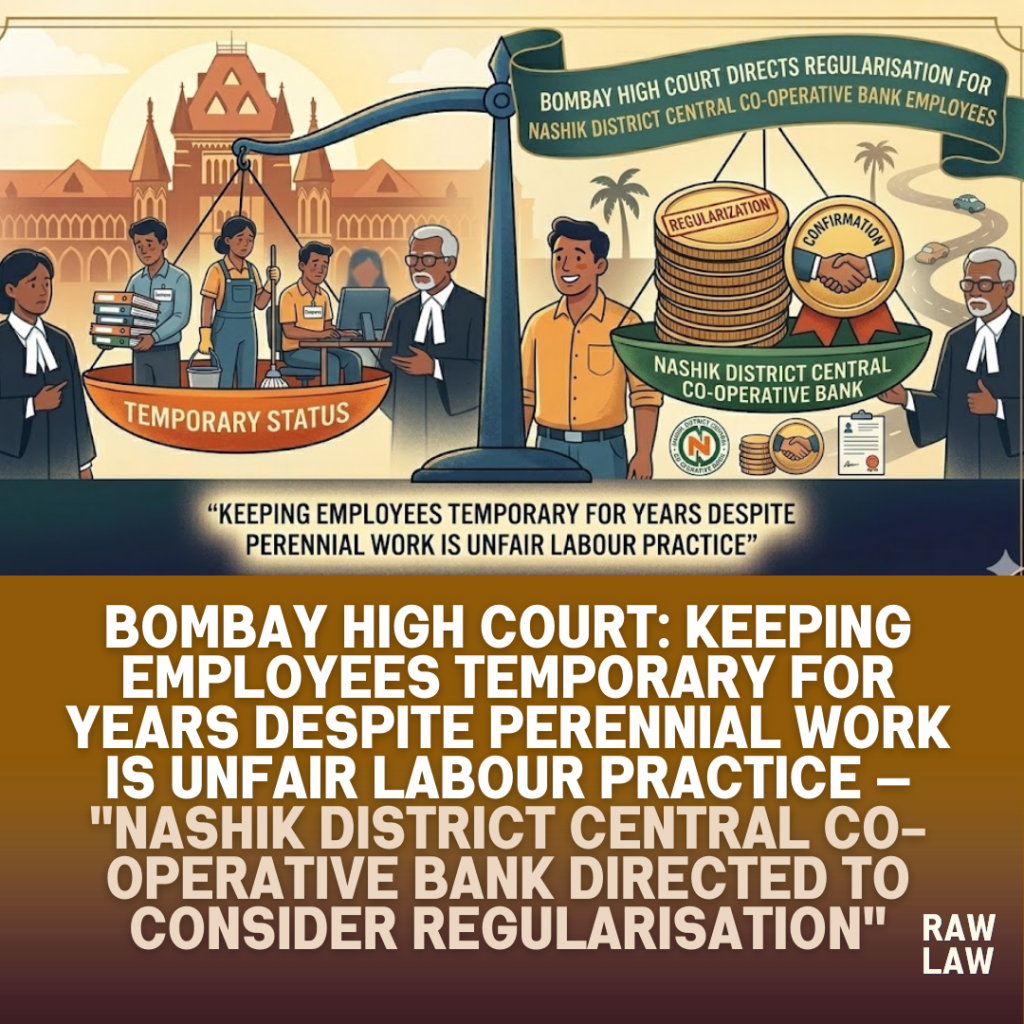
The Bombay High Court set aside the Industrial Court’s decision dismissing complaints filed by temporary employees of the Nashik District Central Co‑operative Bank Ltd.
The Court concluded that the employer’s practice of continuing employees on temporary status for prolonged periods while extracting work of permanent nature amounted to unfair labour practice.
Invoking powers under labour law, the Court directed the bank to undertake an exercise to regularise eligible petitioners against vacant posts, subject to verification of their qualifications and service records.
2. Facts
The petitioners were employees working as clerks and peons in the respondent bank. They approached the Industrial Court alleging unfair labour practices under the Maharashtra Recognition of Trade Unions and Prevention of Unfair Labour Practices Act, 1971.
According to the employees, they had been appointed against vacant posts and had worked continuously for more than ten years. Despite performing duties identical to permanent employees, they were paid only consolidated wages and denied benefits such as dearness allowance, leave entitlements, and promotional opportunities.
The Industrial Court dismissed their complaints solely on the ground that the bank’s staffing pattern had not received approval from competent authorities. Aggrieved by that finding, the petitioners approached the High Court.
3. Issues
The High Court considered several important legal questions.
First, whether continuing employees on temporary status for long periods while extracting work of permanent nature constituted unfair labour practice.
Second, whether the absence of formal approval of a staffing pattern could justify denial of permanency.
Third, whether the Industrial Court had correctly applied the law governing unfair labour practices under the MRTU and PULP Act.
4. Petitioner’s arguments
The petitioners argued that they had been working continuously for several years and possessed the qualifications required for the posts they held.
They contended that provident fund contributions were deducted regularly, demonstrating a continuous employer-employee relationship.
The petitioners further submitted that despite performing the same work as permanent employees, they were paid consolidated wages and denied allowances, leave benefits, and promotional opportunities.
They argued that the bank’s own admissions showed that their work was perennial and that hundreds of permanent posts had fallen vacant due to retirement and other reasons.
According to them, keeping employees temporary for years together was a deliberate strategy to deny them permanency and constituted unfair labour practice.
5. Respondent’s arguments
The bank argued that the petitioners were appointed purely on temporary basis due to acute shortage of manpower.
It submitted that many permanent employees had left service after 2005, creating a manpower deficit, and temporary appointments were made only to ensure continuity of banking operations.
The bank contended that permanent recruitment could not be undertaken because the proposed staffing pattern had not yet been approved by the government.
It also relied on communications issued by the National Bank for Agriculture and Rural Development and regulatory guidelines governing recruitment policies for cooperative banks.
According to the bank, the absence of sanctioned posts legally prevented it from granting permanency to the petitioners.
6. Analysis of the law
The Court examined the statutory framework governing cooperative banks and labour relations.
It analysed the supervisory powers of NABARD under the Banking Regulation Act, 1949 and concluded that communications issued during inspections are generally advisory unless supported by statutory rule-making authority.
The Court also considered Section 79A of the Maharashtra Co‑operative Societies Act, 1960, which empowers the State Government to issue binding directions to cooperative societies in matters of public interest or management.
The Court observed that no statutory order under this provision had been produced showing that the bank was legally barred from undertaking staffing decisions.
7. Precedent analysis
The Court relied on the principles laid down by the Supreme Court of India in Casteribe Rajya Parivahan Karmachari Sanghatana v. Maharashtra State Road Transport Corporation.
In that decision, the Supreme Court held that when an employer keeps workers on temporary status for long periods despite the existence of permanent work, the Industrial Court may grant appropriate relief under the MRTU and PULP Act.
The High Court applied this principle to determine whether the employer’s conduct constituted unfair labour practice.
8. Court’s reasoning
The Court emphasised several undisputed facts emerging from the record.
First, the bank admitted that the work performed by the petitioners was perennial and necessary for its day-to-day operations.
Second, the petitioners had worked continuously for long periods without termination.
Third, the bank itself acknowledged severe staff shortages and submitted proposals seeking approval for a staffing pattern involving approximately 1934 posts.
These circumstances showed that the petitioners were performing work that was both permanent and necessary for the functioning of the institution.
The Court held that merely labeling employees as temporary could not justify denial of permanency where the underlying employment relationship reflected continuous and essential service.
9. Conclusion
The High Court concluded that the Industrial Court had erred in dismissing the complaints without examining the broader factual and legal context.
It held that the bank had engaged in unfair labour practices under Items 5 and 6 of Schedule IV of the MRTU and PULP Act by continuing employees as temporary workers for prolonged periods despite the existence of permanent work.
The Court therefore quashed the Industrial Court’s award and directed the bank to initiate the process of regularisation of eligible petitioners against available vacancies.
10. Implications
The judgment reinforces the principle that employers cannot indefinitely maintain employees on temporary status while assigning them permanent duties.
It clarifies that absence of formal staffing approvals does not automatically justify denial of permanency when the employer itself admits existence of vacancies and continuous work.
The ruling also highlights the power of Industrial Courts under the MRTU and PULP Act to intervene where employers adopt practices intended to deprive workers of legitimate employment benefits.
Case Law References
- Casteribe Rajya Parivahan Karmachari Sanghatana v. Maharashtra State Road Transport Corporation (2009): The Supreme Court held that where an employer keeps workers temporary for years while assigning them permanent work, it may amount to unfair labour practice and Industrial Courts can grant relief.
FAQs
1. What constitutes unfair labour practice under the MRTU and PULP Act?
Unfair labour practice includes acts such as keeping employees on temporary status for long periods with the objective of denying them permanency or equal benefits.
2. Can employees claim permanency if they have worked for many years?
Long service alone does not automatically grant permanency. However, courts may grant relief if the employer deliberately continues temporary employment despite the existence of permanent work and vacancies.
3. Are NABARD guidelines binding on cooperative banks regarding staffing?
NABARD communications issued during supervisory processes are generally advisory unless supported by statutory authority or incorporated into binding regulations.