


Court’s Decision
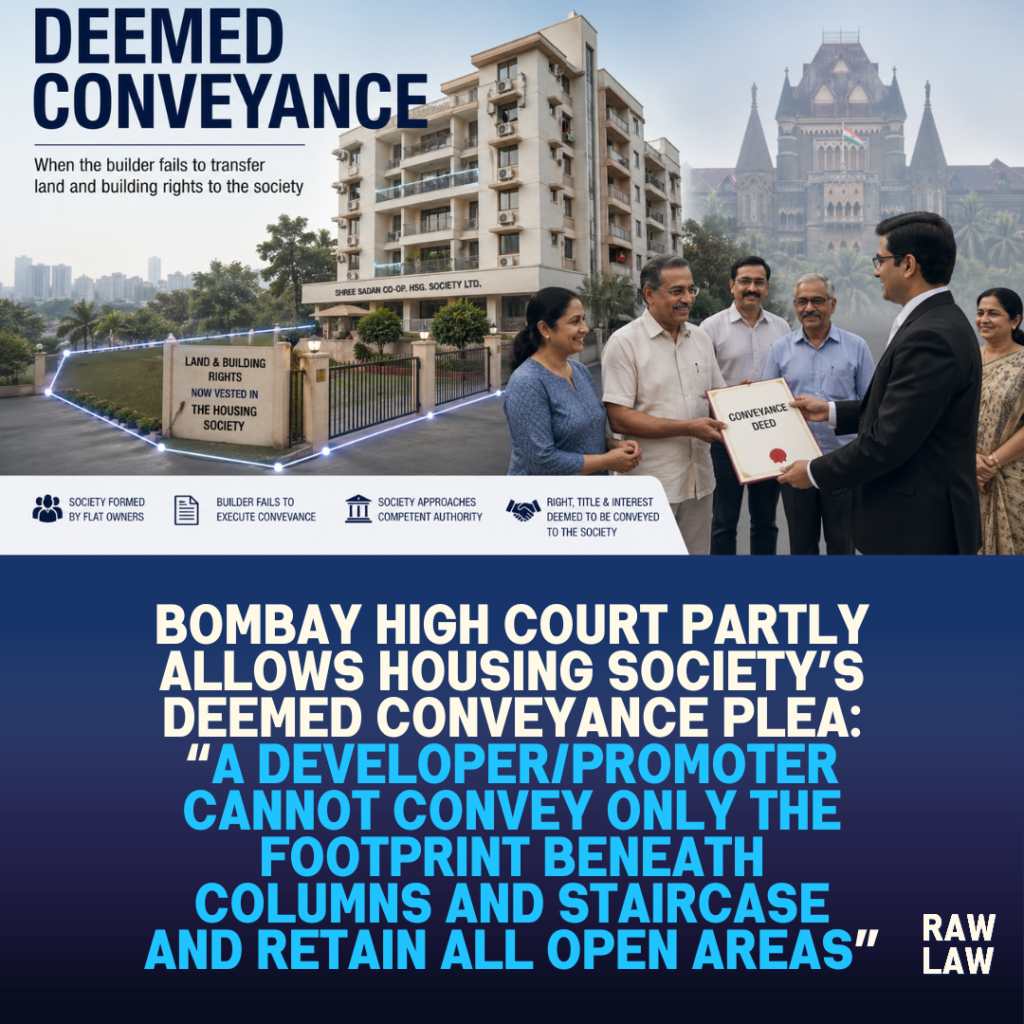
The Bombay High Court partly allowed the writ petition filed by a co-operative housing society challenging the order dated 8 July 2025 passed by the District Deputy Registrar / Competent Authority, Thane, rejecting its application for deemed conveyance. The Court quashed the impugned order and declared that the society is entitled to deemed conveyance under Section 11 of the Maharashtra Ownership Flats Act, 1963 read with the Government Resolution dated 22 June 2018.
The Court determined the society’s entitlement as follows:
| Component | Area |
|---|---|
| Exact Plinth Area | 1151.56 sq. mtrs. |
| Exact Appurtenant Area | 1050.00 sq. mtrs. |
| Total Exclusive Conveyable Area | 2201.56 sq. mtrs. |
| Undivided Proportionate Right in Common Recreational Ground | 703.62 sq. mtrs. |
The Competent Authority was directed to issue a fresh certificate of deemed conveyance within 8 weeks, incorporating the above areas, survey numbers, hissa numbers, layout particulars and municipal plan references.
Facts
The petitioner society was a registered co-operative housing society whose building was constructed by the developer on land forming part of a larger layout at Bhayandar. The larger property consisted of several parcels of land, and the layout had been sanctioned by the municipal corporation. The occupation certificate for the society’s building was issued on 2 December 2013, and the society was formed on 1 December 2015.
According to the society, despite its formation, the promoter / developer failed to execute conveyance in its favour. The society therefore initiated proceedings for deemed conveyance. It obtained survey reports, architect certificates, issued legal notice, and thereafter filed an application before the competent authority for deemed conveyance. Initially, the competent authority granted conveyance only to the extent of plinth area. That order was challenged before the High Court, which remanded the matter for fresh consideration in accordance with the Government Resolution dated 22 June 2018.
After remand, the society produced fresh architect certificates and sought conveyance not merely of the plinth area, but also appurtenant area and proportionate rights in common recreational ground. However, by the impugned order dated 8 July 2025, the competent authority rejected the application for deemed conveyance, which led to the present writ petition.
Issues
The Court identified three principal issues:
- What is the scope of “appurtenant area” under MOFA, building bye-laws and the 2018 Government Resolution?
- In a layout where TDR is loaded, should the society’s land share be computed by plinth area alone or by a wider proportionate FSI / built-up area formula?
- Whether the society is entitled to a share in the layout’s recreational ground, and if yes, to what extent?
Petitioner Society’s Arguments
The society argued that the earlier remand order required the competent authority to freshly decide its deemed conveyance application in light of the Government Resolution dated 22 June 2018. The society submitted that the said Government Resolution recognised entitlement not merely to the plinth area but also to appurtenant area, open spaces, common services, common facilities and access roads.
The society further contended that the developer had obtained revised sanctioned plans during 2018-2019 without the society’s consent and in breach of the requirement of consent of two-thirds allottees under MahaRERA. According to the society, once it was formed, the developer had a statutory obligation under MOFA to execute conveyance in its favour and could not rely upon a future federal society or apex body concept to avoid conveyance.
The society relied upon its architect certificate to claim a larger entitlement, including 3987.16 sq. mtrs. towards land entitlement and 703.62 sq. mtrs. towards proportionate recreational ground rights. It argued that restricting conveyance to a smaller area would seriously affect its ownership rights and future redevelopment potential.
Respondents’ Arguments
The developer and related respondents argued that “appurtenant area” must be understood narrowly. According to them, appurtenant area means only such area which is functionally necessary for the use and enjoyment of the building, such as marginal open spaces required under planning regulations. They submitted that appurtenant area cannot include large common open spaces, recreational grounds or layout amenities meant for all occupants.
They argued that appurtenant area must be building-specific, contiguous, ancillary to the main building, and necessary for light, air, access, ventilation and fire safety. According to them, common areas such as gardens, clubhouses, playgrounds, gymnasiums and other layout-level amenities are different from appurtenant area and vest collectively in all owners in the layout.
The respondents relied upon their architect’s certificate stating that, as per the sanctioned plan dated 29 March 2019, the plinth area of the society’s building was 1151.56 sq. mtrs. and the appurtenant land area was 1050.00 sq. mtrs., aggregating to 2201.56 sq. mtrs. They contended that this was the appropriate area to be conveyed exclusively to the society.
Analysis of the Law
The Court examined the matter in the context of MOFA, the applicable development control regulations, sanctioned plans, open spaces, setbacks, access, amenities and the Government Resolution dated 22 June 2018.
The Court observed that MOFA is a welfare legislation enacted to protect flat purchasers against promoters who sell flats, collect consideration, but retain ownership of land and common areas indefinitely. Therefore, MOFA must be interpreted in favour of protecting the legitimate rights of flat purchasers rather than permitting methods by which conveyance is delayed.
The Court held that Section 11(1) of MOFA requires the promoter to convey the right, title and interest in the land and building in favour of the society. The words “right, title and interest in land and building” are wide and cannot be reduced to transfer of only the superstructure standing upon the land.
The Court made an important observation:
“A promoter cannot convey only the footprint beneath columns and staircase and retain all open areas despite those open areas being mandatory under building rules.”
The Court reasoned that if setbacks, access width, recreational reservations or ventilation distances were necessary for sanctioning the building and obtaining occupation certificate, the promoter cannot later treat such areas as his own inalienable right.
Court’s Reasoning On Appurtenant Area
The Court clarified that appurtenant land does not mean unlimited surrounding land. Its meaning depends on purpose, user, sanctioned layout, planning norms and factual necessity. It may include compulsory marginal open spaces, access roads, passages, fire tender movement areas, utility strips, parking areas if earmarked, gardens or amenities linked with building use, and other areas intended for occupants of that building or group of buildings.
At the same time, the Court accepted that every open land around a building does not become appurtenant. A society may prefer larger grounds or wider spaces, but appurtenant area must have functional connection with the beneficial enjoyment of the building.
The Court held that appurtenant area is a fact-based determination depending upon sanctioned plans, building regulations, actual use, access, parking, fire safety, ventilation, utility areas and layout structure. No abstract formula can decide the issue.
Court’s Reasoning On Proportionate Share Formula
The Court noted that the earlier remand was specifically because the competent authority had not properly determined plinth area and appurtenant area separately. The Government Resolution dated 22 June 2018, particularly in TDR-loaded layouts, requires consideration of plinth area and appurtenant area as distinct components.
The society’s architect certificate used a proportionate share formula based on the built-up area of the society’s building compared with the total built-up area of the entire layout. This resulted in a claimed land share of 3987.16 sq. mtrs. However, the Court held that this figure was not the actual plinth area. It was merely a proportionate land share derived by formula.
The Court held that in property and planning law, plinth area ordinarily means the area covered by the building at ground level, namely its sanctioned footprint. Therefore, the figure of 3987.16 sq. mtrs. could not be accepted as plinth area. Instead, the Court accepted the respondents’ architect certificate, which specifically identified the plinth area as 1151.56 sq. mtrs. and appurtenant area as 1050.00 sq. mtrs. based on the sanctioned plan dated 29 March 2019.
Accordingly, the Court determined:
- Plinth Area: 1151.56 sq. mtrs.
- Appurtenant Area: 1050.00 sq. mtrs.
- Total Exclusive Conveyable Area: 2201.56 sq. mtrs.
Court’s Reasoning On Recreational Ground
The Court then considered the society’s claim to proportionate rights in the Recreational Ground. The society’s architect certificate showed total RG area of 3519.74 sq. mtrs. and the society’s proportionate share as 703.62 sq. mtrs. The respondents had not placed any contrary RG computation before the Court.
The Court clarified that the society cannot receive exclusive possession of 703.62 sq. mtrs. of the Recreational Ground because RG is a common amenity area in a layout. However, the society cannot be denied beneficial participation in the RG. Therefore, the Court held that the society is entitled to an undivided proportionate right in the common RG area to the extent of 703.62 sq. mtrs.
Precedent Analysis
The respondents relied upon judgments such as Maharaj Singh v. State of Uttar Pradesh, Larsen & Toubro Limited v. Trustees of Dharmamurthy Rao Bahadur Calavala Cunnan Chetty’s Charities, State of U.P. v. L.J. Johnson, Marathon Era Co-operative Housing Society Ltd. v. Competent Authority, Property Owners Association v. State of Maharashtra, and Commissioner of Income Tax, A.P. v. Rishi Raj Jain.
The Court accepted the broad principle emerging from these authorities that appurtenant area must be determined factually, with reference to functional dependence, actual use, sanctioned plans, planning regulations and the nature of the land. However, the Court refused to reduce appurtenant area to only the building footprint or a narrow technical reading that would defeat MOFA’s protective purpose.
Court’s Ultimate Holding
The Court partly allowed the writ petition and passed the following operative directions:
- The order dated 8 July 2025 passed by the competent authority was quashed and set aside.
- The society was declared entitled to deemed conveyance under Section 11 of MOFA read with the Government Resolution dated 22 June 2018.
- The society’s entitlement was determined as:
- Plinth Area: 1151.56 sq. mtrs.
- Appurtenant Area: 1050.00 sq. mtrs.
- Total Exclusive Conveyable Area: 2201.56 sq. mtrs.
- Undivided proportionate right in common RG area: 703.62 sq. mtrs.
- The RG right was clarified to be an undivided beneficial right and not exclusive possession over any demarcated portion.
- The competent authority was directed to issue a fresh deemed conveyance certificate within 8 weeks.
- The developer and related respondents were directed to cooperate and furnish title documents, sanctioned plans and revenue particulars within 2 weeks.
- If they failed to cooperate, the competent authority was directed to proceed in accordance with law without waiting for their consent.
Conclusion
The Bombay High Court reaffirmed that deemed conveyance under MOFA cannot be reduced to a narrow transfer of only the building footprint. A society’s entitlement includes the building’s plinth, appurtenant area necessary for beneficial enjoyment, and proportionate undivided rights in common amenities such as recreational ground.
At the same time, the Court carefully distinguished between exclusive conveyable area and common layout amenities. The society was granted exclusive conveyance over 2201.56 sq. mtrs., while its 703.62 sq. mtrs. RG entitlement was recognised only as an undivided proportionate beneficial right, not exclusive possession.
RAW LAW Takeaway
Deemed conveyance is not just about transferring the building standing on the land. It must include the land and rights necessary for the society to meaningfully enjoy, maintain and redevelop its property.
A promoter cannot retain mandatory open spaces and layout benefits after selling flats and forming a society. However, common recreational areas in a larger layout belong beneficially to all entitled occupants and cannot be exclusively claimed by one society unless the sanctioned plan or law permits it.
Also Read: Bombay High Court Refuses To Stall Redevelopment Of 70-Year-Old Wadala Society Buildings, Holds Developer Who Did Not “Move Even A Single Brick” In 13 Years Cannot Block Members’ Right To Safer Homes; Sole Arbitrator Appointed