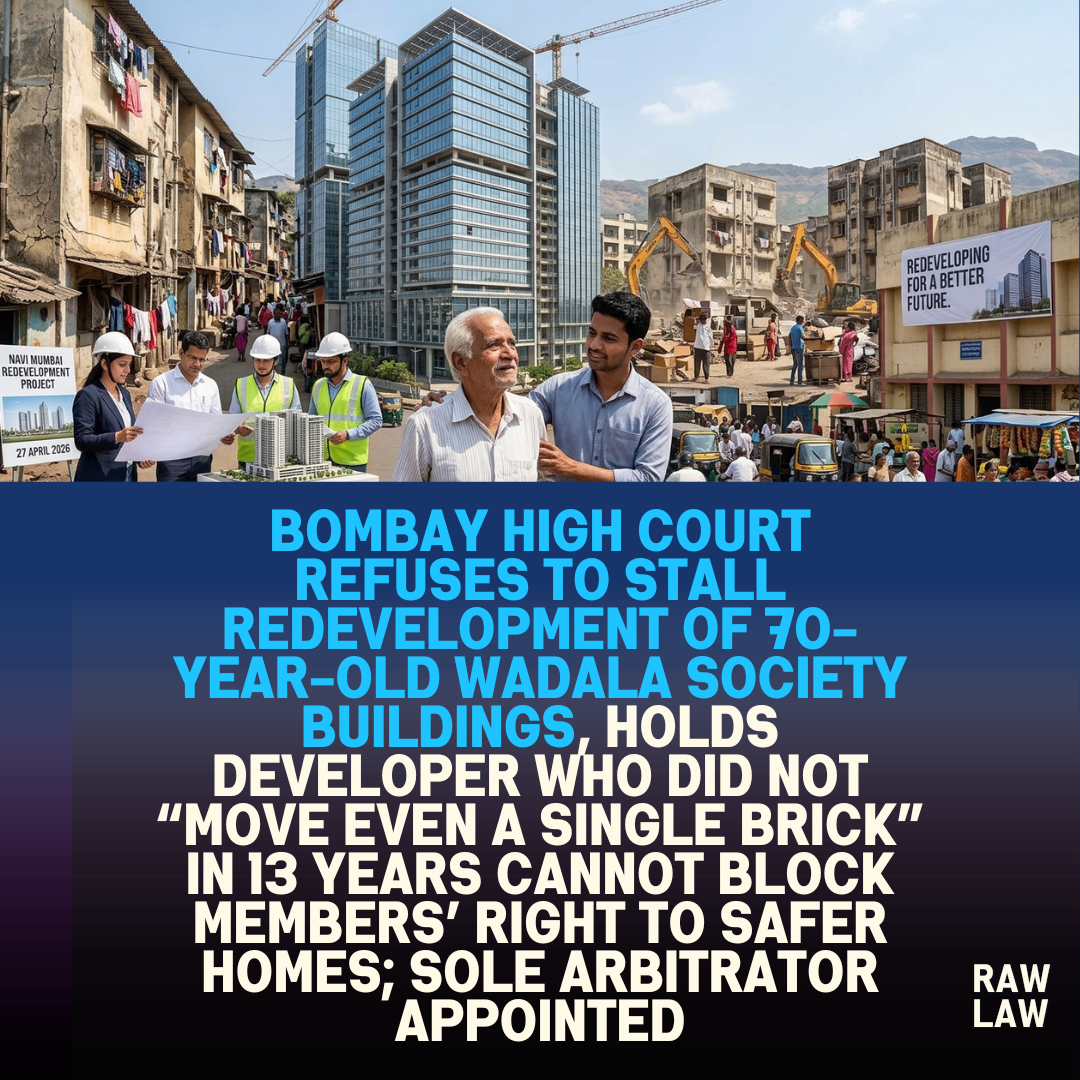
Bombay High Court Refuses To Stall Redevelopment Of 70-Year-Old Wadala Society Buildings, Holds Developer Who Did Not “Move Even A Single Brick” In 13 Years Cannot Block Members’ Right To Safer Homes; Sole Arbitrator Appointed

Court’s Decision
The Bombay High Court dismissed the Section 9 petition filed by the developer seeking interim protection against the housing society from proceeding with a new developer for redevelopment. The Court held that no case was made out for interim measures in favour of the developer, especially when the redevelopment project had not commenced despite nearly 13 years having passed since the developer’s appointment.
However, in the connected Section 11 application, the Court appointed a sole arbitrator to adjudicate disputes arising out of the development agreements between the parties.
Facts
The respondent society consisted of 826 residential premises, 19 shops and 24 stalls spread across 46 buildings at Wadala, Mumbai. The buildings were constructed in 1957 and had become old and dilapidated.
The society had initially selected the petitioner as developer in 2013. A development agreement was executed in 2015, followed by a second development agreement in 2016 after renegotiation of terms. The developer claimed that the project was delayed due to changes in development regulations, litigation by members, and the COVID-19 pandemic.
The society, however, alleged that despite being appointed in 2013, the developer had taken no meaningful steps for 13 years. The society had earlier terminated the developer’s appointment in 2023, later withdrew the termination in 2024, and thereafter again resolved in its AGM dated 30 September 2024 to terminate the developer. The society then proceeded to appoint a new developer in January 2026 and scheduled a Special General Body Meeting on 23 April 2026 to finalise the draft development agreement with the new developer.
The developer approached the High Court under Section 9 of the Arbitration and Conciliation Act, 1996, seeking to restrain the society from acting on the resolution appointing the new developer and from executing any development agreement with the new developer.
Issues
The main issues before the Court were:
- Whether the developer was entitled to interim protection restraining the society from proceeding with a new developer.
- Whether the society could proceed with another developer when disputes arising from the development agreement were yet to be adjudicated.
- Whether the delay of 13 years in commencing redevelopment disentitled the developer from seeking interim measures.
- Whether the rights of the developer to earn profits under a redevelopment agreement could override the rights of society members to safer and better housing.
Petitioner’s Arguments
The developer argued that the society could not appoint a new developer without validly terminating its appointment. It was submitted that the earlier termination had been withdrawn by the society in April 2024, and thereafter no valid cause arose for again terminating the appointment.
The developer further argued that under the development agreement, the society was required to obtain 70% individual consents from members, and only thereafter could the developer approach the municipal authority for necessary permissions. According to the developer, the delay was therefore attributable to the society and not to the developer.
It was also argued that there was no termination clause in the development agreement, and therefore the society could not unilaterally terminate the agreement without approaching the Court.
Respondent Society’s Arguments
The society opposed the petition and argued that the developer had grossly delayed the redevelopment project. It was submitted that despite being appointed in 2013, the developer had done almost nothing for 13 years and had not incurred any substantial expenditure apart from paying earnest money of Rs. 1 crore.
The society contended that its members were residing in extremely old and dilapidated buildings and could not be forced to wait indefinitely. It was further submitted that the developer’s appointment had been terminated by the General Body, and the NOC obtained by the developer from the Divisional Joint Registrar had already been set aside by the Minister in revision.
The society argued that the developer was trying to keep the redevelopment project trapped in litigation and that the society should be permitted to proceed with redevelopment through another developer.
Analysis of the Law
The Court noted that there was an arbitration clause in the 2016 development agreement and therefore the disputes could be referred to arbitration. However, the existence of an arbitration agreement did not automatically entitle the developer to interim protection under Section 9.
The Court examined the conduct of the developer and found that the redevelopment process had not commenced even after 13 years. The buildings were nearly 70 years old, and the Court emphasised that the rights of members to live in safe and better homes were far more important than the developer’s commercial interest in earning profits from the project.
The Court also held that the developer’s reliance on the absence of 70% consent letters did not inspire confidence at the interim stage. The Court observed that the developer had not written any clear communication to the society stating that it was unable to proceed only because of absence of consent letters.
The Court further noted that before the Minister, the developer had given a different explanation for delay, namely the ill health of one of its partners, rather than the alleged absence of member consents.
Court’s Reasoning
The Court found that the developer had not approached the Court with sufficient promptness. The developer had knowledge of the society’s termination decision and also knew that the society was proceeding with a new developer, yet the Section 9 petition was filed only at the last stage, just before the SGBM for finalising the draft development agreement.
The Court also criticised the developer for relying upon the NOC dated 1 April 2025 granted by the Divisional Joint Registrar, while suppressing the fact that the said NOC had already been set aside by the Minister on 17 December 2025.
The Court made a strong observation on the developer’s conduct:
“He has not moved even a single brick.”
The Court further observed that the project appeared to be treated by the developer only as a business venture and that the developer’s negotiations with other entities suggested possible incapability to complete the redevelopment project.
Most importantly, the Court held that when the rights of society members to reside in safer and better homes are pitted against the developer’s right to earn profits, the former must prevail.
Precedent Analysis
The developer relied on the Supreme Court judgment in K.S. Majunath, arguing that unilateral termination of a non-determinable agreement was impermissible. The Court held that the said judgment dealt with an agreement for sale of immovable property and would not apply to redevelopment agreements in the same manner.
The Court distinguished development agreements from agreements for sale, observing that a developer does not become owner of the land. The developer’s right to sell sale-component flats arises only after fulfilling obligations towards society members.
The Court relied on redevelopment jurisprudence of the Bombay High Court, including:
- SSD Escatics Pvt. Ltd. v. Goregaon Pearl Housing Society Ltd.
Relied upon to hold that a developer’s right to profit remains imperfect unless it fulfils its primary obligation of rehousing members. - Huges Real Estate Developers LLP v. Khernagar Adarsh Co-operative Housing Society Ltd.
Relied upon for the principle that the rights of a developer to earn profits remain subservient to the society’s right to have its building reconstructed. - Ison Builders LLP v. Om Sai Ram Co-operative Housing Society
Relied upon to reiterate that old and dilapidated buildings should not remain trapped in litigation where the developer has failed to progress redevelopment. - Borivali Anamika Niwas CHSL v. Aditya Developers, Rajawadi Arundaya CHSL v. Value Project Pvt. Ltd., and Swashray CHSL v. Shanti Enterprises
Referred to in support of the principle that redevelopment should not be indefinitely stalled where society members are suffering due to delay.
Court’s Ultimate Holding
The Court held that all three requirements for interim relief, namely prima facie case, balance of convenience and irreparable loss, were against the developer and in favour of the society.
The Court refused to restrain the society from proceeding with the new developer. The Section 9 petition was disposed of without granting any relief.
In the connected Section 11 application, the Court appointed Advocate Amrut Joshi as the sole arbitrator to decide disputes arising out of the development agreement dated 22 June 2015 as amended by the development agreement dated 22 April 2016.
After pronouncement of judgment, the developer sought continuation of the earlier interim arrangement for one week. The Court rejected the request, considering the findings recorded in the judgment.
Conclusion
The Bombay High Court refused to allow a developer to stall redevelopment after 13 years of inaction, particularly where hundreds of society members were residing in buildings constructed in 1957. The Court clarified that in redevelopment disputes, the developer’s commercial interest cannot override the housing society members’ right to safe and better housing.
At the same time, the Court preserved the contractual dispute by appointing an arbitrator, leaving the developer free to pursue monetary or other claims before the arbitral tribunal.