


Court’s decision
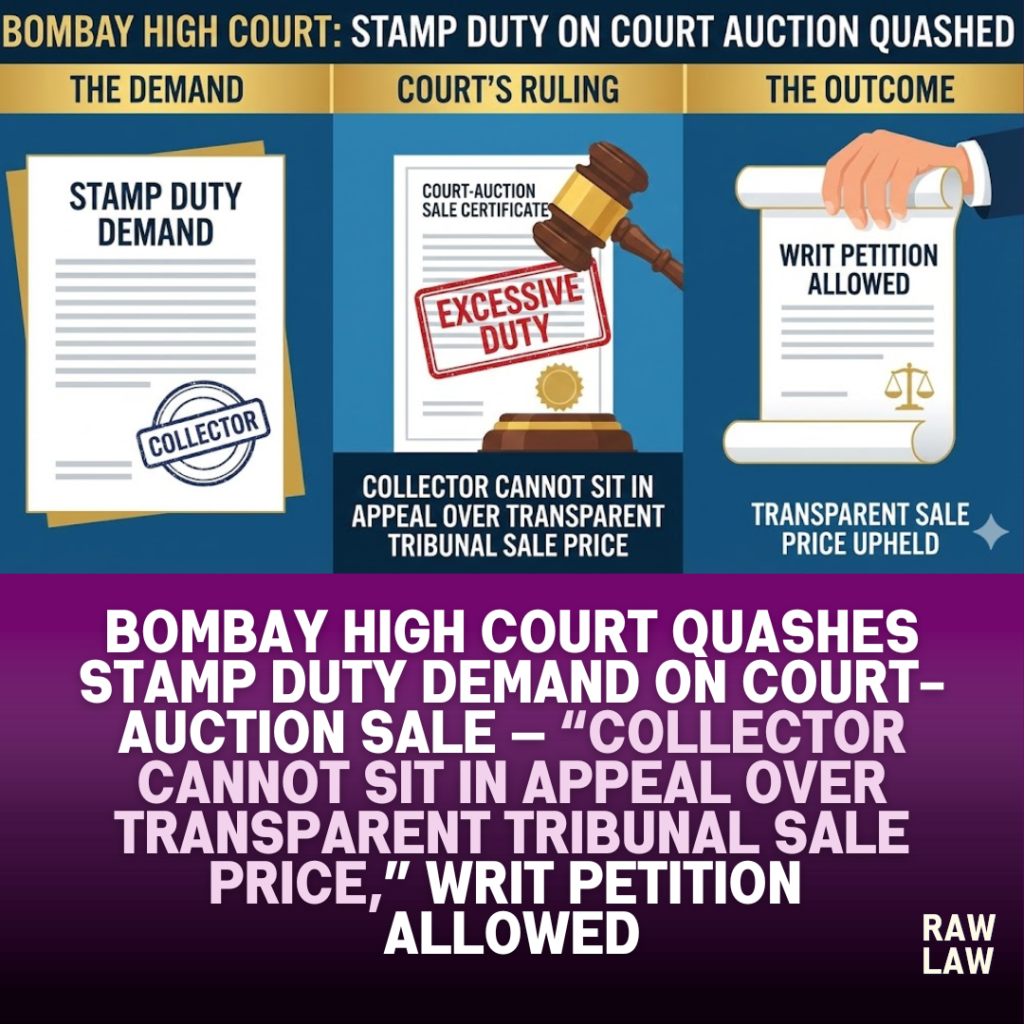
The Bombay High Court has allowed a writ petition challenging the adjudication of stamp duty on a sale certificate issued pursuant to an auction conducted by the Debt Recovery Tribunal. The Court held that where immovable property is sold through a transparent, court- or tribunal-monitored auction process, the price discovered in such auction represents the true market value for the purposes of stamp duty. It ruled that the Collector of Stamps acted illegally in ignoring the auction consideration and determining duty on a higher independently assessed market value, observing that such an approach would amount to the stamp authority sitting in appeal over the sale approved by a judicial forum.
Facts
The petitioner purchased a residential property situated at Bandra (West), Mumbai, in an e-auction conducted by the Recovery Officer of the Debt Recovery Tribunal-I, Mumbai, in execution of a recovery certificate issued in favour of a nationalised bank. The auction was held after issuance of a sale proclamation, fixation of a reserve price, and online electronic bidding. The petitioner emerged as the successful bidder at a consideration of ₹2.01 crore, and a sale certificate was issued in December 2021.
After rectification of the sale certificate, the petitioner approached the Collector of Stamps, Andheri Division, for adjudication of stamp duty. The petitioner contended that duty was payable on the auction price. However, by an interim determination and later a final order dated 29 May 2025 under Section 31 of the Maharashtra Stamps Act, 1958, the Collector assessed stamp duty on a purported market value of ₹8.34 crore, relying on valuation guidelines and a circular dated 15 December 2021. This resulted in a substantially higher duty and penalty, prompting the writ petition.
Issues
The principal issues before the High Court were whether stamp duty on a sale certificate issued pursuant to a DRT-conducted auction could be levied on a value higher than the auction consideration, whether the Collector of Stamps was justified in applying market value based on valuation guidelines despite a transparent auction process, and whether the writ petition was maintainable in view of the statutory appellate remedy under the Stamp Act.
Petitioner’s arguments
The petitioner argued that the auction conducted under the supervision of the Debt Recovery Tribunal was a transparent, competitive process aimed at discovery of the best possible price and therefore the consideration reflected the true market value. It was submitted that the Collector’s action in substituting the auction price with an independently assessed market value was contrary to settled law and amounted to questioning the correctness of a judicially supervised sale.
On maintainability, the petitioner contended that the dispute involved a pure question of law regarding the correct legal basis for determination of stamp duty, and therefore the High Court could entertain the petition notwithstanding the availability of a statutory appeal. Strong reliance was placed on Supreme Court and Bombay High Court precedents recognising court-monitored auctions as the most reliable indicator of market value.
Respondent’s arguments
The State opposed the petition on the ground that an efficacious alternative remedy of appeal was available under the Stamp Act. On merits, it was argued that an auction conducted by the DRT could not be equated with a civil court sale covered by the provisos to Rule 4(6) of the Maharashtra Stamp (Determination of True Market Value of Property) Rules. The State relied on the circular dated 15 December 2021, contending that stamp duty in such cases must be determined with reference to market value based on Annual Statement of Rates to prevent loss of revenue. It was further argued that no valuation report was placed on record to show that the auction price represented true market value.
Analysis of the law
The High Court first addressed the objection on maintainability, reiterating that availability of an alternative remedy is a rule of discretion and not an absolute bar. Where the controversy involves a pure question of law requiring no factual adjudication, the writ court may entertain the petition. The Court relied on Supreme Court jurisprudence distinguishing maintainability from entertainability of writ petitions.
On merits, the Court examined Articles 16 and 25 of Schedule I to the Maharashtra Stamps Act and Rule 4(6) of the 1995 Rules governing determination of market value. It emphasised that the object of stamp valuation provisions is to prevent undervaluation in private transactions, not to override prices discovered through judicially supervised auctions conducted after prescribed safeguards.
Precedent analysis
The Court placed strong reliance on decisions of the Supreme Court of India, particularly Registrar of Assurances v. ASL Vyapar Pvt. Ltd., where it was held that stamp authorities cannot question the price obtained in a court-monitored auction, as such auctions are among the most transparent methods of price discovery. It also relied on consistent Division Bench judgments of the Bombay High Court holding that registering authorities cannot “sit in appeal” over auction prices fixed or accepted by courts, tribunals, or statutory authorities. These precedents were applied squarely to DRT auctions.
Court’s reasoning
Applying the above principles, the Court found that the DRT auction in the present case involved issuance of a sale proclamation, disclosure of reserve price, online competitive bidding, and acceptance of the bid by a statutory authority. Such a process was inherently designed to discover fair market value. The Collector’s reliance on valuation guidelines and the 2021 circular to ignore the auction consideration was held to be legally untenable.
The Court observed that permitting stamp authorities to reassess market value in such cases would undermine the sanctity of tribunal-approved auctions and effectively place the Collector in appellate review over judicial or quasi-judicial sales. This, the Court held, could not be countenanced under the Stamp Act or the Rules.
Conclusion
The writ petition was allowed. The impugned order dated 29 May 2025 passed by the Collector of Stamps was quashed and set aside. The respondent was directed to adjudicate stamp duty on the sale certificate strictly on the basis of the auction consideration of ₹2.01 crore and to pass consequential orders within four weeks. Rule was made absolute with no order as to costs.
Implications
This judgment reinforces the legal position that stamp duty on properties sold through court- or tribunal-monitored auctions must be levied on the auction price and not on hypothetical market valuations. It provides significant relief to auction purchasers and strengthens certainty in enforcement and recovery proceedings. For stamp authorities, the ruling limits reliance on valuation guidelines and circulars where transparent judicial sales are involved, thereby preventing prolonged disputes and inconsistent demands.
Case law references
- Registrar of Assurances v. ASL Vyapar Private Limited: Held that stamp authorities cannot reassess value in court-monitored auctions; applied directly.
- Trident Estate Private Limited v. Joint District Registrar: Bombay High Court reaffirmed sanctity of court-approved auction prices.
- Collector of Stamps v. Pinak Bharat & Company: Held that registering authority cannot sit in appeal over court-fixed prices.
- Dr. Prince John Edavazhikai v. Collector of Stamps: Applied ASL Vyapar principles to SARFAESI auctions.
FAQs
Q1. Is stamp duty payable on market value or auction price in DRT auctions?
Stamp duty is payable on the auction price, as it represents true market value in a transparent tribunal-monitored sale.
Q2. Can the Collector of Stamps reassess value after a court or tribunal auction?
No. Courts have held that stamp authorities cannot sit in appeal over prices discovered through judicial auctions.
Q3. Is a writ petition maintainable despite an appellate remedy under the Stamp Act?
Yes, where the dispute involves a pure question of law and does not require factual adjudication.