


Court’s decision
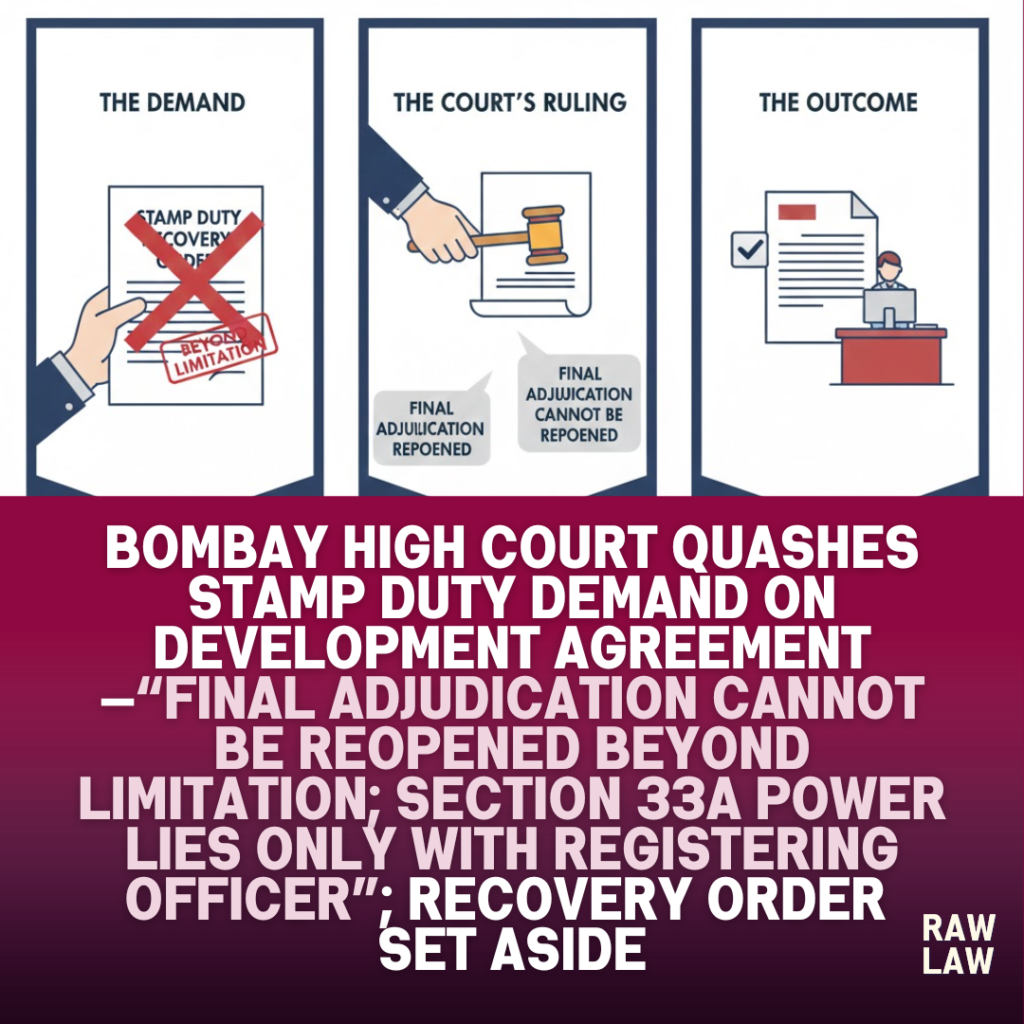
The Bombay High Court partly allowed a writ petition filed by a real estate developer and quashed an order demanding deficit stamp duty by treating a development agreement as a conveyance. The Court held that once the competent authority had, in 2006, conclusively determined that proper stamp duty was paid and that decision had attained finality, the revenue authorities could not reopen the issue after the expiry of the statutory limitation period. The Court further ruled that proceedings under Section 33A of the Maharashtra Stamp Act, 1958 can be initiated only by the registering officer who registered the document, and not by a superior revenue authority lacking statutory competence. The impugned recovery order was therefore held to be without jurisdiction.
Facts
The dispute arose from a development agreement executed on 24 February 2004 between a landowner and the petitioner-developer for development of immovable property in Pune, for a total consideration of ₹21.80 crores. The agreement was duly stamped and registered before the competent Sub-Registrar.
In April 2006, an audit objection was raised contending that the agreement ought to have been treated as a conveyance and stamped at 10 percent. Upon scrutiny, the Joint District Registrar and Collector of Stamps rejected the audit objection by an order dated 28 August 2006, expressly holding that proper stamp duty had been paid. This order was not challenged and attained finality.
More than three years later, in September 2009, the Inspector General of Registration directed initiation of proceedings accepting the earlier audit objection. Notices were issued, and eventually, by an order dated 26 April 2014, the Joint District Registrar levied stamp duty at 10 percent by invoking powers purportedly under Section 33A of the Act. Aggrieved, the developer approached the High Court.
Issues
The key issues before the Court were whether the revenue authorities could reopen a concluded determination on stamp duty after a lapse of several years, whether the impugned order was barred by limitation under the Maharashtra Stamp Act, whether Section 33A could be invoked by an authority other than the registering officer, and whether the development agreement could be treated as a conveyance for levy of stamp duty.
Petitioner’s arguments
The petitioner contended that the order of 28 August 2006 rejecting the audit objection amounted to a final adjudication under the Stamp Act and had attained legal finality. It was argued that any attempt to reopen the issue could only be undertaken through the revisional power under Section 53A, and strictly within the limitation of six years prescribed therein. Since the impugned order was passed in April 2014, well beyond six years from the 2006 determination, it was ex facie barred by limitation.
It was further argued that Section 33A empowers only the registering officer who registered the document to impound it post-registration. In the present case, the order was passed by the Joint District Registrar, who was not the registering officer for the instrument, rendering the action without jurisdiction. The petitioner also submitted that individual flat purchasers had subsequently paid full stamp duty on agreements under the Maharashtra Ownership of Flats Act, reinforcing that the development agreement was not a conveyance.
Respondents’ arguments
The State defended the action by contending that the substance of the development agreement disclosed transfer of rights akin to a conveyance and justified levy of stamp duty at 10 percent. It was argued that wide powers were conferred on the developer, including authority to deal with the property and receive sale consideration, indicating transfer of right, title and interest.
The respondents further submitted that Section 33A should be interpreted broadly to permit revenue authorities to correct mistakes in stamping, and that the petitioner had an alternative statutory remedy by way of revision, rendering the writ petition not maintainable.
Analysis of the law
The High Court undertook a detailed examination of the scheme of the Maharashtra Stamp Act. It emphasised that once a competent authority certifies an instrument as duly stamped under the Act, the statute attaches legal consequences and a degree of finality to such certification. While the Act permits correction of errors through revisional powers under Section 53A, such power is expressly circumscribed by a limitation period of six years.
The Court highlighted that fiscal statutes must be strictly construed. Section 33A specifically vests the power to impound an instrument post-registration in the “registering officer”, a term which cannot be expansively interpreted to include any superior revenue authority in the administrative hierarchy.
Precedent analysis
The Court relied on consistent judicial principles recognising that concluded stamp duty adjudications cannot be reopened at the discretion of authorities beyond the statutory framework. It also drew support from earlier High Court rulings holding that limitation under Section 53A is mandatory and that proceedings initiated or concluded beyond the prescribed period are without authority of law. The Court reiterated that availability of an alternative remedy does not bar writ jurisdiction where the impugned action is without jurisdiction or barred by limitation.
Court’s reasoning
Applying these principles, the Court held that the 2006 order rejecting the audit objection operated as a final adjudication that proper stamp duty had been paid. No revision under Section 53A was concluded within six years, and therefore, the authorities were barred from reopening the issue thereafter.
The Court further held that the impugned order could not be sustained as an exercise of power under Section 33A, since it was passed by an officer who was not the registering officer for the document. Jurisdiction under Section 33A, the Court ruled, is document-specific and attaches only to the officer who handled the registration. Administrative directions from superior officers could not cure this jurisdictional defect.
Conclusion
The Bombay High Court quashed the order dated 26 April 2014 demanding deficit stamp duty on the development agreement and permitted the petitioner to withdraw the amount deposited in court along with accrued interest. The Court held that the impugned action was barred by limitation and suffered from lack of jurisdiction.
Implications
This judgment provides significant clarity on the finality of stamp duty adjudications and the strict limits on reopening such determinations. It reinforces that revenue authorities must act strictly within the powers, authorities, and timelines prescribed by the Maharashtra Stamp Act. For developers and commercial actors, the ruling underscores the importance of certainty in property transactions and protects against belated and jurisdictionally flawed stamp duty demands.
Case law references
- Sony Mony Electronics Ltd. v. State of Maharashtra: Relied upon to hold that proceedings under Section 53A must culminate within the statutory limitation period.
- J.D.R. v. Hill Site Construction Co.: Considered by the authorities but distinguished in light of statutory finality and limitation.
- Suhas Damodar Sathe v. State of Maharashtra: Referred to on interpretation of development agreements vis-à-vis conveyance, though held inapplicable on jurisdictional grounds.
FAQs
Can stamp duty be reopened after a final adjudication?
Only through the mechanism provided in the Stamp Act and strictly within the limitation period prescribed, usually under Section 53A.
Who can invoke Section 33A of the Maharashtra Stamp Act?
Only the registering officer who registered the document; superior revenue authorities cannot assume this power without statutory backing.
Does availability of a revision remedy bar a writ petition?
No. When the impugned action is without jurisdiction or barred by limitation, the High Court can exercise writ jurisdiction.