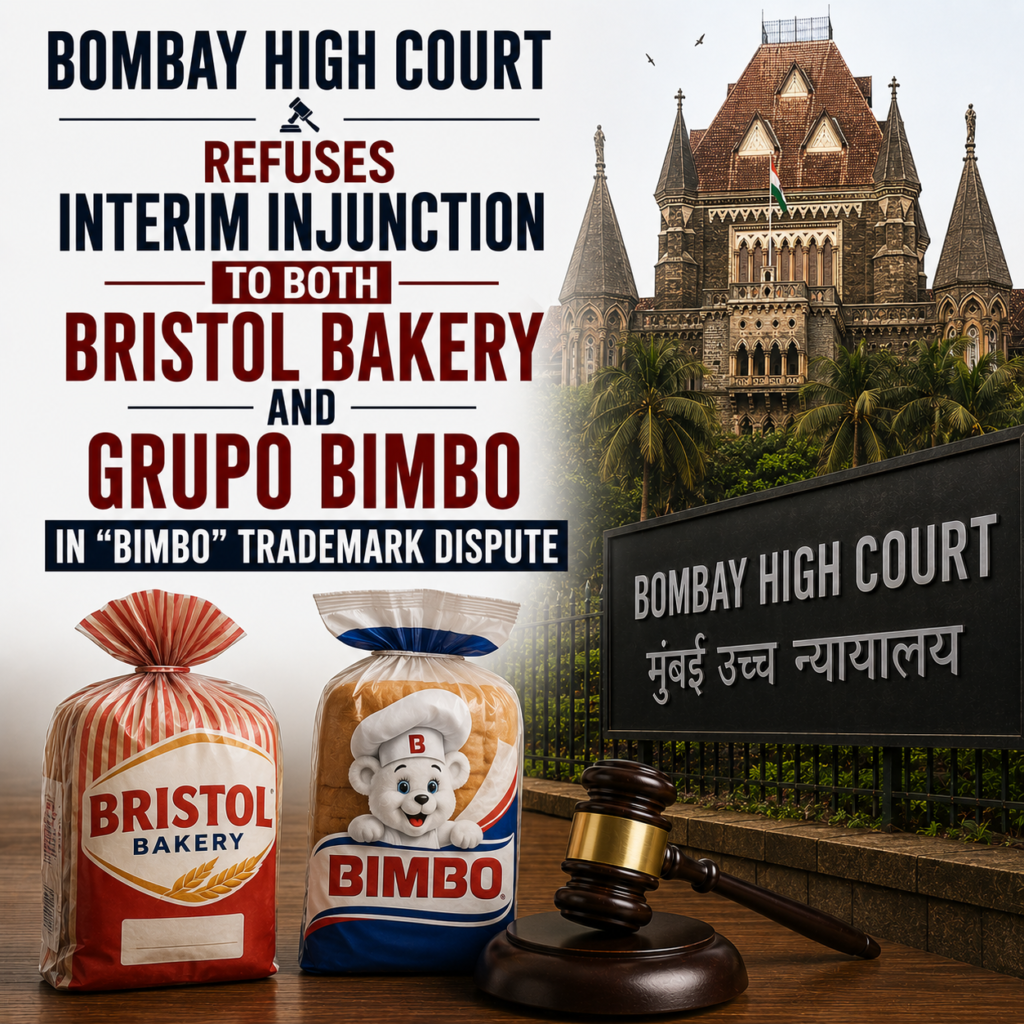
Bombay High Court Refuses Interim Injunction to Both Bristol Bakery and Grupo Bimbo in “BIMBO” Trademark Dispute, Says Both Parties Acquiesced in Each Other’s Use
Facts
The Bombay High Court decided two cross-interim applications in commercial IP suits concerning the identical trademark “BIMBO” used for bread and bakery products.
Bristol Bakery claimed that it had adopted the mark “Bimbo” in India since 1979, allegedly derived from the phrase “Best In Maharashtra Before Others.” It claimed registration of its “Bimbo” label mark in Class 30 from 6 March 1979 and asserted long, open and continuous use of the mark for bakery products.
Grupo Bimbo, a Mexico-based multinational bakery company, claimed that it had adopted the mark “Bimbo” in Mexico in 1943 and had secured registrations in several countries. In India, Grupo Bimbo had secured registration of its device mark in 1993 and later obtained other registrations.
Both parties filed cross-suits alleging infringement and passing off. Bristol Bakery sought to restrain Grupo Bimbo from using the mark in India, while Grupo Bimbo sought to restrain Bristol Bakery, alleging dishonest adoption, fraudulent registration and misuse of its internationally reputed mark.
The Court noted that both parties were registered proprietors of marks containing “Bimbo”, and therefore, at the interlocutory stage, the dispute substantially turned on passing off, prior use, goodwill, trans-border reputation, invalidity of registration and balance of convenience.
Issues
- Whether Grupo Bimbo could maintain an infringement action against Bristol Bakery despite Bristol Bakery’s registered trademark.
- Whether Bristol Bakery’s 1979 registration was ex facie fraudulent or illegal.
- Whether Grupo Bimbo had established trans-border reputation or goodwill in India when Bristol Bakery adopted the mark in 1979.
- Whether Bristol Bakery had established actionable goodwill in India when Grupo Bimbo began using the mark in India.
- Whether either party was entitled to interim injunction against the other.
- Whether delay and acquiescence defeated the grant of interim relief.
Petitioner’s Arguments
Bristol Bakery argued that it was the prior adopter and prior registered proprietor of the mark “Bimbo” in India since 1979.
It submitted that Grupo Bimbo’s first Indian registration was only in 1993 and that Grupo Bimbo had no actual use of the mark in India for decades after registration. According to Bristol Bakery, Grupo Bimbo entered the Indian market only around 2017 through acquisitions and began affixing the “Bimbo” mark on Indian products only in 2019.
Bristol Bakery contended that Grupo Bimbo had failed to establish trans-border reputation in India as of 1979. It argued that Grupo Bimbo’s reputation in Mexico, America or Latin America could not defeat Bristol Bakery’s prior Indian adoption unless such reputation had actually spilled over into India.
It further argued that it had built substantial goodwill in India through long use, sales and promotional material, and that it filed the suit soon after discovering Grupo Bimbo’s products in the Indian market.
Grupo Bimbo argued that “Bimbo” was its coined mark, adopted in Mexico in 1943, and that Bristol Bakery’s adoption was dishonest.
It contended that Bristol Bakery had copied not only the word “Bimbo”, but also similar branding elements, including “Super Bread”, which according to Grupo Bimbo resembled its “Super Pan” brand, and a cartoon-style device.
Grupo Bimbo further argued that Bristol Bakery’s registration was fraudulent and illegal because Grupo Bimbo had prior international registrations and reputation. It also submitted that Bristol Bakery had not filed a written statement in Grupo Bimbo’s suit and that the suit should therefore be decreed.
Respondent’s Arguments
Bristol Bakery opposed Grupo Bimbo’s claim by arguing that registration under Indian trademark law is territorial, and Grupo Bimbo’s foreign reputation could not override Bristol Bakery’s prior Indian registration and use unless actual spill-over reputation in India was shown.
It also submitted that the negotiations between the parties were without prejudice and could not be used to prove acquiescence.
Grupo Bimbo opposed Bristol Bakery’s application by arguing that Bristol Bakery had known about Grupo Bimbo since at least 2010, when Grupo Bimbo opposed Bristol Bakery’s second label mark. It further argued that Bristol Bakery was aware of Grupo Bimbo’s Indian expansion and yet waited before filing proceedings.
Grupo Bimbo also contended that Bristol Bakery had not produced sufficient evidence, such as certified sales figures or advertisement expenditure, to establish strong goodwill in the “Bimbo” mark for the purpose of passing off.
Analysis of the Law
The Court considered the statutory scheme under the Trade Marks Act, 1999.
The Court held that where two parties are registered proprietors of identical or similar marks, Section 28(3) limits the exclusive right of one registered proprietor against another. Section 30(2)(e) also protects the use of a registered mark where such use is in exercise of rights conferred by registration. Therefore, one registered proprietor generally cannot sue another registered proprietor for infringement merely on the strength of registration.
The Court also relied on Section 27(2), which preserves the common law remedy of passing off even against a registered proprietor.
On invalidity of registration, the Court held that registration is prima facie evidence of validity under Section 31. At the interim stage, a civil court can examine invalidity only in exceptional cases where the registration is ex facie illegal, fraudulent or shocks the conscience of the Court.
The Court held that Bristol Bakery’s 1979 registration did not shock the conscience of the Court and could not be treated as ex facie fraudulent merely because Grupo Bimbo had reputation in America or Latin America. Grupo Bimbo had not shown spill-over reputation in India as of 1979.
Precedent Analysis
The Court relied on S. Syed Mohideen v. P. Sulochana Bai, where the Supreme Court held that one registered proprietor cannot maintain an infringement action against another registered proprietor, but a passing off action remains available.
The Court relied on the Full Bench decision of the Bombay High Court in Lupin Ltd. v. Johnson & Johnson, which held that although a civil court can prima facie examine validity of registration at the interim stage, the burden is very heavy. Interim relief may be refused only where the registration is ex facie illegal, fraudulent or shocks the conscience of the Court.
The Court relied on Toyota Jidosha Kabushiki Kaisha v. Prius Auto Industries Ltd. and related passing off principles to emphasize that trans-border reputation must be shown to have spilled over into India.
The Court also relied on Power Control Appliances v. Sumeet Machines Pvt. Ltd. on acquiescence, holding that a party which knowingly allows another trader to build up business under a similar mark may be disentitled from interim injunction.
The Court referred to Brihan Karan Sugar Syndicate Pvt. Ltd. v. Yashwantrao Mohite while considering the need to prove goodwill through material such as sales figures and advertisement expenditure.
Court’s Reasoning
The Court found that the rival marks were undoubtedly similar because “Bimbo” was the dominant and essential feature in both marks. However, the Court observed that the cartoon characters in the rival labels were distinguishable; the real similarity arose from the word “Bimbo” itself.
On Grupo Bimbo’s infringement claim, the Court held that both parties held registrations and Bristol Bakery’s registration was not shown to be ex facie illegal or fraudulent. Therefore, Grupo Bimbo failed to make out a prima facie case for infringement.
On Grupo Bimbo’s passing off claim, the Court held that Grupo Bimbo may have shown international use and reputation, but it failed to establish that its goodwill had spilled over into India when Bristol Bakery adopted the mark in 1979. The Court held that use under the Trade Marks Act must be understood territorially as use in India, and Grupo Bimbo had no prior Indian use or spill-over reputation at the relevant time.
On Bristol Bakery’s passing off claim, the Court noted that Grupo Bimbo admitted that it entered the Indian market with the “Bimbo” mark around 2019. Therefore, 2019 was the relevant date for assessing Bristol Bakery’s goodwill against Grupo Bimbo.
However, the Court held that Bristol Bakery had not produced sufficient material to prove goodwill and reputation of the kind required for passing off. The Court noted that Bristol Bakery relied on sales figures pleaded in the plaint, but there was no certified sales material or sufficient promotional/advertising evidence to establish that consumers identified “Bimbo” exclusively with Bristol Bakery.
The Court also found that both parties had acquiesced. Bristol Bakery knew of Grupo Bimbo’s registrations and opposition proceedings since 2010 and was aware of Grupo Bimbo’s Indian market presence or expansion, yet it waited. Grupo Bimbo, on the other hand, was also aware of Bristol Bakery’s registration and could have taken steps earlier. The Court held that both had allowed each other to build their businesses under the mark.
Therefore, the balance of convenience favoured maintaining coexistence at the interlocutory stage rather than restraining either side.
Conclusion
The Bombay High Court refused interim injunction to both Bristol Bakery and Grupo Bimbo.
The Court held that Bristol Bakery was prima facie the prior adopter and user in India, while Grupo Bimbo failed to show spill-over goodwill in India as of 1979.
However, Bristol Bakery also failed to establish sufficient goodwill and reputation as of 2019 to obtain a passing off injunction against Grupo Bimbo.
The Court further held that both parties had acquiesced in each other’s use of the mark and that the long-standing coexistence should not be disturbed at the interim stage.
Accordingly, both interim applications were dismissed.
Case Details
Case: Bristol Bakery v. Grupo Bimbo S.A.B. DE C.V. & Ors.; Grupo Bimbo S.A.B. DE C.V. v. Bristol Bakery & Anr.
Court: Bombay High Court, Commercial Division
Case Number: Interim Application (L) No. 13958 of 2023 in Commercial IP Suit No. 117 of 2025; Interim Application No. 5609 of 2025 in Commercial IP Suit No. 189 of 2025
Judge: Justice Sharmila U. Deshmukh
Date: 6 July 2026
Result: Both interim applications dismissed; no interim injunction granted to either Bristol Bakery or Grupo Bimbo.