


Court’s Decision
The Bombay High Court dismissed a Commercial Arbitration Application seeking termination of the mandate of the earlier sole arbitrator and appointment of a substitute arbitrator under Sections 11 and 14 of the Arbitration and Conciliation Act, 1996.
The Court held that although the earlier arbitrator’s mandate could ordinarily be substituted where the arbitral reference remains alive, the present case was different because the applicants had taken no meaningful steps for almost nine years after the last arbitral meeting. The Court concluded that the conduct of the applicants led to only one inference: the arbitral proceedings had been abandoned and stood terminated under Section 32(2)(c) of the Arbitration Act.
Facts
The dispute arose out of the affairs, business and assets of a partnership firm. By an order dated 17 September 2014, the Bombay High Court had referred the disputes arising from the partnership deed to arbitration and appointed a sole arbitrator. The order stated that the arbitrator shall “endeavour” to pass the award within nine months from the first meeting.
A further order dated 17 March 2015 also referred connected disputes between the parties to the same sole arbitrator. The arbitration commenced, pleadings were filed, counterclaims were raised, and affidavits of evidence were also placed on record. The matter had reached the stage of cross-examination.
However, the last arbitral meeting was held on 25 July 2017. Thereafter, no arbitral meeting took place. According to the applicants, settlement talks were ongoing between the parties and therefore the proceedings were not pursued. The applicants later claimed that the earlier arbitrator was of advanced age and was not in a position to actively conduct and conclude the arbitration.
On that basis, the applicants approached the High Court seeking termination of the mandate of the earlier arbitrator and appointment of a substitute arbitrator so that the arbitration could continue from the stage already reached.
Issues
The principal issue before the Court was whether the arbitral proceedings were still alive, permitting appointment of a substitute arbitrator under Sections 11, 14 and 15 of the Arbitration Act, or whether the arbitration had been abandoned by the parties due to prolonged inaction.
The Court also considered whether the direction in the earlier order requiring the arbitrator to “endeavour” to pass an award within nine months amounted to a mandatory time limit.
Applicants’ Arguments
The applicants argued that the earlier arbitrator had become unable to proceed due to advanced age and therefore his mandate deserved to be terminated under Section 14. They contended that the arbitral proceedings had not legally terminated and only the arbitrator required substitution.
They further argued that since the reference was made before the 2015 amendment to the Arbitration Act, Section 29A, which prescribes timelines for arbitral awards, would not apply retrospectively. Reliance was placed on Board of Control for Cricket in India v. Kochi Cricket Private Limited for the proposition that Section 29A applies prospectively.
The applicants also submitted that the word “endeavour” in the earlier order could not be treated as a mandatory time limit. They relied on Tata Sons Private Limited v. Siva Industries and Holdings Limited to contend that such timeline language is directory and not mandatory.
On abandonment, the applicants argued that abandonment cannot be lightly inferred merely from delay or non-fixation of dates. They relied on Dani Wooltex Corporation v. Sheil Properties Private Limited to contend that abandonment requires clear, convincing and unequivocal circumstances.
Respondents’ Arguments
The contesting respondents opposed the application and argued that the arbitration proceedings were no longer alive. According to them, no communication was addressed to the arbitrator for almost nine years, and therefore the parties’ conduct showed that the arbitral reference had been abandoned.
They also argued that once the earlier order contemplated passing of an award within nine months, the applicants ought to have approached the Court for extension of time. Their failure to do so, coupled with prolonged inaction, showed that the arbitration could not be revived through a fresh application for substitution of arbitrator.
Analysis of the Law
The Court first clarified that the direction in the 2014 order requiring the arbitrator to “endeavour” to pass an award within nine months could not be treated as a mandatory time limit. The Court observed that a mere direction to make an endeavour does not create an automatic consequence of termination if the award is not passed within that period.
The Court also noted that Section 29A was introduced only with effect from 23 October 2015 and therefore did not apply to arbitral references made before that amendment. Further, even the parties themselves had not treated the nine-month period as fatal, because arbitral meetings continued until 25 July 2017, well beyond nine months.
The Court then drew a clear distinction between termination of the mandate of an arbitrator under Sections 14 and 15 and termination of arbitral proceedings under Section 32. It held that where only the arbitrator’s mandate terminates, the Court can appoint a substitute arbitrator. But once the arbitral proceedings themselves terminate under Section 32, a substitute arbitrator cannot be appointed.
Precedent Analysis
The Court considered Dani Wooltex Corporation, where the Supreme Court held that abandonment of arbitral proceedings cannot be readily inferred. The Supreme Court had held that merely because a claimant does not request the arbitrator to fix a hearing date, it does not automatically mean that the proceedings have become unnecessary or impossible.
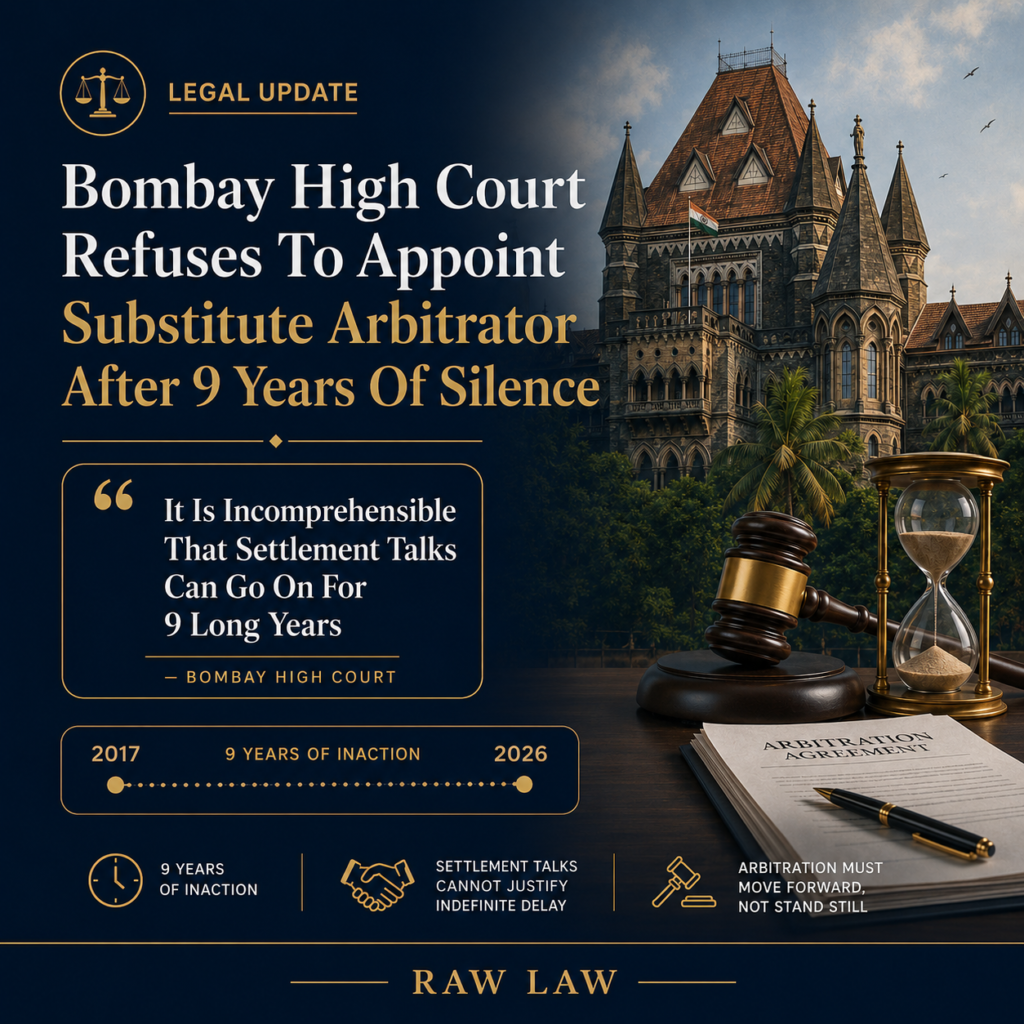
However, the Bombay High Court distinguished that precedent on facts. In Dani Wooltex Corporation, there were circumstances explaining why one claim had not progressed, including the fact that another connected claim was being given priority. In the present case, there was no such explanation. The Court found that from 25 July 2017 to 2 January 2026, nothing had happened in the arbitration.
The Court relied on the principle that abandonment may be express or implied, but implied abandonment can be inferred only where the admitted or proved facts are so clinching that the only possible conclusion is that the claimant has given up the claim.
Court’s Reasoning
The Court held that mere failure to seek dates may not, by itself, amount to abandonment. However, the conduct in the present case went far beyond ordinary delay. The applicants had not referred to any concrete event between 25 July 2017 and 2 January 2026 concerning the arbitral proceedings.
The Court rejected the vague explanation of settlement talks, observing:
“It is incomprehensible that settlement talks can go on for 9 long years.”
The Court noted that if the applicants were genuinely serious about prosecuting the arbitration, they would have at least written to the arbitrator stating that dates were not being sought because negotiations were ongoing. No such communication was placed on record. No material was also produced to show that settlement meetings had actually taken place during the long period of silence.
The Court also found it significant that the email dated 2 January 2026 seeking resumption of arbitration was not sent by the applicants themselves, but by a respondent/legal heir who was not shown to have been formally brought on record in the arbitral proceedings. The applicants, therefore, could not rely on that email to demonstrate their own intention to prosecute the arbitration.
On these facts, the Court held that the applicants had virtually abandoned the arbitral proceedings.
Conclusion
The Bombay High Court dismissed the application. It held that since the arbitral proceedings had been abandoned and stood terminated under Section 32(2)(c) of the Arbitration Act, the Court could not appoint a substitute arbitrator under Sections 11 or 14.
The Court concluded:
“The inescapable conclusion that emerges is that the arbitral proceedings are abandoned by the Applicants.”
Accordingly, the Commercial Arbitration Application failed and was dismissed with no order as to costs.
Key Takeaway
The judgment clarifies that while abandonment of arbitration cannot be inferred lightly, prolonged and unexplained silence for nearly nine years can amount to implied abandonment. A party seeking substitution of an arbitrator must show that the arbitral reference is still alive. If the proceedings themselves are treated as terminated under Section 32(2)(c), the Court cannot revive them by appointing a substitute arbitrator.
Judgments Cited
- Board of Control for Cricket in India v. Kochi Cricket Private Limited — relied upon for the proposition that Section 29A of the Arbitration Act applies prospectively.
- Tata Sons Private Limited v. Siva Industries and Holdings Limited — relied upon for the interpretation of “endeavour” language as directory in nature.
- Dani Wooltex Corporation v. Sheil Properties Private Limited — discussed on abandonment of arbitral proceedings and the principle that abandonment cannot be readily inferred.
- Nalin Vallabhbhai Patel v. Athrava Realtors — considered on the distinction between abandoned arbitral proceedings and substitution of arbitrator.
- Tata Motors Passenger Vehicles Ltd. — referred to on the distinction between termination of arbitrator’s mandate and termination of arbitral proceedings.
- Kifayatullah Haji Gulam Rasool — referred to on Sections 14, 15, 25 and 32 of the Arbitration Act.
- Khorshed E. Nagarwalla — referred to for the principle that termination of an arbitrator’s mandate does not automatically terminate the arbitration agreement or reference.