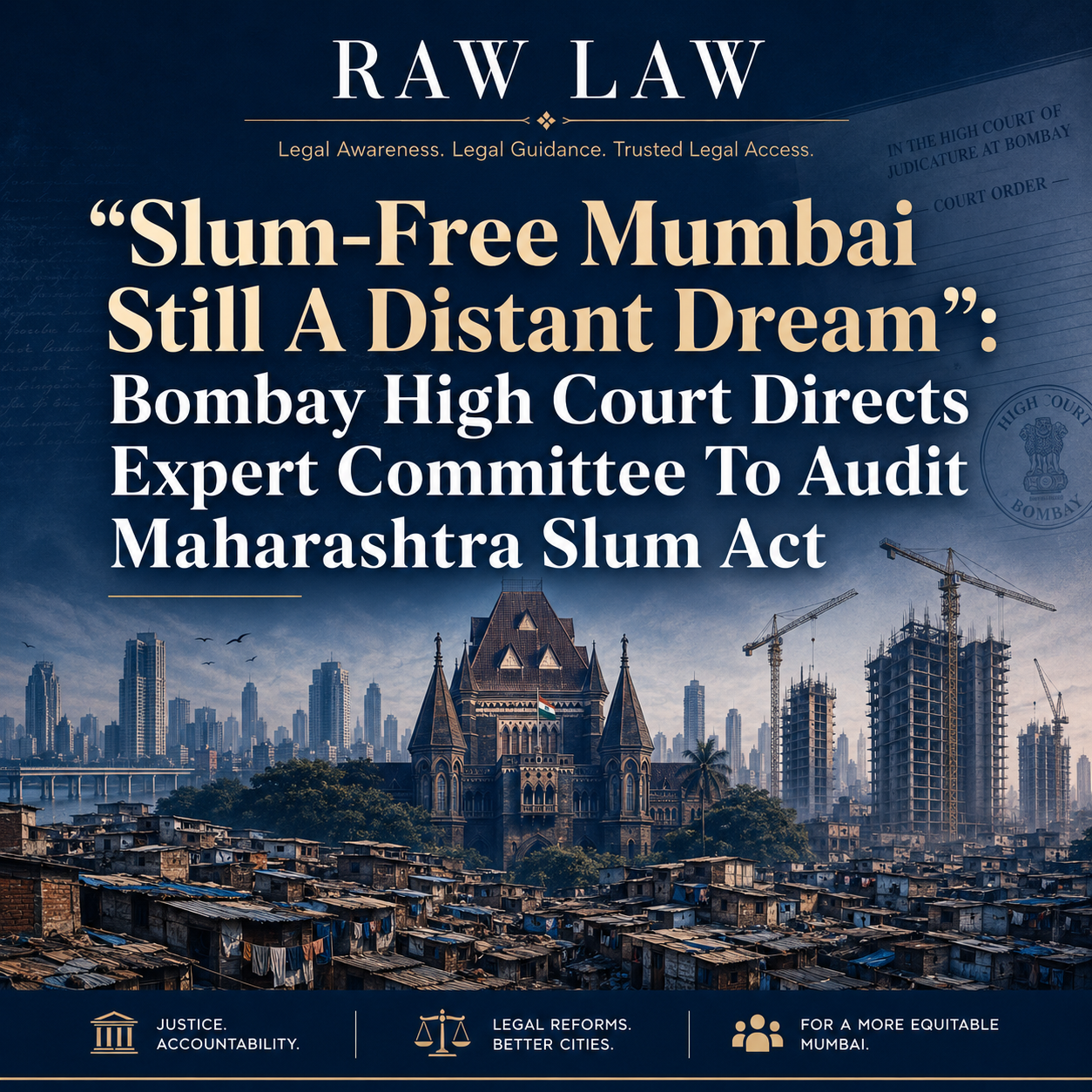
“Slum-Free Mumbai Still A Distant Dream”:Bombay High Court Directs Expert Committee To Audit Maharashtra Slum Act

Court’s Decision
The Bombay High Court directed the State Government to constitute an Expert Committee for conducting a performance audit of the Maharashtra Slum Areas (Improvement, Clearance and Redevelopment) Act, 1971, with the objective of making the statute more effective and moving towards the “distant dream of slum-free Mumbai” and other major cities in Maharashtra. The Court directed that the Committee be constituted within four weeks, and that it should endeavour to submit its report within ten months.
The Court clarified that its role was facilitative: it could direct an audit and identify systemic fault-lines, but legislative reforms would remain within the domain of the legislature and executive.
Facts
The proceedings arose after the Supreme Court, in Yash Developers, noted serious concerns regarding the working of the Slum Act and requested the Chief Justice of the Bombay High Court to constitute a Bench to review the statute’s performance. The Supreme Court had observed that the working of the Slum Act required a “performance audit”, especially because the legislation was intended to benefit marginalised slum dwellers but had generated extensive litigation and administrative gridlock.
Pursuant to the Supreme Court’s direction, the Bombay High Court examined the functioning of the Slum Act, heard several stakeholders, considered suggestions from amici, and reviewed issues concerning slum identification, eligibility of slum dwellers, private land rights, developer selection, transit accommodation, statutory remedies, redevelopment delays, and public land encroachments.
Issues
The Court considered whether the Slum Act, after more than five decades of operation, was actually achieving its object of slum clearance, redevelopment, and rehabilitation. The major issues included:
- Identification and declaration of land as slum land.
- Identification of eligible slum dwellers.
- Selection and replacement of developers.
- Apportionment between rehabilitation area and sale area.
- Transit accommodation and transit rent.
- Independence and effectiveness of statutory authorities.
- Effectiveness of AGRC/GRC remedies.
- Whether Article 226 litigation can be a long-term substitute for statutory reform.
The Court also noted recurring disputes relating to Annexure II, delays in schemes, acquisition of private lands, slums on government lands, and disputes involving developers, financiers, purchasers and MahaRERA-related issues.
Submissions
The stakeholders placed wide-ranging concerns before the Court. Slum dwellers and public-interest participants raised issues of eligibility, transit accommodation, PAP housing, lack of transparency, delay, and the vulnerability of slum residents in redevelopment schemes. Private landowners emphasised their preferential right to redevelop their own lands before compulsory acquisition under Section 14. Developers and real estate bodies raised concerns regarding viability, procedure, permissions, density, financing and project delays.
The SRA highlighted practical difficulties in processing schemes, especially verification of Annexure II. It submitted that Annexure II certification is time-consuming, disputes arise after eligibility is declared, ineligible occupants often challenge certification and refuse to vacate, and hutments are sometimes divided after certification to demand additional tenements.
Analysis Of The Law
The Court traced the history of the Slum Act from 1971 and noted that despite 21 amendments between 1973 and 2025, the statute had not achieved its intended objective. The Court observed that the law was originally remedial and transitional in nature, but “the extinction of the slums has remained a dream on paper.”
The Court emphasized that the Slum Act was never intended to perpetuate slums. Its object was to improve, clear and redevelop slum areas, while ensuring rehabilitation of eligible slum dwellers. The Court also noted that slum redevelopment cannot be viewed only as a private real estate transaction because it involves public land, private land, constitutional dignity, housing, urban planning, public health and civic infrastructure.
Precedent Analysis
The Court relied on earlier decisions which had repeatedly highlighted systemic defects in the working of the Slum Act.
In State of Maharashtra v. Mahadeo Pandharinath Dhole, the Court had held that slum laws were “intermediary remedial measures” and that their object was not to perpetuate slums but to regulate, clear and redevelop them.
In Indian Cork Mills, the Court had recognised the rights of private landowners and held that compulsory acquisition under Section 14 cannot bypass the statutory opportunity available to landowners to undertake redevelopment. The Court reiterated that owners must be given notice and a reasonable opportunity before acquisition is resorted to.
In Susme Builders, the Supreme Court had upheld the SRA’s power to remove a developer where redevelopment was delayed and slum dwellers suffered for decades. The High Court relied on this principle to stress that authorities must act effectively where developers fail to perform.
In Galaxy Enterprises, the Court had already expressed concern that scores of slum schemes remain incomplete for years, with slum dwellers forced into litigation because of disputes over developers, eligibility, delays and lack of monitoring.
Court’s Reasoning
The Court found that Mumbai’s slum problem had reached alarming proportions. It recorded that approximately 875.97 acres of land in Mumbai is under slums and that a large number of people live in slum areas, including on private land, State land, Central Government land and municipal land. The Court also noted that similar issues exist across other municipal corporations surrounding Mumbai and in other major cities such as Pune and Nashik.
The Court identified several reasons why slum eradication remained only a “dream on paper”: lack of deterrent policy against encroachments, failure to protect public and private lands, vertical slums, uncertainty in slum demarcation, disputes concerning slum societies, difficulties on private lands, ineffective AGRC/GRC mechanisms, recurring Annexure II litigation, lack of public housing pools, financing gaps, absence of density caps, poor developer selection, and failure to preserve town planning reservations.
The Court was particularly concerned that public lands had been consumed by encroachments and redevelopment without a robust constitutional policy. It noted that under the guise of rehabilitation, public lands were being used for residential and commercial development, raising serious concerns regarding constitutional morality and management of State resources.
Court’s Key Observations
The Court observed that there was “something drastically amiss” in the implementation of the Slum Act, given the avalanche of disputes reaching courts.
It further observed:
“The extinction of the slums has remained a dream on paper.”
The Court also stated that the Expert Committee must examine the working of the statute so that the Government can move towards the “distant dream of slum-free Mumbai” and other cities in Maharashtra.
Conclusion
The Bombay High Court directed the State Government to constitute an Expert Committee for performance audit of the Slum Act. The Committee must include experts in town planning, representatives from municipal and planning authorities, independent architects, senior government officials, and public representatives with specialised knowledge. The Committee is to be constituted within four weeks, and it should endeavour to submit its report within ten months.
The judgment is significant because it does not merely decide an individual dispute; it records a systemic judicial audit of Maharashtra’s slum rehabilitation framework. The Court’s message is clear: after 55 years, the Slum Act cannot continue to generate endless litigation while slum eradication remains unrealised. The State must now examine the statute’s failures, strengthen the institutional mechanism, protect public and private land, ensure fair rehabilitation, and create a workable roadmap for slum-free cities.