

Court’s decision
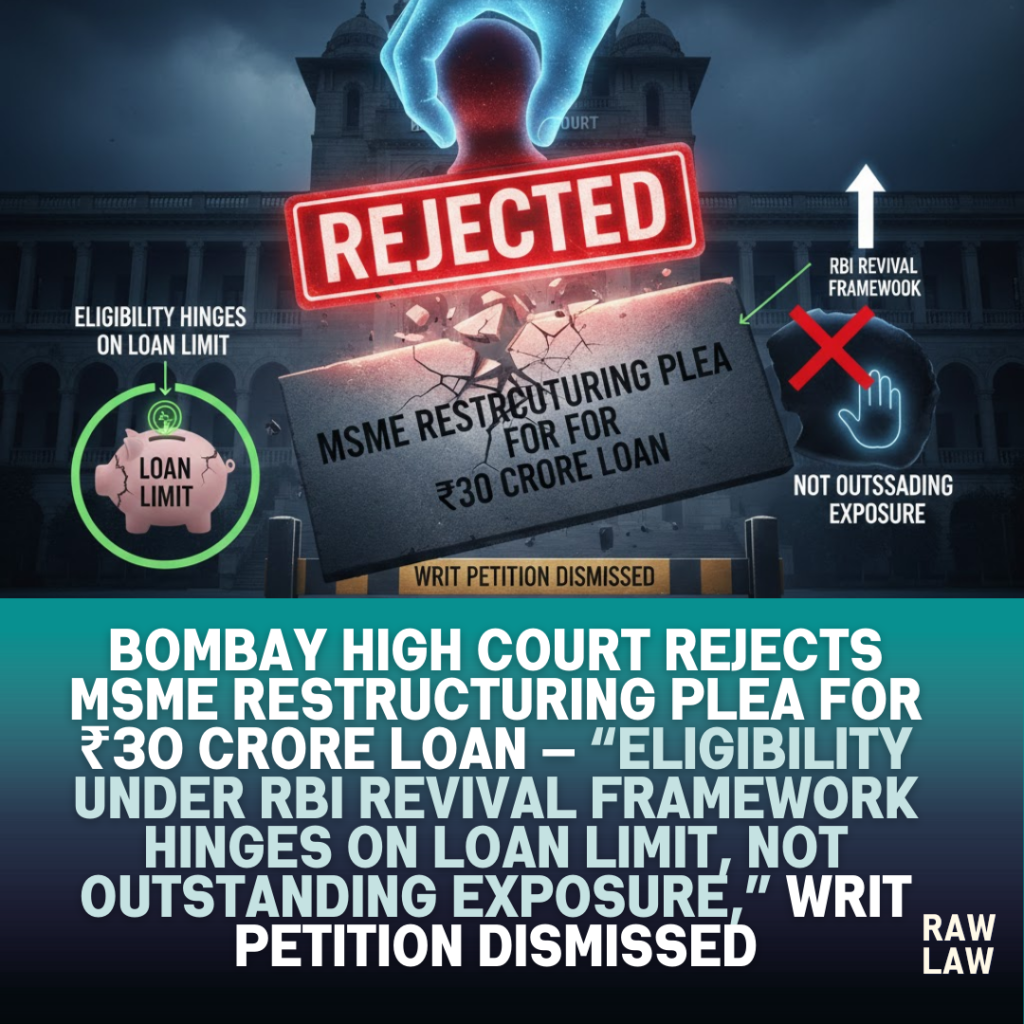
The Bombay High Court has dismissed a writ petition filed by an agro-processing company and its promoter seeking mandatory reference of their loan account to the RBI-mandated Committee for Revival and Rehabilitation of MSMEs. The Court held that although the borrower was registered as an MSME, it was not an eligible MSME under the RBI Framework because its sanctioned loan limit exceeded ₹25 crore. Interpreting RBI Master Circulars, Directions, and the Union Government’s notification, the Court ruled that eligibility is determined by the loan limit, not the outstanding amount, and therefore the bank was justified in proceeding under SARFAESI and insolvency law without invoking the MSME revival framework.
Facts
The first petitioner, an agro-processing company, had availed multiple credit facilities from a nationalised bank, including a term loan of ₹30 crore, along with other loans such as Covid facilities, pledge loans, and guarantee-backed loans. The petitioners repeatedly sought restructuring of the account after the Covid-19 pandemic, claiming MSME status and requesting rescheduling of repayments.
Despite these requests, the loan account was declared a non-performing asset in July 2023. The bank issued notices under Sections 13(2) and 13(4) of the Securitisation Act, followed by steps for sale of secured assets. During this period, the bank also permitted opening of a Trust and Retention Account with a 15% cut-back mechanism to service dues, but alleged that the borrower failed to route transactions through the account and diverted funds. Eventually, the bank initiated insolvency proceedings before the National Company Law Tribunal. The writ petition was filed seeking directions to compel restructuring under the MSME revival framework.
Issues
The central issues before the High Court were whether the petitioner qualified as an eligible MSME under the RBI Framework for Revival and Rehabilitation of MSMEs, whether the ₹25 crore threshold under the framework referred to the sanctioned loan limit or merely the outstanding exposure, and whether the bank was under a mandatory obligation to refer the account to the MSME committee before declaring it an NPA. The Court also examined the applicability of recent Supreme Court rulings on mandatory consideration of MSME restructuring prior to SARFAESI action.
Petitioner’s arguments
The petitioners argued that from the inception of stress in the account, the bank was aware that the borrower was an MSME and therefore was bound to follow the RBI Framework for Revival and Rehabilitation. Relying heavily on the Supreme Court decision in Pro Knits, it was contended that the bank had a suo motu duty to identify incipient stress, classify the account under Special Mention Account categories, and refer it to the committee before declaring it an NPA.
The petitioners submitted that the RBI Master Circular on exposure norms defines “exposure” as the higher of sanctioned limits or outstanding amounts, and in the case of fully drawn term loans, exposure could be reckoned on outstanding dues. Since the outstanding amount at the relevant time was below ₹25 crore, the petitioner claimed eligibility under the MSME framework. It was also argued that the bank never expressly communicated any finding of ineligibility until filing its affidavit in court.
Respondent’s arguments
The bank and regulatory authorities opposed the petition, contending that the RBI framework clearly restricts mandatory MSME revival mechanisms to enterprises with loan limits up to ₹25 crore. Since the petitioner’s term loan alone was ₹30 crore, it fell outside the eligible category, regardless of the outstanding amount.
The respondents argued that the petitioner had been given ample opportunities under the bank’s own restructuring policy, including TRA and hold-in-operation facilities, which were misused. It was further contended that Supreme Court judgments relied upon by the petitioners applied only to eligible MSMEs and did not override the express eligibility thresholds set out in RBI circulars and frameworks.
Analysis of the law
The High Court undertook a detailed interpretation of the Notification dated 29 May 2015 issued under the MSME Act, the RBI Master Circular on exposure norms dated 1 July 2015, the Framework for Revival and Rehabilitation of MSMEs dated 17 March 2016, and the RBI Master Direction dated 21 July 2016.
The Court emphasised that while the term “exposure” has a technical definition, the eligibility clauses in the MSME framework repeatedly and unambiguously use the expression “loan limits up to ₹25 crore.” The policy intent, the Court noted, was to extend special protection only to relatively smaller MSMEs, while larger borrowers were to be governed by corporate debt restructuring or joint lenders’ forum mechanisms.
Precedent analysis
The Court analysed the Supreme Court’s ruling in Pro Knits and its later clarification in Shri Shri Swami Samarth Construction. It held that while banks have a duty to consider MSME revival measures suo motu, this obligation arises only when the borrower satisfies the eligibility criteria under the RBI framework. The later Supreme Court judgment clarified that borrowers must assert MSME claims with supporting material and affidavits at the earliest opportunity, particularly after SARFAESI notices are issued. These precedents were held inapplicable once the borrower was found ineligible under the ₹25 crore loan limit criterion.
Court’s reasoning
Applying the framework to the facts, the Court found that the petitioner’s sanctioned credit facilities far exceeded ₹25 crore, with total sanctioned limits above ₹80 crore. The emphasis on outstanding dues, the Court held, could not override the express eligibility condition based on loan limits.
The Court also noted the petitioner’s conduct in failing to comply with the TRA mechanism and diverting revenues despite substantial turnover, observing that the bank had acted reasonably in attempting alternative restructuring before proceeding with recovery. Since the petitioner was not an eligible MSME, the bank was under no obligation to refer the account to the committee or halt SARFAESI and insolvency proceedings.
Conclusion
The writ petition was dismissed. The Bombay High Court held that the petitioner did not qualify as an eligible MSME under the RBI revival framework due to its loan limits exceeding ₹25 crore. Consequently, the bank’s actions under SARFAESI and initiation of insolvency proceedings were upheld as lawful. The bank was relieved of its earlier statement to defer NCLT proceedings and was permitted to proceed in accordance with law.
Implications
This judgment provides authoritative clarity on MSME restructuring eligibility, conclusively holding that the ₹25 crore threshold relates to sanctioned loan limits and not merely outstanding exposure. It narrows the scope of mandatory MSME protection under RBI frameworks and reinforces lenders’ ability to proceed under SARFAESI and the Insolvency Code against larger borrowers registered as MSMEs. The ruling will significantly impact stressed MSME accounts with high-value credit facilities and curb expansive interpretations of MSME revival protections.
Case law references
- Pro Knits v. Board of Directors of Canara Bank: Held that banks must consider MSME revival measures suo motu before declaring eligible MSME accounts as NPA; distinguished on eligibility.
- Shri Shri Swami Samarth Construction & Finance Solutions v. NKGSB Co-op Bank: Clarified that MSME borrowers must assert eligibility with material and affidavits; applied to reject petitioner’s claim.
- Navinchandra Steels v. Union of India: Earlier Bombay High Court view on MSME applications; noted as overruled on the duty aspect by Pro Knits.
FAQs
Q1. Does MSME registration automatically entitle a borrower to RBI restructuring benefits?
No. The borrower must also satisfy the eligibility criteria under the RBI framework, including the ₹25 crore loan limit.
Q2. Is MSME eligibility based on outstanding dues or sanctioned loan limits?
The Bombay High Court has held that eligibility depends on sanctioned loan limits, not merely outstanding exposure.
Q3. Can banks proceed under SARFAESI without MSME committee reference?
Yes, if the borrower is not an eligible MSME under the RBI framework.


