


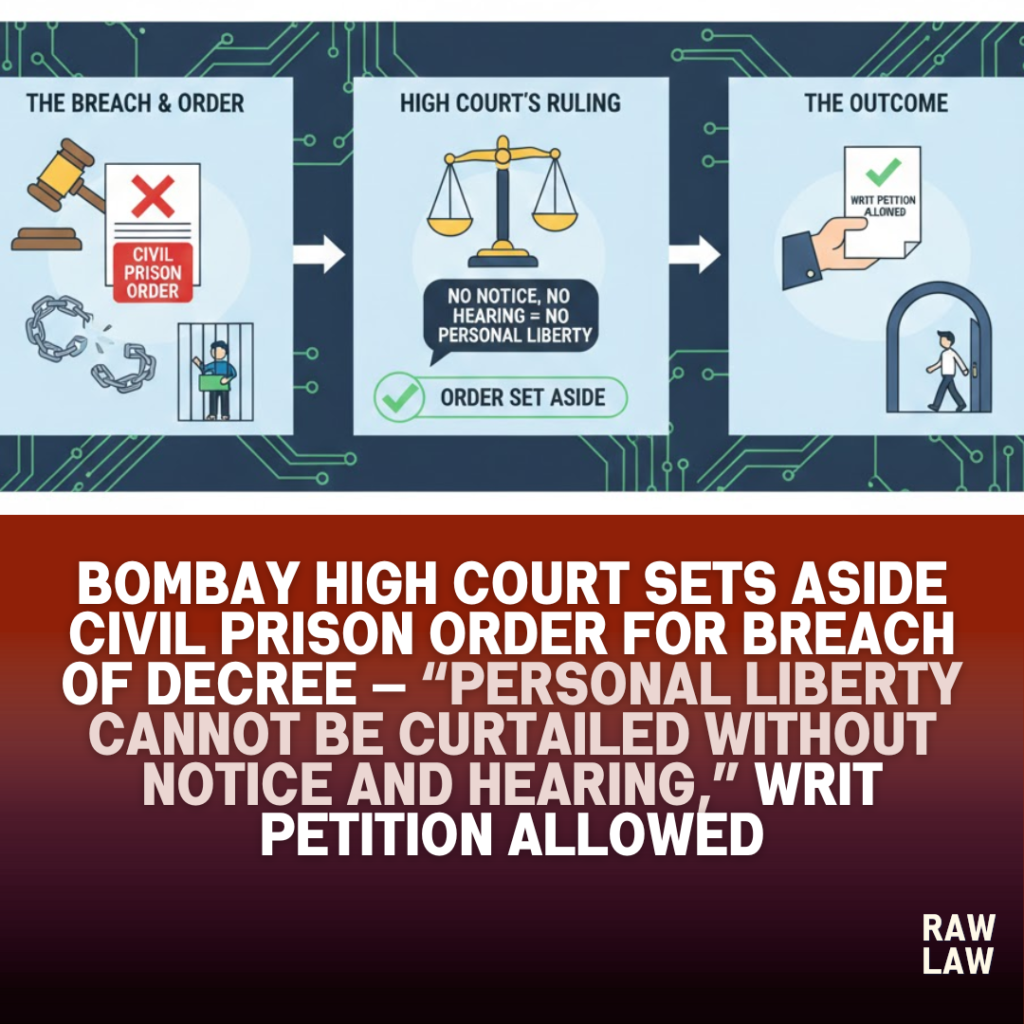
Court’s decision
The Bombay High Court, Aurangabad Bench, has quashed an order directing detention of a judgment debtor in civil prison for alleged breach of a civil decree, holding that such coercive action cannot be taken without issuing notice and affording an opportunity of hearing. Emphasising the primacy of personal liberty and principles of natural justice, the Court ruled that even where a decree is allegedly violated, the executing court must first call for an explanation before ordering detention. The writ petition was allowed, the impugned order was set aside, and the executing court was directed to conclude the execution proceedings expeditiously in accordance with law.
Facts
The dispute arose from long-pending execution proceedings initiated to enforce a civil decree passed in the early 2000s. Alleging continued obstruction and willful disobedience of the decree, the decree holder moved the executing court seeking coercive measures. Acting on an application during execution, the executing court ordered detention of the judgment debtor in civil prison for one month. Crucially, the order was passed without issuing prior notice to the judgment debtor or granting any opportunity to explain the alleged breach. Aggrieved by the deprivation of liberty without hearing, the judgment debtor approached the High Court under its writ jurisdiction challenging the legality of the detention order.
Issues
The core legal issues before the High Court were whether an executing court can order detention in civil prison without issuing notice or granting a hearing, whether such an order violates principles of natural justice and personal liberty, and whether the executing court is duty-bound to adopt a less drastic, procedurally fair approach even in cases of alleged willful breach of a decree. The case also raised the question of the High Court’s supervisory role in correcting procedural lapses that result in serious consequences such as arrest and detention.
Petitioner’s arguments
The petitioners contended that the impugned order was manifestly illegal as it directly curtailed personal liberty without following due process. They argued that no notice was served and no opportunity of hearing was granted before ordering civil imprisonment. According to them, even assuming a breach of the decree, the executing court was bound to issue notice and seek an explanation prior to invoking coercive measures. Reliance was placed on recent Supreme Court authority underscoring that detention in execution proceedings is a severe consequence and must be preceded by a fair hearing. The failure to follow this mandatory safeguard, it was argued, vitiated the order in its entirety.
Respondent’s arguments
The respondent opposed the writ petition, asserting that the decree had been passed decades earlier and had been consistently obstructed by the judgment debtor. It was argued that despite an injunction operating against the judgment debtor, there was deliberate and intentional disobedience warranting strict action. The executing court, according to the respondent, was justified in ordering detention given the prolonged non-compliance. The respondent further highlighted that the decree holder had deposited subsistence allowance for detention, indicating procedural compliance, and urged the High Court not to interfere with the executing court’s discretionary order.
Analysis of the law
The High Court analysed the law governing execution of decrees, particularly provisions permitting arrest and detention in civil prison. While the Code of Civil Procedure allows such measures, they are hedged with safeguards to prevent arbitrary deprivation of liberty. Detention is not punitive but coercive, intended to compel compliance. However, because it impacts fundamental rights, courts are required to strictly adhere to principles of natural justice. Issuance of notice and an opportunity of hearing are integral to fair procedure. The Court reiterated that procedural safeguards are not empty formalities but essential checks against misuse of coercive powers in execution proceedings.
Precedent analysis
A significant reliance was placed on a recent Supreme Court judgment which criticised executing courts for ordering arrest and detention without granting a hearing. The apex court had observed that even where there is delay or non-compliance, the executing court should be “more considerate” given the severe consequences involved. It underscored that High Courts, exercising supervisory jurisdiction, must intervene where such procedural lapses occur. The Bombay High Court found this precedent directly applicable, noting that the executing court’s failure to afford even one opportunity of hearing rendered the detention order unsustainable in law.
Court’s reasoning
Applying the above principles, the High Court held that the executing court committed a clear error by ordering detention without notice or hearing. Such an order, the Court observed, results in deprivation of personal liberty and therefore must strictly comply with natural justice. Even if a breach of the decree was apparent, the executing court was expected to issue notice and call for an explanation before resorting to civil imprisonment. The absence of this mandatory step vitiated the order. The Court also took note of the deposited subsistence allowance and permitted its withdrawal by the decree holder, while setting aside the detention order in its entirety.
Conclusion
The writ petition was allowed. The impugned order directing detention in civil prison was quashed and set aside. The decree holder was permitted to withdraw the amount deposited towards subsistence allowance. Importantly, the executing court was directed to decide the execution proceedings afresh, strictly in accordance with law, within a stipulated time frame. The ruling reinforces that coercive execution measures cannot override procedural fairness and that personal liberty remains protected even at the execution stage of civil proceedings.
Implications
This judgment serves as a strong reminder to executing courts that arrest and detention are exceptional measures requiring scrupulous adherence to due process. For litigants and practitioners, it clarifies that non-compliance with a decree does not automatically justify civil imprisonment without notice and hearing. The decision strengthens procedural safeguards in execution proceedings and underscores the High Court’s role in correcting orders that infringe personal liberty. It is likely to influence execution practice by ensuring greater judicial caution before resorting to detention as a coercive tool.
Case law references
- Supreme Court precedent on execution and detention: The apex court held that before ordering arrest and detention in execution proceedings, the executing court must afford an opportunity of hearing, given the severe consequences involved. The present court applied this principle to set aside the detention order passed without notice.
FAQs
Q1. Can a civil court send a judgment debtor to prison without notice?
No. The Bombay High Court has held that detention in civil prison without issuing notice and granting a hearing violates principles of natural justice and personal liberty.
Q2. Is detention in execution proceedings automatic on breach of decree?
No. Detention is a coercive measure, not automatic. Courts must first issue notice and seek an explanation before ordering civil imprisonment.
Q3. What is the High Court’s role in such execution matters?
The High Court can exercise supervisory and writ jurisdiction to set aside execution orders that violate due process or fundamental rights.