


Court’s decision
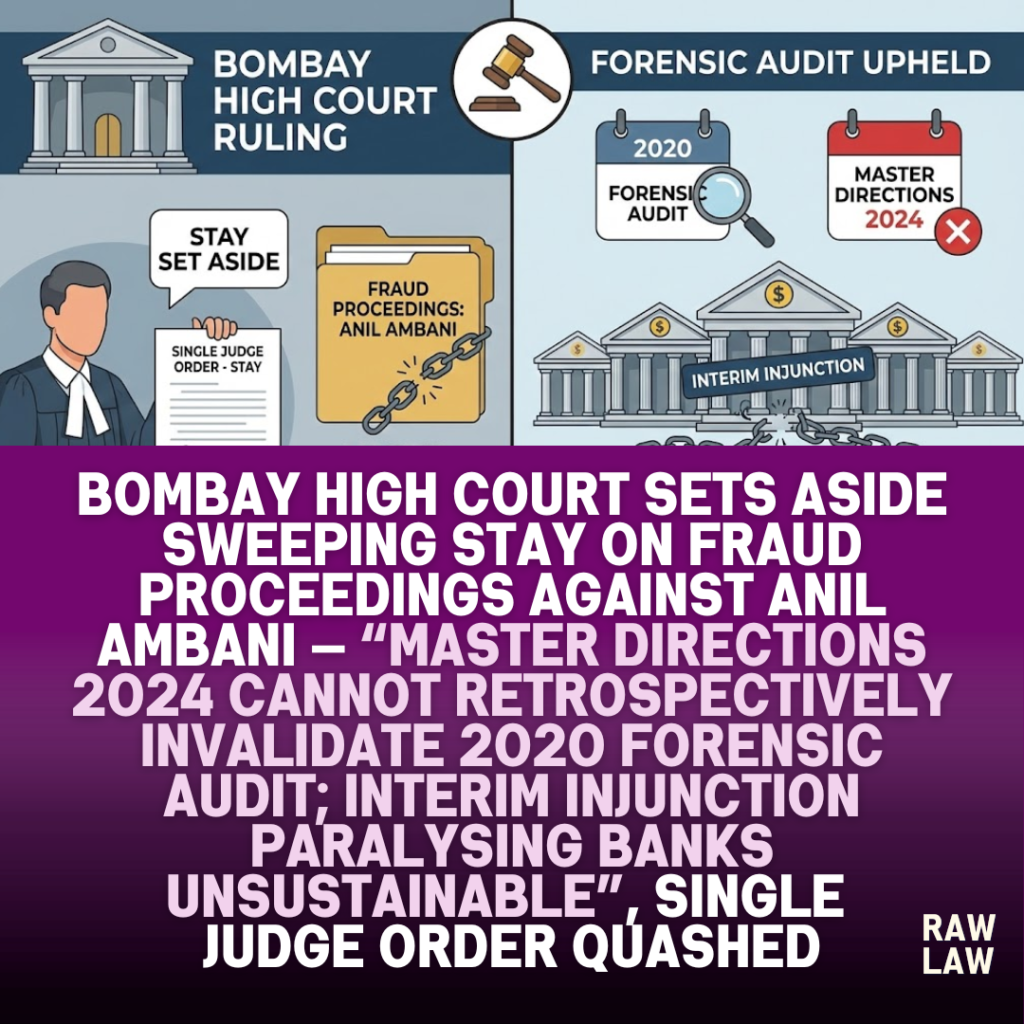
The Bombay High Court (Division Bench) allowed a batch of appeals filed by Bank of Baroda, IDBI Bank, Indian Overseas Bank and BDO India LLP, and set aside the interim order of the learned Single Judge which had stayed all actions based on the Forensic Audit Report dated 15 October 2020.
The Division Bench held that the Reserve Bank of India Master Directions on Frauds, 2024 cannot retrospectively invalidate actions taken under the 2016 Master Directions. It found that the interim injunction effectively stalled fraud classification proceedings and paralysed statutory banking action. The impugned order was quashed, and the restraint against banks proceeding under the forensic report was lifted.
Facts
The respondent, a former non-executive director of Reliance Communications Limited and its group entities, filed three commercial suits challenging show-cause notices and a fraud classification order issued by certain banks.
The banks relied upon a Forensic Audit Report dated 15 October 2020 prepared by BDO India LLP pursuant to the RBI Master Directions on Frauds, 2016.
The respondent contended that the forensic audit was illegal as BDO was allegedly not qualified under the Companies Act or ICAI framework. He further argued that under the RBI Master Directions, 2024—particularly Footnote 14 to Clause 4.1—only auditors qualified under relevant statutes could conduct such audits.
The learned Single Judge granted interim relief staying all actions taken or proposed to be taken under the forensic report and restrained banks from proceeding further.
Issues
The Division Bench examined:
- Whether the RBI Master Directions, 2024 apply retrospectively to invalidate forensic audits conducted in 2020 under the 2016 framework.
- Whether an external forensic audit under Clause 8.8.2 of the 2016 Master Directions must be conducted by a statutory auditor under the Companies Act.
- Whether the Single Judge exceeded jurisdiction by recording findings on eligibility and independence of the forensic auditor at the interim stage.
- Whether the grant of interim injunction satisfied the settled triple test of prima facie case, balance of convenience and irreparable injury.
Appellants’ arguments
The banks and BDO argued that the 2024 Master Directions operate prospectively and cannot nullify actions taken under the 2016 regime. Clause 10 of the 2024 Directions did not repeal or invalidate past forensic audits.
They contended that Clause 8.8.2 of the 2016 Master Directions permitted appointment of external forensic experts and did not mandate engagement of a Chartered Accountant registered under the Companies Act.
It was further argued that the respondent’s challenge was belated, having accepted the forensic report since 2020 and raised objections only after fraud proceedings were initiated. The interim injunction, they submitted, froze statutory banking powers and disrupted fraud risk management mechanisms.
Respondent’s arguments
The respondent argued that the forensic report lacked legal sanctity as it was not signed by a qualified Chartered Accountant as required under the Companies Act.
He relied on Footnote 14 of Clause 4.1 in the 2024 Master Directions, asserting that only auditors qualified under relevant statutes could conduct forensic audits.
It was submitted that what was implicit under the 2016 Directions was made explicit in 2024. The respondent also contended that supply of the complete forensic report occurred only in 2025, thereby extending limitation. He asserted that classification as fraud would have devastating consequences, amounting to “civil death.”
Analysis of the law
The Division Bench emphasized the settled principle that statutes and subordinate legislation operate prospectively unless expressly made retrospective.
The Court examined Clause 10 of the 2024 Master Directions and noted that while certain circulars were superseded, there was no express provision nullifying forensic audits conducted earlier under the 2016 Directions.
It held that the Single Judge erred in reading Footnote 14 as a mandatory retrospective qualification requirement. The 2016 Directions allowed appointment of external forensic experts for investigative purposes. A forensic audit is distinct from a statutory audit under Sections 139–143 of the Companies Act.
Precedent analysis
The Court referred to principles laid down in decisions concerning prospective operation of statutes, including rulings emphasizing that repeal or supersession does not invalidate past actions unless expressly provided.
It also relied on jurisprudence clarifying that fraud classification is a function of lending banks and not of the auditor. The forensic report is investigative material, not a statutory adjudication.
The Bench observed that interim courts must refrain from rendering final findings on disputed statutory interpretation at an interlocutory stage, particularly where such findings may prejudice trial.
Court’s reasoning
The Division Bench held that the learned Single Judge travelled beyond pleadings and arguments in recording findings on auditor independence and alleged incompetence.
It found that the injunction virtually created a status quo ante and prevented banks from exercising statutory powers under fraud risk management directions. Such restraint had systemic implications for the banking sector.
The Court concluded that no strong prima facie case was made out. The balance of convenience lay in allowing banks to proceed with show-cause processes, where the respondent would have full opportunity to respond.
Irreparable injury was not established merely by apprehension of fraud classification, especially when due process safeguards existed.
Conclusion
The Division Bench allowed the appeals, quashed the interim injunction, and restored the banks’ liberty to proceed under the Forensic Audit Report and corresponding show-cause notices.
The Court clarified that observations were confined to the interim stage and would not prejudice final adjudication of the suits.
Implications
This ruling has significant implications for banking regulation and fraud risk management in India.
It affirms that RBI Master Directions operate prospectively and protects actions taken under earlier regulatory regimes.
The judgment also delineates the distinction between statutory audit under the Companies Act and investigative forensic audits commissioned by banks.
Importantly, it curtails the use of civil suits to stall fraud classification proceedings at an interlocutory stage, reinforcing judicial restraint in banking and financial fraud matters.
Case Law References
- Zile Singh v. State of Haryana (2004) 8 SCC 1 – Statutes presumed prospective unless expressly retrospective.
- Commissioner of Income Tax v. Vatika Township Pvt. Ltd. (2015) 1 SCC 1 – Reiterated rule against retrospective operation affecting substantive rights.
- C. Bright v. District Collector (2021) 2 SCC 392 – Timelines in public duty statutes often directory unless expressly mandatory.
These principles were applied to hold that the 2024 Master Directions cannot invalidate a 2020 forensic audit.
FAQs
1. Can RBI Master Directions 2024 invalidate forensic audits conducted under the 2016 framework?
No. The Bombay High Court held that the 2024 Directions operate prospectively and do not retrospectively nullify audits conducted earlier.
2. Must a forensic audit under RBI fraud directions be conducted by a Chartered Accountant under the Companies Act?
The Court held that external forensic audits under the 2016 Directions are distinct from statutory audits and need not be conducted by a Companies Act auditor.
3. Can courts stay fraud classification proceedings at the interim stage?
Only if a strong prima facie case, balance of convenience and irreparable injury are clearly established. Mere apprehension of reputational harm is insufficient.