


Court’s Decision
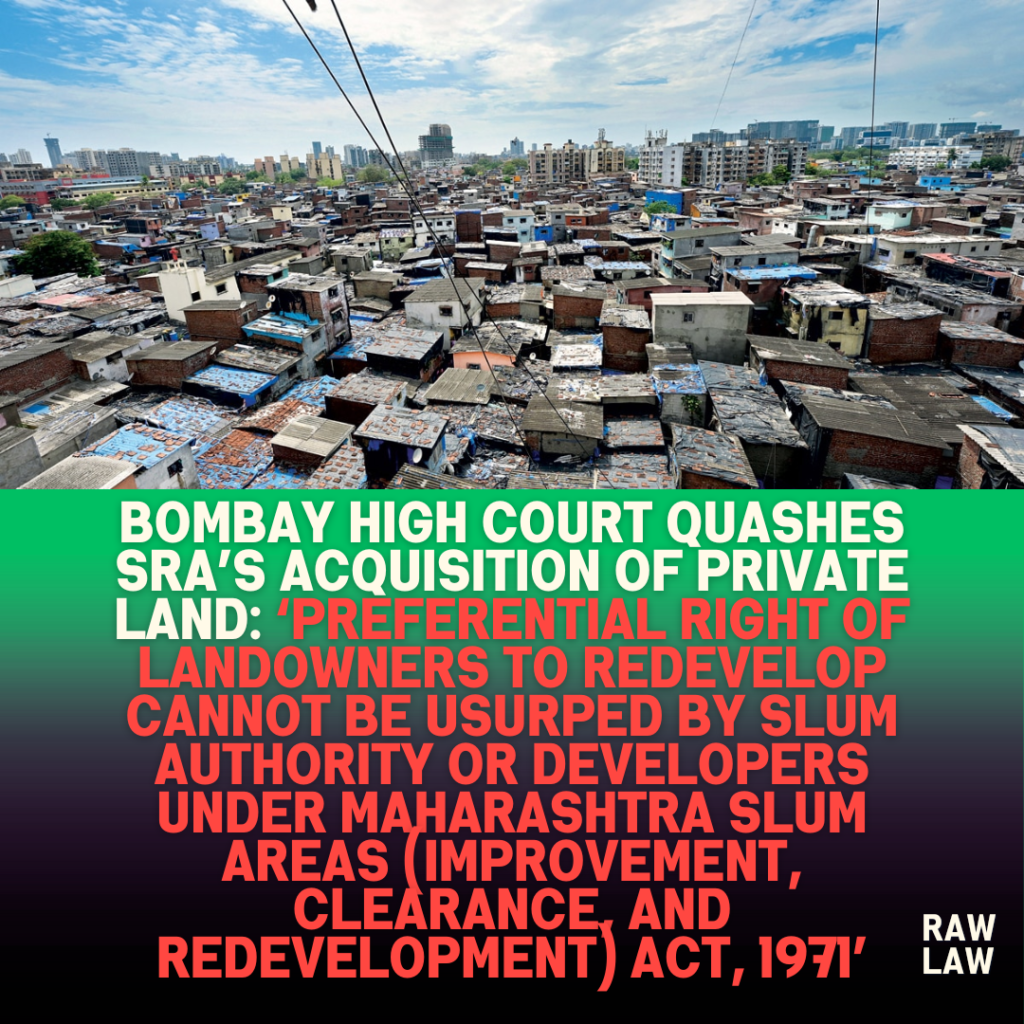
The Bombay High Court, in a landmark ruling delivered by Justice G.S. Kulkarni and Justice Aarti Sathe, quashed the Government Notification dated 21 April 2016 acquiring private land under Section 14(1) of the Maharashtra Slum Areas (Improvement, Clearance, and Redevelopment) Act, 1971, holding the acquisition as arbitrary, illegal, and unconstitutional.
The Court declared that landowners enjoy a preferential right to undertake redevelopment of their own property, and the State or Slum Rehabilitation Authority (SRA) cannot initiate acquisition without first offering the landowner a fair opportunity to propose redevelopment. It directed that the acquisition proceedings, the SRA’s award, and possession notice be set aside and further admonished SRA officials for collusive and high-handed conduct influenced by private developers.
Justice Kulkarni remarked:
“Before the draconian powers under Section 14 are exercised, authorities must ensure that they are not acting at the behest of unscrupulous elements and that landowners’ constitutional rights under Article 300A are duly respected.”
Facts
The case concerned private land in Goregaon (East), Mumbai, owned by the petitioner, on which slum structures had come up. The land was declared as a Slum Rehabilitation Area under Section 3C(1) of the Slum Act. A society formed by slum dwellers requested acquisition under Section 14(1), claiming the landowner had failed to provide basic facilities. Acting on this request, the Deputy Collector and CEO, SRA, recommended acquisition to the State Government.
The petitioner alleged that no show-cause notice was served, and publication of the notice in a local paper was inadequate and obscure. Despite objections, the Housing Department issued a notification acquiring the land in April 2016 and later awarded a paltry compensation of ₹12 lakhs. The petitioner filed this writ petition in 2017, challenging the acquisition as violative of due process and fundamental rights.
During proceedings, the slum society (Respondent No.6) filed an affidavit admitting it had been misled by the developer and withdrew support for the acquisition, agreeing to partner with the landowner for redevelopment. The society terminated its earlier developer and resolved to implement redevelopment jointly with the petitioner.
Issues
- Whether the State Government and SRA could acquire private land under Section 14(1) without first recognizing the landowner’s preferential right to redevelop the property.
- Whether the acquisition proceedings were vitiated by procedural irregularities and lack of notice.
- Whether the actions of the SRA and developer amounted to arbitrary exercise of power violating Article 300A of the Constitution.
Petitioner’s Arguments
The petitioner contended that it was the lawful owner of the private land, and that the SRA’s acquisition was arbitrary, mechanical, and contrary to the Slum Act’s statutory scheme. It argued that the preferential right to redevelop vested in the landowner under Sections 13 and 14 was violated.
Relying on Indian Cork Mills Pvt. Ltd. v. State of Maharashtra (2018 SCC OnLine Bom 1214) and Bishop John Rodrigues v. State of Maharashtra (2004 SCC OnLine Bom 1632), counsel submitted that Section 14(1) cannot be invoked until the landowner is offered a 120-day notice to submit a redevelopment proposal. The petitioner emphasized that the acquisition occurred without notice, hearing, or cross-verification and was initiated solely at the behest of private developers seeking commercial benefit under Regulation 33(10) of the Development Control Regulations.
It was further argued that the compensation awarded (₹12 lakh) was shockingly inadequate and contrary to the principles of fairness and proportionality, violating the petitioner’s constitutional right to property under Article 300A.
Respondent’s Arguments
The State and SRA defended the acquisition, asserting that slum dwellers had formed a cooperative society and initiated the process under Section 14 due to the landowner’s failure to rehabilitate residents. They claimed compliance with statutory procedures and contended that the land was legitimately acquired for public purpose — slum rehabilitation.
However, they admitted during the hearing that no independent verification or invitation had been issued to the petitioner to redevelop the property, and that no speaking order or written reasoning preceded the acquisition notification.
The slum society, in its later affidavit, completely withdrew its earlier stand, confirming that the developer had misled it, and supported the petitioner’s claim that the acquisition was legally unsustainable.
Analysis of the Law
The Court analyzed the legislative framework of the Slum Act, focusing on Sections 13 and 14. Section 13 requires the CEO, SRA to invite landowners to redevelop declared slum areas within 120 days. Section 14 authorizes compulsory acquisition only if the landowner fails to act or refuses redevelopment.
The Bench noted that preferential rights of landowners are statutorily protected and form an integral part of Chapter I-A of the Slum Act, ensuring fairness before expropriation. Justice Kulkarni emphasized that acquisition is the last resort, permissible only after due process, notice, and opportunity are exhausted.
The Court held that none of these preconditions were satisfied, and hence, the State’s action was unconstitutional, reiterating that “acquisition machinery cannot be misused to usurp the landowner’s lawful rights.”
Precedent Analysis
- Indian Cork Mills Pvt. Ltd. v. State of Maharashtra (2018 SCC OnLine Bom 1214) – Recognized the landowner’s preferential right to redevelop slum property and held that Section 14 cannot be invoked without exhausting Section 13 procedure.
- Bishop John Rodrigues v. State of Maharashtra (2004 SCC OnLine Bom 1632) – Held that valuable property rights under Article 300A cannot be curtailed unless the SRA proves that acquisition is the only viable option, emphasizing the need for notice and opportunity.
- Tarabai Nagar Co-operative Housing Society v. State of Maharashtra (2025 SCC OnLine SC 1795) – The Supreme Court affirmed Indian Cork Mills, holding that acquisition must be kept in abeyance until the landowner’s preferential right is extinguished.
- Saldanha Real Estate Pvt. Ltd. v. Bishop John Rodrigues (2025 SCC OnLine SC 1794) – The Supreme Court reiterated that acquisition without notice is void ab initio, condemning collusion between developers and SRA officials as a “violation of rule of law and misuse of statutory power.”
The Court noted that these rulings form a binding precedent, safeguarding private ownership against arbitrary State action in slum redevelopment contexts.
Court’s Reasoning
Applying the above principles, the Court held that the State’s acquisition was procedurally defective and substantively unconstitutional. It found that:
- No 120-day notice or invitation to redevelop was issued to the petitioner;
- The SRA failed to record reasons or conduct an inquiry before recommending acquisition;
- The acquisition served private interests, not public welfare; and
- The compensation was nominal and disproportionate to the land value.
Justice Kulkarni strongly criticized the SRA’s conduct, observing that:
“The SRA has forsaken its duty to uphold the rule of law and instead acted as an instrument of private gain. Such bureaucratic misuse of statutory powers cannot be tolerated in a democratic framework.”
The Court emphasized that acquisition under the Slum Act is not for public purpose but for private rehabilitation, and therefore requires stricter scrutiny to prevent misuse.
Conclusion
The High Court allowed the writ petition, quashing the notification of acquisition, the award, and the possession order. It also reaffirmed that the petitioner is entitled to redevelop the land in partnership with the slum society, which had now aligned with the owner.
It further directed the SRA and State Government to exercise heightened caution in future acquisitions and warned against collusion with private developers, noting that such misuse of power could attract judicial censure.
“The State and its officers must act as protectors of private property rights, not facilitators of private profiteering under the garb of rehabilitation.”
Implications
This judgment reaffirms the primacy of landowners’ preferential rights in slum redevelopment and curbs arbitrary acquisitions by the SRA. It also warns that public authorities acting under private developer influence will face judicial consequences.
The ruling marks a turning point for Mumbai’s redevelopment regime — asserting that redevelopment cannot become a tool for dispossession, and Article 300A rights remain inviolable unless extinguished through due process.