


Court’s decision
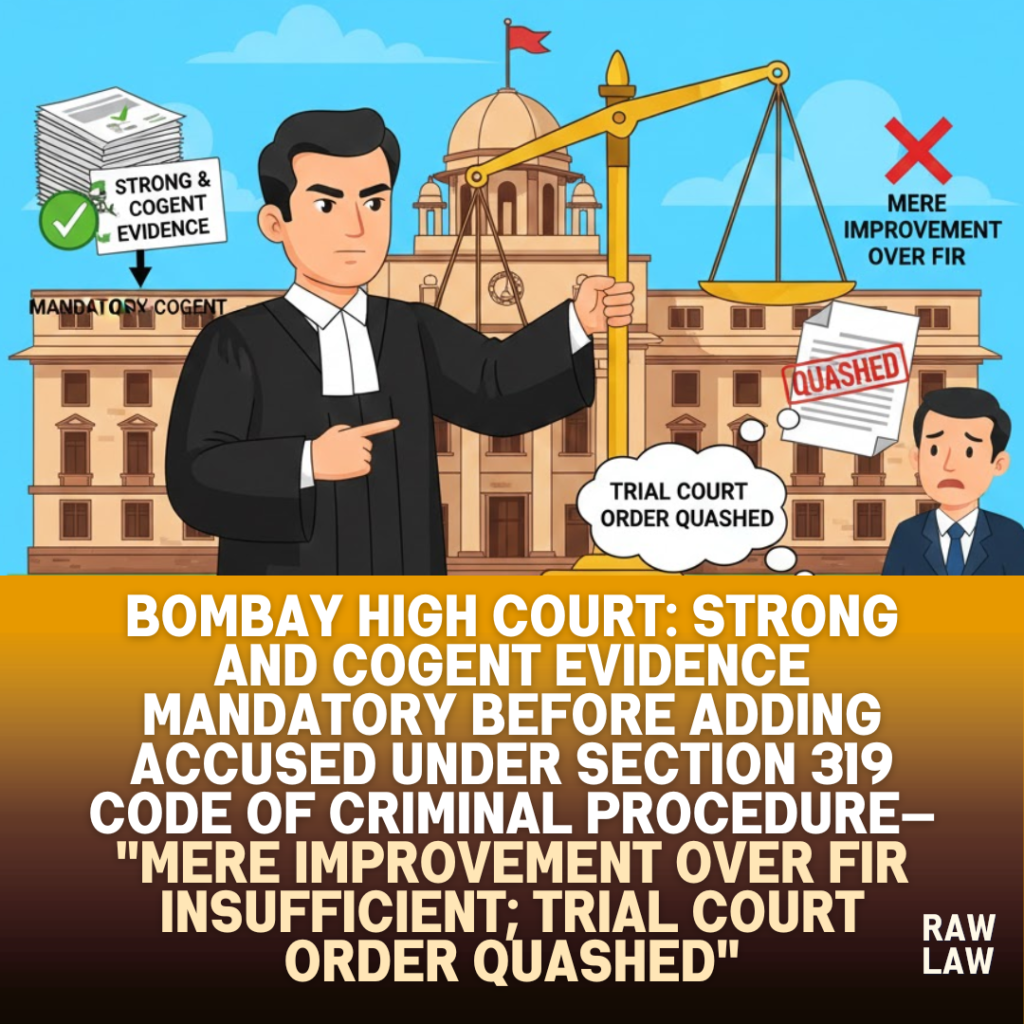
The Bombay High Court quashed a Sessions Court order that had added three individuals as accused under Section 319 of the Code of Criminal Procedure during trial in an assault case. The Court held that the power to summon additional accused is extraordinary and must be exercised sparingly, only when strong and cogent evidence emerges during trial.
Finding that the Trial Court relied primarily on the complainant’s examination-in-chief, despite material omissions in the FIR and witness statements, the High Court set aside the addition of the three accused. However, it upheld the Trial Court’s refusal to add two other proposed accused alleged to be conspirators.
Facts
The case arose from an alleged assault incident dated 1 May 2020. The FIR was lodged on 3 May 2020 and named seven accused persons. Notably, the three petitioners who were later added as accused were not named in the FIR.
Statements of several eye-witnesses, including injured witnesses, were recorded during investigation under Section 161 of the Code of Criminal Procedure. None of these witnesses named the three petitioners as assailants.
Subsequently, the complainant’s statement was recorded under Section 164 of the Code of Criminal Procedure approximately one and a half months after the incident. In that statement, the names of the three petitioners were disclosed for the first time as alleged assailants.
During trial, after the complainant’s examination-in-chief, an application under Section 319 of the Code of Criminal Procedure was filed seeking addition of five persons as accused. The Trial Court partly allowed the application by adding three persons and rejecting the addition of two others. Both sides challenged the order before the High Court.
Issues
The principal issue before the High Court was whether the Trial Court correctly exercised its discretionary power under Section 319 of the Code of Criminal Procedure while adding three new accused during trial.
The Court was required to determine whether the evidence on record, particularly the complainant’s examination-in-chief, met the heightened standard laid down by the Constitution Bench of the Supreme Court for summoning additional accused.
A connected issue was whether the Trial Court erred in refusing to add two other proposed accused alleged to be conspirators.
Petitioner’s arguments
The petitioners contended that their names were absent in the FIR and in the statements of injured eye-witnesses recorded during investigation. They argued that their implication surfaced only in the complainant’s later statement under Section 164 and in his deposition before the Trial Court.
Relying upon the Constitution Bench decision in Hardeep Singh v. State of Punjab, they argued that Section 319 requires a standard higher than that applied at the stage of framing of charge. The Court must be satisfied that the evidence, if unrebutted, would reasonably lead to conviction. According to them, the Trial Court failed to apply this rigorous test and mechanically relied on improved testimony.
Respondent’s arguments
The complainant supported the Trial Court’s order adding the three accused and argued that he had earlier submitted a complaint to the Superintendent of Police regarding non-inclusion of their names. He further relied upon his statement under Section 164 of the Code of Criminal Procedure, wherein he specifically attributed roles to the petitioners.
With respect to the two persons not added as accused, the complainant argued that they were the masterminds behind the assault and had allegedly orchestrated the attack due to a civil dispute. It was submitted that the Trial Court erred in refusing to summon them as conspirators.
Analysis of the law
The High Court undertook a detailed analysis of Section 319 of the Code of Criminal Procedure in light of the Constitution Bench judgment in Hardeep Singh v. State of Punjab. The Supreme Court has held that the power under Section 319 is discretionary and extraordinary. It must be exercised sparingly and only when strong and cogent evidence appears against a person.
The test is more stringent than the prima facie standard applied at the stage of framing of charge. The Court must assess whether the evidence, if left unrebutted, would reasonably lead to conviction. Mere probability of complicity is insufficient.
The High Court also considered Hetram @ Babli v. State of Rajasthan, which clarified that while cross-examination need not always precede a Section 319 decision, the quality of evidence must still satisfy the higher threshold.
Precedent analysis
In Hardeep Singh v. State of Punjab, the Constitution Bench crystallized the legal standard for invoking Section 319. It emphasized that summoning an additional accused is not routine but an exceptional step requiring strong and cogent evidence.
In Rajendra Singh v. State of Uttar Pradesh and Sarabjit Singh v. State of Punjab, the Supreme Court reiterated that the Court must apply stringent tests and that satisfaction must go beyond mere suspicion.
In Hetram @ Babli v. State of Rajasthan, the Supreme Court observed that where material omissions and contradictions exist, courts cannot record the satisfaction contemplated under Section 319.
The High Court found that the Trial Court failed to apply these binding principles.
Court’s reasoning
The High Court noted that the three petitioners were not named in the FIR nor in the statements of injured eye-witnesses. Their alleged involvement was disclosed for the first time in the complainant’s later statement under Section 164 and reiterated in examination-in-chief.
Significantly, the complainant attributed specific overt acts to the petitioners in his deposition. However, the injured witness concerned had not mentioned any such role in his earlier statement under Section 161. These omissions were material and went to the root of the prosecution case.
The High Court observed that summoning an accused is a serious judicial act and cannot be treated as a perfunctory exercise. The Trial Court failed to record the degree of satisfaction mandated by Hardeep Singh.
Accordingly, the addition of the three petitioners was held unsustainable. However, the refusal to add the two alleged conspirators was upheld as the material against them was speculative.
Conclusion
The Bombay High Court allowed the writ petition filed by the three newly added accused and quashed the order summoning them under Section 319 of the Code of Criminal Procedure. The connected petition seeking addition of two alleged conspirators was dismissed.
The Court clarified that its observations were prima facie and would not influence the Trial Court in adjudicating the case against the charge-sheeted accused.
Implications
This judgment reinforces the stringent safeguards surrounding Section 319 of the Code of Criminal Procedure. It underscores that improved testimony, unsupported by earlier statements or corroborative evidence, cannot justify the exercise of extraordinary powers.
Trial courts must carefully evaluate whether the evidence on record meets the “strong and cogent” standard before summoning additional accused. The ruling strengthens procedural safeguards and prevents misuse of criminal process through belated implication of individuals.
Case law references
- Hardeep Singh v. State of Punjab (AIR 2014 SC 1400)
Constitution Bench ruling that Section 319 power is extraordinary and requires strong and cogent evidence beyond prima facie suspicion. - Rajendra Singh v. State of Uttar Pradesh (AIR 2007 SC 2786)
Clarified that courts must apply judicial discretion and not act mechanically while invoking Section 319. - Sarabjit Singh v. State of Punjab (AIR 2009 SC 2792)
Held that a higher standard than framing of charge is required for summoning additional accused. - Hetram @ Babli v. State of Rajasthan (2024)
Reiterated that courts must assess material omissions and contradictions before invoking Section 319.
FAQs
1. What is the standard for adding an accused under Section 319 CrPC?
The court must find strong and cogent evidence indicating that the person, if not already accused, appears to have committed the offence. The standard is higher than that for framing a charge.
2. Can a person be added as accused based solely on examination-in-chief?
Yes, but only if the evidence is credible and strong enough that, if unrebutted, it could reasonably lead to conviction.
3. Do omissions in the FIR affect a Section 319 application?
Yes. Material omissions in the FIR and witness statements are relevant factors and may weaken the case for summoning additional accused.