


1. Court’s decision
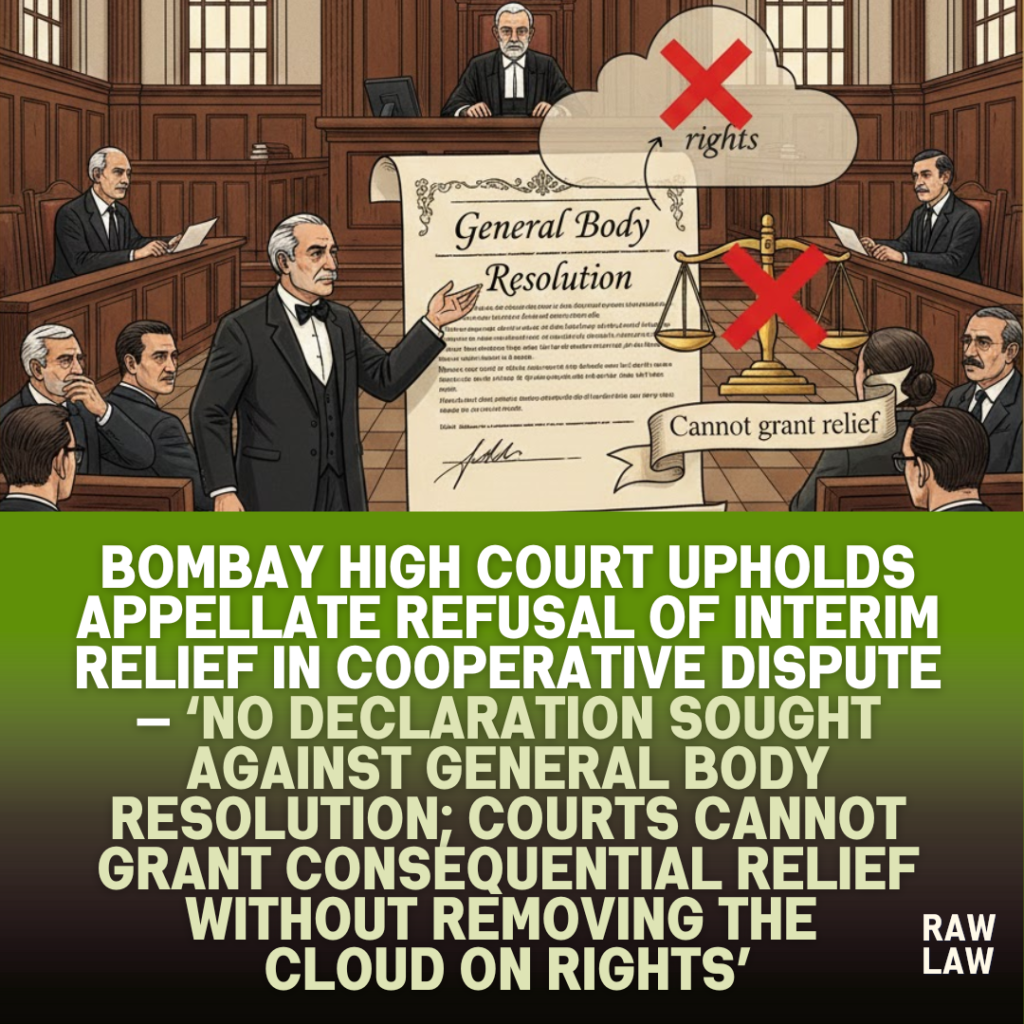
The Bombay High Court dismissed the writ petition filed under Article 227 challenging the Cooperative Appellate Court’s order which had set aside interim relief earlier granted by the Cooperative Court in a dispute concerning parking rights, antenna-revenue claims, maintenance charges, and alleged obstruction by the managing committee of a cooperative housing society. The High Court held that the petitioners, who were both members and developers of the building, had not sought any declaratory relief challenging the general body resolutions that formed the very basis of the society’s actions. Without removing that “cloud” over their rights, no interim injunction could be granted. The Court further upheld the findings that the petitioners had no established parking entitlement, had failed to prove enforceable contractual rights under a 2005 letter, and had not displaced the legal effect of the 2020 deemed conveyance vesting management rights in the society.
2. Facts
The cooperative housing society was registered in 2007. The petitioners, who were the developers of the building and later became members, claimed special rights allegedly arising from a 5 May 2005 letter signed by flat purchasers prior to registration. They asserted entitlement to: (i) separate parking, (ii) exclusive antenna rights and 50% revenue from the mobile tower, (iii) use of a garage, (iv) reduced maintenance rates, and (v) exemption from stamp duty and registration charges.
The society denied the authenticity of the 2005 letter, alleged forgery, and asserted that such pre-registration documents cannot bind the corporate entity. It relied on the 23 October 2020 deemed conveyance conveying leasehold rights of the land and building. The society alleged that the petitioners were defaulters in maintenance, and recovery certificates were issued under Section 154B-29.
The Cooperative Court granted interim relief, including appointment of a Chartered Accountant. The Appellate Court reversed, prompting the present writ petition.
3. Issues
The High Court examined:
• Whether the 5 May 2005 letter created enforceable rights after registration and deemed conveyance.
• Whether the petitioners had any proven right to specific parking spaces under Bye-laws 80–81.
• Whether the failure to challenge the society’s general body resolution barred interim relief relating to maintenance and parking.
• Whether the Cooperative Court exceeded jurisdiction in appointing an accountant.
• Whether Article 227 permitted interference with appellate fact-findings.
4. Petitioners’ arguments
The petitioners argued that the 5 May 2005 letter was a binding contractual understanding with flat purchasers, obligating the society to honour its terms, including parking rights and antenna revenue sharing. They contended that the society’s general body resolution imposing double maintenance on commercial units was void ab initio and required no declaratory challenge, relying on the Supreme Court’s guidance in Annamalai v Vasanthi (2025).
They submitted that equality of treatment between commercial and residential units is mandated by the precedent in Venus Cooperative Housing Society Ltd v J.Y. Detwani (2003), and therefore the society’s levy of higher maintenance was arbitrary.
On parking, they relied on Bye-laws 80 and 81, arguing that the society’s refusal was discriminatory. They defended the Trial Court’s appointment of a Chartered Accountant on grounds of serious financial discrepancies. They argued that the Appellate Court erred in reversing an equitable interim order without noticing long-standing harassment by the society.
5. Respondent society’s arguments
The society argued that the petitioners never applied for parking allotment, and no documentary evidence showed any allocation. The Appellate Court’s factual findings on this point, it argued, were final. It contended that the 2005 letter was fabricated, unsigned by the society, inconsistent, and devoid of legal enforceability.
It asserted that the 2020 deemed conveyance vested all management rights—including antenna control—in the society. It stressed that the petitioners were serial defaulters, as evidenced by a recovery certificate.
Importantly, it argued that petitioners had not challenged the general body resolution approving differential maintenance and therefore sought interim relief indirectly nullifying a binding resolution without seeking the essential declaratory relief. It contended that the Cooperative Court lacked jurisdiction to appoint a Chartered Accountant.
6. Analysis of the law
The Court first held that the 2005 letter lacked probative value: it was on plain paper, included overwritings, lacked formal adoption by the corporate entity, and showed no evidence that the society ratified the pre-incorporation understanding. Cooperative societies act only through resolutions and statutory procedures; pre-registration arrangements do not bind them unless properly adopted.
Next, the Court held that Bye-laws 80–81 demand an application for parking and a transparent procedure for allotment. The petitioners produced neither an application nor an allotment record. Findings of fact by the Appellate Court cannot be interfered with under Article 227 absent perversity.
The Court’s central analysis involved the application of the Supreme Court’s doctrine in Annamalai v Vasanthi (2025), which clarifies when declaratory relief is mandatory. If consequential relief (such as injunction against maintenance or parking arrangements) depends on removing a cloud over the plaintiff’s right, a declaration is essential. Since petitioners’ rights depended entirely on invalidating general body resolutions—and they failed to challenge them—the Court held that no consequential interim relief could be granted.
Interim relief cannot grant indirectly what cannot be granted finally. Such relief must be ancillary to a final prayer, and here the foundational declaratory prayer was missing.
7. Precedent analysis
• Annamalai v Vasanthi (2025) — The Supreme Court held that where the plaintiff’s asserted right is clouded, a declaration is necessary before consequential relief can be granted. The High Court applied this principle to hold that petitioners’ failure to challenge the general body resolution was fatal.
• Venus Cooperative Housing Society Ltd (2003) — The petitioners relied on this judgment to argue against discriminatory maintenance charges. The Court held that while the principle of parity may apply, it cannot override a subsisting, unchallenged general body resolution.
• Cooperative jurisprudence on Article 227 — Reiterates that the High Court cannot re-appreciate evidence or overturn findings of fact absent jurisdictional error. The Appellate Court’s findings regarding the 2005 letter, parking, and antenna rights were grounded in evidence and therefore immune from supervisory interference.
8. Court’s reasoning
The Court concluded:
• The petitioners failed to establish any surviving contractual right from the 2005 letter;
• The 2020 deemed conveyance vested antenna revenue and management control in the society, absent proof of superior rights;
• No application or allotment existed for parking spaces; hence no prima facie case;
• Interim relief cannot suspend the general body’s decisions unless the petitioners challenge them directly;
• Without seeking a declaration that the resolution imposing higher maintenance was void, the petitioners could not seek interim injunctions nullifying that resolution;
• The Cooperative Court’s appointment of a Chartered Accountant was a permissible procedural aid but ultimately irrelevant to the central bar: absence of declaratory relief.
Given the lack of perversity or jurisdictional error, the High Court refused to intervene.
9. Conclusion
The writ petition was dismissed. The Court affirmed that cooperative societies are governed by their general body resolutions, which cannot be circumvented by indirect interim orders. It held that the petitioners must challenge such resolutions directly if they seek to avoid their operation.
It further held that pre-incorporation letters lacking formal adoption cannot bind a cooperative society; that parking rights must arise from documented allotment; and that Article 227 does not permit re-appreciation of factual findings. The petitioners failed to establish any right warranting interim intervention.
10. Implications
This ruling fortifies several principles of cooperative law:
• General body supremacy: Resolutions bind all members unless set aside by competent legal challenge.
• Declaratory relief as a necessity: Courts cannot grant injunctions that presuppose invalidity of an unchallenged resolution.
• Strict burden on developers-turned-members: Pre-registration understandings do not bind the society without adoption.
• Parking rights must be proven: Absence of application and allotment defeats claims under Bye-laws 80–81.
• Supervisory jurisdiction is narrow: Article 227 does not permit substituting factual findings with equitable preferences.
The ruling strengthens procedural discipline and internal autonomy of cooperative societies.
CASE LAW REFERENCES
1. Annamalai v Vasanthi (2025 SCC OnLine SC 2300)
Clarified when declaratory relief is essential before seeking consequential relief; applied directly.
2. Venus Coop. Housing Society Ltd (2003 (2) All MR 570)
Recognized parity in maintenance but cannot override an unchallenged resolution; distinguished.
3. Cooperative jurisprudence on Article 227
Affirms non-interference with factual findings absent perversity; applied to uphold the appellate court’s order.
FAQ SECTION
1. Can a member challenge differential maintenance without challenging the general body resolution?
No. Courts cannot suspend or override a general body decision unless the member first seeks a declaration that the resolution is void or illegal.
2. Do pre-registration agreements bind a cooperative housing society?
Not automatically. Unless the society adopts or ratifies such documents, they do not create enforceable rights against the corporate body.
3. What must a member prove to claim parking rights under cooperative bye-laws?
They must show an application for allotment and an actual allocation. Without such documents, no enforceable parking right exists.