


Court’s decision
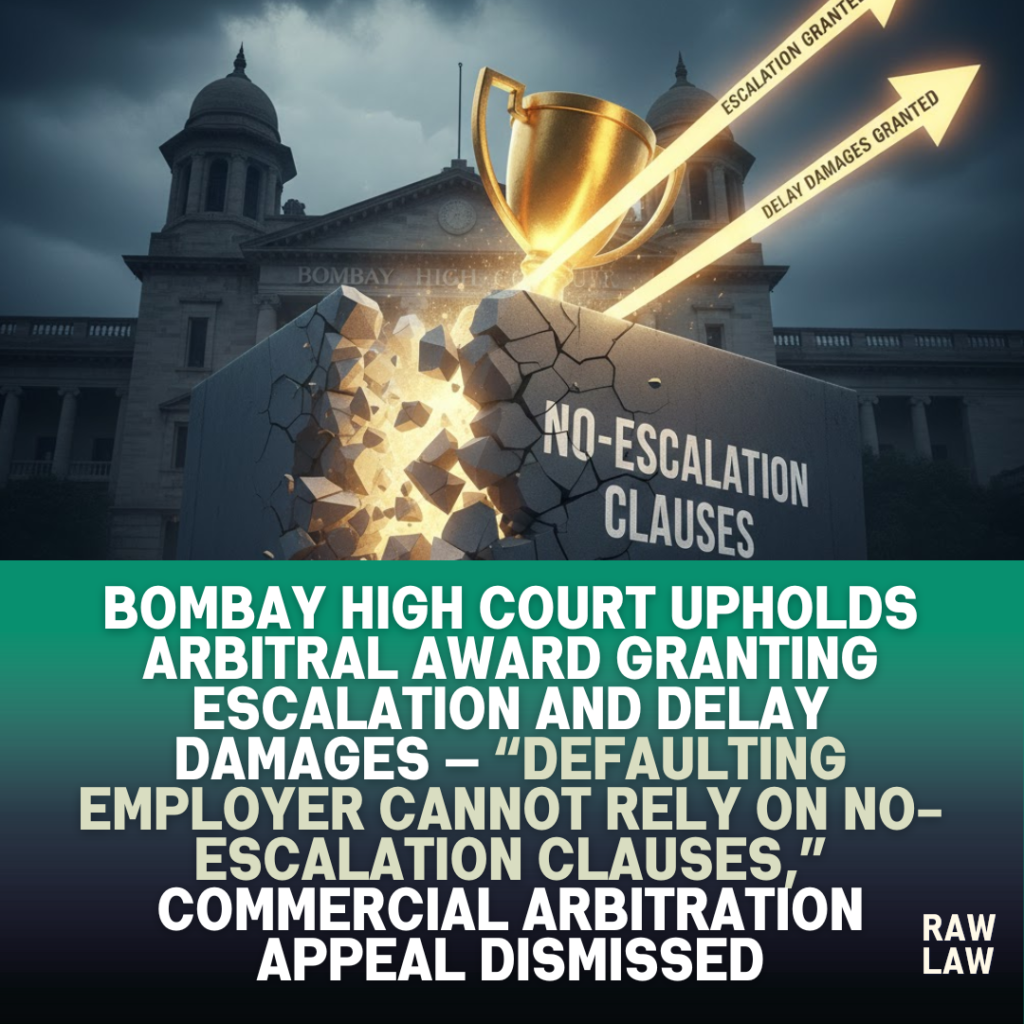
The Bombay High Court, Aurangabad Bench, has dismissed a commercial arbitration appeal filed by State authorities and irrigation officials, affirming an arbitral award that granted substantial compensation to a contractor for delay, escalation, loss of overheads, and wrongful deductions. The Court held that once a fundamental breach of contract by the employer is established, the defaulting party cannot fall back on contractual clauses barring escalation or compensation for idling of labour and machinery. Upholding both the arbitral award and the Commercial Court’s refusal to set it aside, the Division Bench ruled that there was no patent illegality or jurisdictional error warranting interference under Section 37 of the Arbitration and Conciliation Act.
Facts
The litigation arose from a large public works contract relating to repair, renovation, and restoration of multiple minor irrigation tanks in a drought-prone district of Maharashtra. The contract, valued at nearly ₹30 crore, was awarded after negotiations and was required to be completed within twelve months. The contractor commenced work pursuant to a work order issued in November 2006. However, the execution of work extended far beyond the stipulated period due to various impediments, including delay in completion of mandatory silt surveys, late handing over of work sites, and interruptions caused by administrative lapses. As the project prolonged by nearly three years, disputes arose between the parties regarding responsibility for delay and financial consequences.
Issues
The principal issues before the High Court were whether the arbitral tribunal had acted beyond the terms of the contract by granting escalation, loss of overheads, and compensation for reduced productivity; whether the arbitral award was contrary to substantive law or suffered from patent illegality; whether claims were barred by limitation; and whether the Commercial Court had erred in dismissing the challenge under Section 34 of the Arbitration and Conciliation Act. The appeal also raised questions on the scope of judicial interference under Section 37 and the extent to which courts can reappreciate evidence in arbitration matters.
Petitioner’s arguments
The appellants, representing State authorities, argued that the arbitral award was patently illegal and contrary to the express terms of the contract. They contended that the contract specifically prohibited escalation of prices and compensation for idling of machinery and labour. According to them, delays were attributable to the contractor’s slow progress, failure to mobilise resources properly, and non-compliance with contractual conditions such as submission of daily progress reports. It was argued that the arbitrator exceeded jurisdiction by ignoring contractual clauses and awarding amounts under heads that were expressly barred. The appellants further asserted that the claims were time-barred and that the Commercial Court had failed to appreciate these defects while dismissing the Section 34 challenge.
Respondent’s arguments
The contractor resisted the appeal by submitting that the arbitral tribunal had carefully analysed the contract, correspondence, and evidence before recording findings of fundamental breach by the employer. It was argued that delays were primarily due to failure of authorities to complete silt surveys in time, delayed availability of work sites, and administrative acts such as release of water into canals during execution. The respondent emphasised that once breach by the employer was established, the contractor was legally entitled to compensation for escalation, overheads, and loss of productivity. It was further submitted that the scope of interference under Section 37 was extremely limited and did not permit reappreciation of evidence or substitution of the court’s view for that of the arbitrator.
Analysis of the law
The High Court undertook a detailed analysis of the law governing judicial interference with arbitral awards. It reiterated that interpretation of contractual terms lies primarily within the domain of the arbitrator. Courts can interfere only where the award is patently illegal, perverse, or in conflict with public policy. The Bench emphasised that patent illegality must go to the root of the matter and cannot be invoked to reopen factual findings or reassess evidence. The Court also underscored the principle that arbitration is intended to provide finality and minimal court intervention, particularly in commercial disputes involving technical contracts.
Precedent analysis
The Court relied on a consistent line of decisions of the Supreme Court of India, including rulings holding that construction of contracts and assessment of evidence fall squarely within the arbitrator’s jurisdiction. It noted that escalation is a normal incident in prolonged contracts in an inflationary economy, especially where delay is attributable to the employer. The Bench also referred to precedents clarifying that a defaulting party cannot insist on strict enforcement of contractual clauses that bar compensation when its own breach has caused delay. These principles were applied to uphold the arbitral award in the present case.
Court’s reasoning
On facts, the High Court found that the arbitrator had extensively examined contractual clauses, evidence, and correspondence before concluding that the employer was responsible for substantial delays. The silt survey, a precondition for execution, was not completed for nearly six months, and thereafter monsoon conditions rendered execution impracticable. The Court accepted the arbitrator’s finding that the authorities committed fundamental breach by failing to perform their contractual obligations. In such circumstances, the Court held, the employer could not rely on clauses prohibiting escalation or compensation. The Commercial Court had rightly refused to set aside the award, and no jurisdictional error or patent illegality was demonstrated.
Conclusion
The Commercial Arbitration Appeal was dismissed. The High Court upheld the arbitral award granting compensation under multiple heads, as well as the Commercial Court’s order rejecting the challenge under Section 34. Interim relief earlier granted was vacated, and no stay of the judgment was granted despite partial deposit of the award amount. The ruling reinforces judicial restraint in arbitration matters and affirms the principle that courts will not interfere with reasoned arbitral awards absent clear illegality.
Implications
This judgment has significant implications for public contracts and arbitration involving government authorities. It clarifies that “no escalation” and “no compensation” clauses cannot shield an employer who is guilty of fundamental breach. The ruling strengthens contractor confidence in arbitration as an effective dispute resolution mechanism and reiterates the narrow scope of interference under Sections 34 and 37 of the Arbitration and Conciliation Act. For public bodies, it serves as a caution that administrative delays can result in substantial financial liability despite restrictive contractual clauses.
Case law references
- Assam State Electricity Board v. Buildworth Private Limited: Held that escalation is a normal consequence of delay in an inflationary economy; applied to justify compensation where employer caused delay.
- P.M. Paul v. Union of India: Recognised entitlement to escalation where delay is attributable to the employer.
- K.N. Sathyapalan v. State of Kerala: Held that an arbitrator can award extra costs where one party’s failure prevents timely performance.
- McDermott International v. Burn Standard Co. Ltd.: Affirmed that interpretation of contracts lies within the arbitrator’s domain.
These precedents were relied upon to uphold the award and reject the appeal.
FAQs
Q1. Can an arbitrator grant escalation despite a no-escalation clause?
Yes. If the employer is found to be in fundamental breach causing delay, courts have held that escalation and compensation can be granted despite restrictive clauses.
Q2. What is the scope of High Court interference under Section 37 of the Arbitration Act?
Interference is extremely limited. Courts cannot reappreciate evidence and may interfere only if the award suffers from patent illegality or jurisdictional error.
Q3. Are government authorities bound by arbitral awards in public works contracts?
Yes. Government bodies are equally bound, and cannot avoid liability for delay by relying on contractual clauses if they are themselves in breach.