

Court’s decision
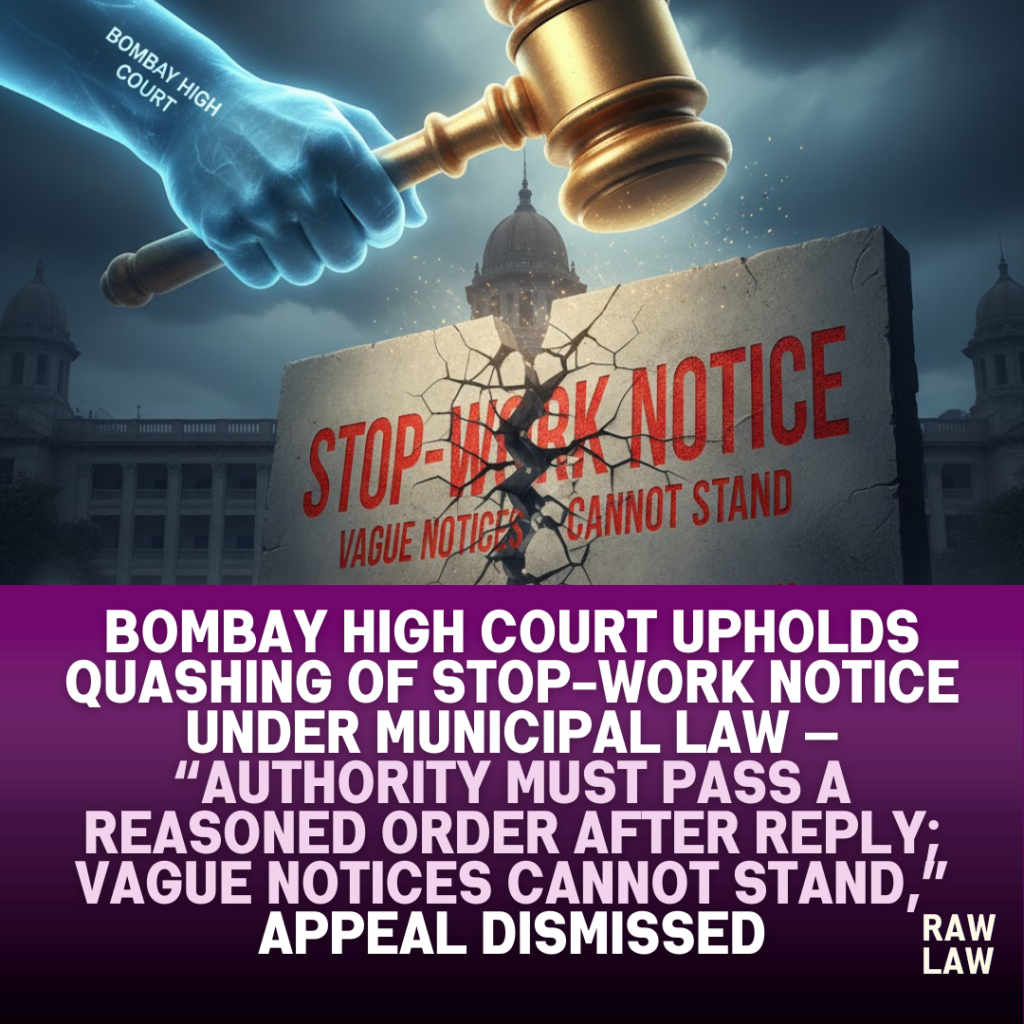
The Bombay High Court, Civil Appellate Jurisdiction, has dismissed a first appeal filed by the municipal corporation and confirmed the City Civil Court’s decree quashing a stop-work notice issued under Section 354A of the Mumbai Municipal Corporation Act, 1888. The Court held that where a reply is filed to a Section 354A notice, the municipal authority is bound—by its own binding circular—to pass a reasoned order. The Court further found the impugned notice to be impermissibly vague, as it failed to specify the nature of the alleged unauthorised work. With no adjudicatory order passed after receipt of the reply, the notice could not survive.
Facts
The respondent occupied and possessed a structure situated at CTS No. 950 (part), near Link Road, Dahisar (West), Mumbai. According to the respondent, she undertook plastering of walls of the suit structure. On 4 February 2008, the municipal corporation issued a notice under Section 354A directing stoppage of the repairing work, characterising it as “unauthorised repairing” and calling upon the occupant to produce permissions within 24 hours. The respondent replied on the very same day, denying that plastering fell within Section 354A and asserting the structure’s census status, enclosing supporting documents including a Census Certificate, Gumasta licence, and prior applications.
Despite receipt of the reply, the corporation did not pass any order adjudicating the objections. The respondent therefore instituted a civil suit challenging the notice. The City Civil Court decreed the suit on 8 December 2009, quashing the notice on grounds of vagueness and failure to pass an order after reply. The corporation appealed.
Issues
The High Court was called upon to decide whether the City Civil Court was justified in quashing the Section 354A notice; whether Section 354A requires the authority to pass an order after receiving a reply; whether a municipal circular mandating a reasoned order binds the authority; and whether a stop-work notice that fails to describe the nature of alleged unauthorised work can be sustained.
Petitioner’s arguments
The municipal corporation contended that the notice was validly issued to stop unauthorised repairing of the respondent’s premises and that Section 354A does not mandate passing of any adjudicatory order after issuance of a stop-work notice. It argued that the trial court erred in quashing the notice merely on the ground that no order followed the reply, and urged that the appeal be allowed.
Respondent’s arguments
The respondent argued that once a reply is filed to a Section 354A notice, the authority must consider it and pass a reasoned order, particularly in light of the corporation’s own circular dated 29 April 2006. The respondent emphasised that the impugned notice was vague, did not specify what constituted the alleged unauthorised work, and that the authority’s failure to pass any order after the reply rendered the notice unsustainable.
Analysis of the law
The Court examined the scheme of Section 354A, which empowers the municipal authority to issue stop-work notices to prevent unauthorised construction or work. While the provision facilitates immediate preventive action, the Court underscored that administrative action must adhere to fairness, transparency, and binding internal instructions. Crucially, the corporation’s circular dated 29 April 2006—then in force—explicitly required the concerned officer to pass a reasoned order where a reply is received to a Section 354A notice. Such circulars bind the issuing authority and operationalise principles of natural justice within municipal enforcement.
The Court also emphasised the requirement of specificity in notices that carry civil consequences. A notice that merely labels work as “unauthorised repairing” without identifying the offending act or provision fails to afford meaningful opportunity to respond and cannot withstand scrutiny.
Precedent analysis
While the judgment turned on statutory construction and the binding municipal circular rather than citation-heavy precedent, the Court’s reasoning aligns with settled administrative law principles: internal circulars are binding on authorities; reasoned decisions are integral to fair process; and vague notices with penal or coercive effects are liable to be set aside. These principles informed the Court’s refusal to interfere with the trial court’s decree.
Court’s reasoning
The Court noted that paragraph 3 of the corporation’s circular dated 29 April 2006 mandated a reasoned order upon receipt of a reply to a Section 354A notice. The circular was in force on the date of issuance of the impugned notice, and there was no impediment to compliance. Admittedly, no order was passed after the respondent’s reply. This failure alone justified the trial court’s decision.
Independently, the Court found the notice vague. It neither specified the nature of the allegedly unauthorised repairing nor identified any contravention. The notice’s directive to stop “erection/execution” without particulars, followed by a demand to produce permission within 24 hours, did not cure the defect. The Court observed that even if the authority had been satisfied after considering the reply, it was duty-bound to communicate its decision by a reasoned order—accepting or rejecting the reply. The complete omission vitiated the action.
Conclusion
The appeal was dismissed. The High Court confirmed the City Civil Court’s decree quashing the Section 354A notice dated 4 February 2008. A subsequent request for stay was also rejected, noting that there had been no stay since 2009 and no case was made out for interim relief.
Implications
The ruling reinforces procedural discipline in municipal enforcement. Authorities issuing stop-work notices must draft them with specificity and must pass reasoned orders when replies are filed—especially where binding circulars so require. The judgment curbs open-ended, non-speaking municipal action and strengthens occupiers’ rights to fair consideration, without diluting the municipality’s power to act swiftly where violations are properly identified and adjudicated.
Case law references
- Present judgment (Bombay High Court, Civil Appellate Jurisdiction): Held that a Section 354A notice must be followed by a reasoned order upon receipt of a reply, as mandated by a binding municipal circular; vague notices lacking particulars are unsustainable.
FAQs
Q1. Is a municipal authority required to pass an order after a reply to a stop-work notice?
Yes. Where a binding circular mandates it, failure to pass a reasoned order after receiving a reply can invalidate the notice.
Q2. Can a stop-work notice be quashed for vagueness?
Yes. Notices that do not specify the nature of the alleged unauthorised work or the violated provisions are vulnerable to being set aside.
Q3. Does Section 354A allow immediate action without hearing?
Preventive action is permitted, but fairness requires consideration of replies and a reasoned decision where the authority’s own rules so require.


