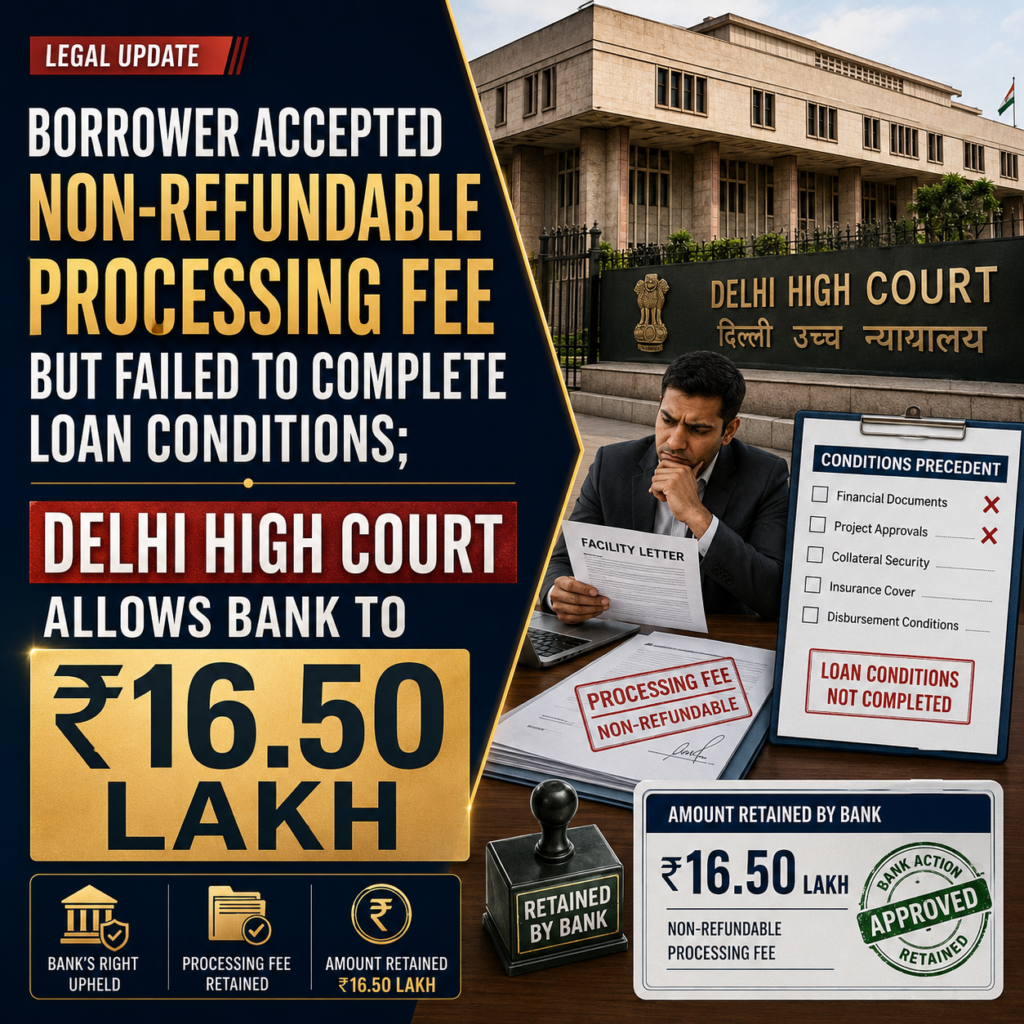
Loan Not Disbursed Because Borrower Failed to Submit Required Documents; Delhi High Court Denies Refund of Processing Fee
Facts
M/s Chitra Utsav Video Pvt. Ltd. owned a commercial property in Gurugram that had been leased to three corporate tenants. It had earlier obtained finance from Syndicate Bank and later negotiated with Standard Chartered Bank for a Lease Rental Discounting facility against future rental income from the property.
On 23 May 2012, Standard Chartered Bank issued an indicative term sheet proposing a loan facility of ₹27 crore. On the same day, Chitra Utsav handed over a cheque for ₹13.50 lakh. The accompanying letter described the amount as a mobilisation fee that would be adjusted against the sanctioned facility and refunded, after deducting actual expenses, if the transaction was not approved.
The Bank subsequently issued a Facility Letter dated 20 July 2012 sanctioning a reduced facility of ₹25.50 crore. Clause 5 of that letter provided that the processing fee of 1% plus service tax was payable upfront and was non-refundable.
The borrower accepted and signed the Facility Letter on 8 August 2012 pursuant to a board resolution. It nevertheless continued to raise objections regarding the Debt Service Reserve Account, interest rate, processing fee and the manner in which monthly instalments would be appropriated.
The loan was never disbursed because the borrower failed to furnish three mandatory letters from Syndicate Bank, including confirmation of the outstanding balance and a no-dues certificate. The Bank claimed that the loan documents had been executed and the amount was ready for disbursement, but the transaction remained incomplete solely because the borrower did not satisfy these conditions precedent.
The borrower sought refund of the amount already paid. The Bank refused, relying upon the non-refundable processing-fee clause. A further ₹3 lakh was nevertheless paid in May 2013 through a group company, bringing the total amount paid to ₹16.50 lakh.
The borrower then filed a suit seeking recovery of ₹16.50 lakh with interest. The Trial Court decreed the suit and directed the Bank to refund the amount with pendente lite interest at 9% per annum and future interest at 6% per annum.
Standard Chartered Bank challenged that decree before the Delhi High Court.
Issues
- Whether the borrower, after expressly accepting the Facility Letter, was bound by Clause 5 making the processing fee non-refundable.
- Whether the earlier letter dated 23 May 2012 describing the payment as a refundable mobilisation fee could override the later Facility Letter.
- Whether alleged oral assurances regarding waiver of processing fees and reduction of interest could alter the written contract.
- Whether the borrower could claim refund after failing to satisfy the mandatory conditions precedent required for disbursement.
- Whether the processing fee became refundable merely because the loan was ultimately not disbursed.
- Whether the RBI Fair Practices Code circulars prohibited the Bank from retaining the processing fee.
- Whether the Trial Court erred in directing refund despite holding that the borrower had failed to fulfil the pre-disbursement conditions.
Petitioner’s Arguments
Standard Chartered Bank, as the appellant, argued that the Trial Court’s judgment contained an internal contradiction.
It submitted that the Trial Court had correctly found that the borrower failed to comply with the conditions precedent under the Facility Letter, but still wrongly ordered refund of the processing fee.
The Bank argued that:
- The Facility Letter dated 20 July 2012 was the final and binding contract.
- The borrower accepted it on 8 August 2012 after a board resolution and with full knowledge of its terms.
- Clause 5 clearly provided that the processing fee was non-refundable.
- The earlier term sheet and covering letter were merely preliminary communications and could not prevail over the later written contract.
- The borrower’s letter dated 23 May 2012 was not properly proved in evidence because the original was not produced.
- Any alleged oral assurances regarding waiver of fees or reduction of interest were unsupported and inadmissible against the written contract.
- The Bank had completed due diligence, obtained internal approvals, sanctioned the loan and kept the amount ready for disbursement.
- Disbursement failed only because the borrower did not furnish the required documents from Syndicate Bank.
- A party in breach of its own obligations could not take advantage of that breach and demand a refund.
- The further payment of ₹3 lakh in May 2013 amounted to affirmation of the Facility Letter and acknowledgment of liability towards the processing fee.
- The RBI circulars applied primarily where a loan application was rejected or charges were not disclosed; neither situation existed here.
The Bank therefore sought setting aside of the recovery decree and dismissal of the borrower’s suit.
Respondent’s Arguments
The borrower had earlier contended before the Trial Court that the ₹13.50 lakh payment was made as a refundable mobilisation fee under the letter dated 23 May 2012.
It argued that:
- The initial payment was made before issuance of the Facility Letter.
- The Bank accepted and encashed the cheque without objecting to the terms stated in the covering letter.
- The fee was to be adjusted against the sanctioned facility or refunded after deduction of actual appraisal expenses if the transaction did not proceed.
- Bank officials had orally assured it that the interest rate would be reduced and the processing fee waived.
- The Facility Letter contained terms that materially reduced the benefit of the loan, including the Debt Service Reserve Account requirement and the interest-related float period.
- The transaction was never concluded and no loan amount was actually disbursed.
- Retention of the full fee amounted to an unfair trade practice.
- The RBI Fair Practices Code required transparency and refund where a loan transaction was not completed.
The borrower also relied upon the earlier mobilisation-fee letter and the fact that the loan was never disbursed to justify recovery of ₹16.50 lakh.
The respondent stopped appearing during the later stages of the appeal and was proceeded against ex parte.
Analysis of the Law
Binding Effect of a Signed Written Contract
The High Court held that once parties consciously reduce their agreement to writing and sign it, the written document ordinarily represents the final expression of their intentions.
The borrower’s board had considered the Facility Letter and authorised its acceptance. The letter was then signed by the authorised representative.
The Court noted that the borrower was already aware of the disputed terms before accepting the contract. Its own emails showed that it had raised concerns about the reserve account and other loan conditions before signing the Facility Letter.
Accordingly, the plea that the terms contained hidden defects or were accepted without full knowledge was rejected.
Oral Assurances Cannot Override Written Terms
The Court held that the alleged oral promises regarding waiver of the processing fee and reduction of the interest rate were unsupported by evidence.
The witness examined by the borrower admitted that he had not personally dealt with the Bank regarding the transaction. He also acknowledged that no document showed that the Bank had agreed to refund or waive the processing fee.
Sections 91 and 92 of the Indian Evidence Act, 1872 barred oral evidence intended to contradict, vary, add to or subtract from the terms of the written Facility Letter.
Effect of the Earlier Mobilisation-Fee Letter
The Court found that the letter dated 23 May 2012 had not been proved in accordance with law because the original was not produced and the document remained only marked, not exhibited.
A decree could not properly be founded upon an unproved document.
Even assuming that the letter could be considered, it was only an antecedent communication. Its terms conflicted with the subsequent Facility Letter, which expressly made the processing fee non-refundable.
The later written and accepted contract therefore prevailed.
The Court also noted that the borrower’s conduct demonstrated that it treated the earlier communication as having merged into the final Facility Letter.
Failure to Fulfil Conditions Precedent
The Facility Letter required the borrower to furnish three letters from Syndicate Bank before disbursement.
These documents were mandatory preconditions, not optional requirements.
The borrower admitted that it had not furnished the statement confirming the outstanding balance. The Bank’s email also recorded that the disbursement was ready but could not proceed due to non-availability of the required documents.
The Trial Court’s finding that the borrower failed to comply with these conditions was never challenged through cross-objections and had therefore attained finality.
The High Court applied the principle that no person can take advantage of their own wrong. Since the borrower’s breach prevented disbursement, it could not rely on the absence of disbursement to seek refund.
Nature of the Processing Fee
The Court characterised the processing fee as consideration for the Bank’s work in:
- Appraising the proposal;
- Conducting due diligence;
- Obtaining internal credit approvals;
- Sanctioning the facility; and
- Preparing and executing the loan documentation.
The Bank had performed these services and kept the loan ready for disbursement.
The absence of final disbursement, where caused by the borrower’s own failure, did not amount to failure of consideration for the processing fee.
RBI Fair Practices Code
The Court held that the RBI circulars relied upon by the Trial Court did not prohibit a properly disclosed non-refundable processing fee.
Those circulars mainly required transparency regarding fees and the amount refundable where a loan application was not accepted.
In this case:
- The loan application was accepted.
- The facility was sanctioned.
- The fee was expressly disclosed as non-refundable.
- Loan documents were executed.
- The loan was made ready for disbursement.
The later RBI circular dated 22 January 2015 could also not govern a transaction that had concluded in 2012.
Precedent Analysis
Bharathi Knitting Company v. DHL Worldwide Express Courier Division of Airfreight Ltd., (1996) 4 SCC 704
The Supreme Court held that a person who signs a document containing contractual terms is ordinarily bound by those terms.
A party seeking to avoid the document must prove circumstances that legally justify non-enforcement.
The Delhi High Court relied upon this principle to hold that the borrower was bound by the non-refundable processing-fee clause.
Roop Kumar v. Mohan Thedani, (2003) 6 SCC 595
This decision explains Sections 91 and 92 of the Evidence Act.
Where the parties have reduced their agreement to writing, the written instrument is treated as the final repository of their intentions. Oral evidence cannot ordinarily be used to contradict or vary its terms.
The Court relied upon this case to reject the alleged oral assurances and the inconsistent earlier communication.
Bank of India v. Brindavan Agro Industries Pvt. Ltd., 2020 INSC 232
The Supreme Court considered processing and appraisal charges collected by a bank in connection with a credit proposal.
It recognised that such charges do not automatically become refundable merely because the borrower ultimately does not avail the facility, particularly where the borrower knew of the charges and the bank performed appraisal work.
The High Court used this decision to support the Bank’s entitlement to retain the fee.
In re: Kuttadan Velayudhan, 2001 SCC OnLine Ker 14
The Trial Court had relied upon this decision for the proposition that mere signing of a document may not amount to execution if the parties never acted upon it.
The High Court distinguished it because the parties in the present case had acted upon the Facility Letter by:
- Passing a board resolution;
- Signing the Facility Letter;
- Executing the loan documents;
- Preparing the loan for disbursement; and
- Making a further processing-fee payment.
DLF Limited v. Punjab National Bank
The Trial Court had relied upon this case while directing refund.
The High Court distinguished it because that case involved non-disclosure of the relevant charge, whereas the present Facility Letter expressly disclosed the non-refundable processing fee.
M/s Athena Energy Ventures Pvt. Ltd. v. Andhra Bank
This decision was also distinguished on similar grounds.
The present case did not involve rejection of a loan application or non-disclosure of charges. The loan had been sanctioned and the fee had been expressly accepted.
Court’s Reasoning
The Court found that the Facility Letter dated 20 July 2012 was the final contract between the parties.
The borrower had considered its terms, raised objections, obtained board approval and then signed the document. It could not later avoid Clause 5 merely because the loan transaction did not ultimately proceed.
The earlier letter describing the payment as a refundable mobilisation fee was neither properly proved nor capable of overriding the later written agreement.
The borrower’s alleged oral assurances were unsupported and legally inadmissible against the written terms.
The Court also attached significance to the further payment of ₹3 lakh made in May 2013. That payment was made after the borrower already knew that the Bank had refused a refund and that the processing fee was described as non-refundable. The payment therefore affirmed the contract rather than contradicting it.
Most importantly, the loan was not disbursed because the borrower failed to provide the mandatory Syndicate Bank documents.
The Bank had completed its processing work and kept the amount ready. The failure of disbursement was therefore attributable to the borrower, not the Bank.
The Trial Court’s conclusion that the borrower breached the conditions precedent but was still entitled to a refund was held to be internally inconsistent and legally unsustainable.
Conclusion
The Delhi High Court allowed Standard Chartered Bank’s appeal.
It held that:
- The Facility Letter was the binding contract.
- The processing fee was expressly non-refundable.
- The borrower could not rely on earlier communications or alleged oral assurances to contradict the written contract.
- The loan was not disbursed because the borrower failed to fulfil the conditions precedent.
- The Bank had completed the appraisal and sanction process and was entitled to retain the fee.
- The RBI Fair Practices Code did not require refund in the facts of the case.
The judgment and decree dated 31 July 2020 directing refund of ₹16.50 lakh with interest were set aside.
The recovery suit filed by M/s Chitra Utsav Video Pvt. Ltd. was dismissed.
Case Details
Case: Standard Chartered Bank v. M/s Chitra Utsav Video Pvt. Ltd.
Court: High Court of Delhi at New Delhi
Case Number: RFA 293/2020
Judge: Hon’ble Ms. Justice Neena Bansal Krishna
Date: 29 June 2026
Result: Bank’s appeal allowed; decree directing refund of ₹16.50 lakh with interest set aside; borrower’s recovery suit dismissed.