


HEADNOTE
Neelesh Kumar Singh & Ors. v. State (Govt. of NCT of Delhi) & Anr.
Court: High Court of Delhi
Bench: Justice Ravinder Dudeja
Date of Judgment: 12 December 2025
Citation: CRL.M.C. 8116/2025
Laws / Sections Involved: Section 528 Bharatiya Nagarik Suraksha Sanhita; Sections 498A, 406, 34 IPC; Section 482 CrPC (principle)
Keywords: FIR quashing, matrimonial dispute, Section 498A IPC, settlement, inherent powers, Delhi High Court
Summary:
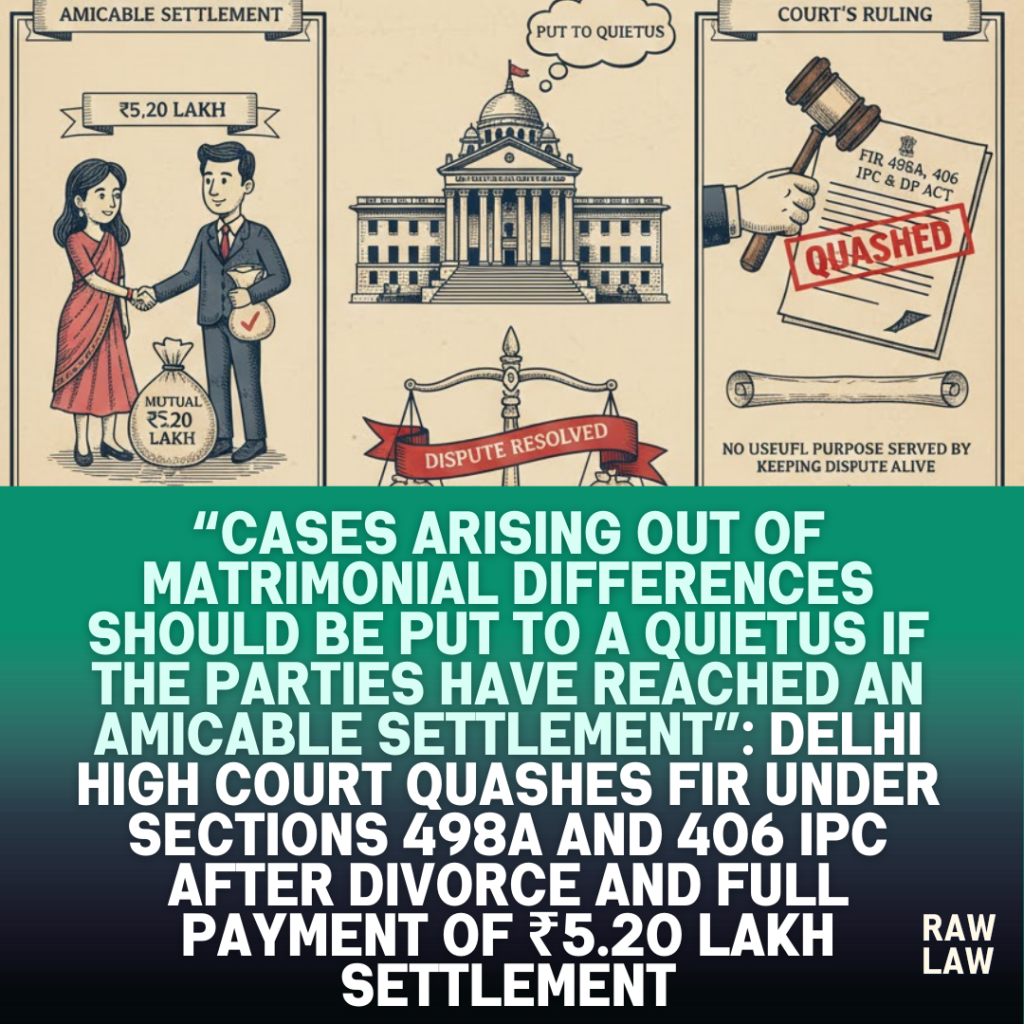
The Delhi High Court quashed an FIR registered under Sections 498A and 406 IPC after noting that the matrimonial dispute between the parties had been amicably resolved. The Court observed that the husband and wife had settled their differences before the Family Court, obtained a decree of divorce, and the agreed settlement amount of ₹5.20 lakh had been fully paid. Emphasising that continuation of criminal proceedings would amount to abuse of the process of law, the Court reiterated that disputes arising out of matrimonial discord deserve a quietus once parties reach a voluntary settlement. Relying on consistent Supreme Court precedents, the Court held that inherent powers can be exercised to quash even non-compoundable offences to secure the ends of justice.
Court’s decision
The Delhi High Court allowed the petition seeking quashing of FIR No. 0295/2019 registered at Police Station Khyala under Sections 498A, 406 and 34 IPC. The Court held that since the matrimonial dispute between the parties had been amicably settled, the continuation of criminal proceedings would serve no useful purpose. Taking note of the fact that the complainant-wife had received the entire settlement amount and raised no objection to quashing of the FIR, the Court concluded that it was a fit case to exercise inherent jurisdiction to prevent abuse of the process of law and to secure the ends of justice.
Facts
The marriage between petitioner no.1 and respondent no.2 was solemnised on 19 April 2018 in accordance with Hindu rites and ceremonies. No child was born from the wedlock. Due to temperamental differences, the parties began living separately from 8 February 2020. Subsequently, the wife lodged an FIR alleging physical and mental harassment in connection with dowry demands. The FIR was registered under Sections 498A and 406 IPC against the husband and his family members. During pendency of proceedings, the parties opted for amicable resolution through the Counseling Cell at the Family Court, Tis Hazari Courts, Delhi.
Issues
The central issue before the High Court was whether criminal proceedings arising from a matrimonial dispute, involving non-compoundable offences under Sections 498A and 406 IPC, could be quashed on the basis of a voluntary settlement between the parties. The Court was also required to consider whether continuation of the proceedings would amount to abuse of the judicial process when the marriage had already been dissolved and all settlement obligations had been fully complied with.
Petitioner’s arguments
The petitioners submitted that the matrimonial dispute had been completely resolved through mutual settlement dated 10 November 2022. It was argued that the parties had obtained a decree of divorce on 23 March 2024 and that the entire settlement amount of ₹5.20 lakh had been paid to the complainant-wife in accordance with the agreed schedule. The petitioners contended that the wife had no surviving grievance and had willingly consented to quashing of the FIR. In these circumstances, continuation of criminal proceedings would be oppressive, unnecessary, and contrary to the interests of justice.
Respondent’s arguments
Respondent no.2, the original complainant, appeared before the Court and categorically stated that the dispute had been settled without any force, coercion or undue influence. She confirmed receipt of the entire settlement amount and expressed that she had no objection to quashing of the FIR and all consequential proceedings. The State, represented by the Additional Public Prosecutor, also did not oppose the petition, noting that the settlement was genuine and the complainant no longer wished to pursue the matter.
Analysis of the law
The Court examined the scope of inherent powers exercised by High Courts to quash criminal proceedings. While offences under Sections 498A and 406 IPC are non-compoundable, judicial precedent has consistently recognised that such proceedings can be quashed where the dispute is essentially private in nature and has been amicably settled. The object of criminal law is not to perpetuate bitterness once the underlying cause of dispute has ceased to exist. The Court noted that matrimonial disputes stand on a distinct footing, warranting a pragmatic and justice-oriented approach.
Precedent analysis
The Court relied upon authoritative decisions of the Supreme Court, including Gian Singh v. State of Punjab, Jitendra Raghuvanshi v. Babita Raghuvanshi, and B.S. Joshi v. State of Haryana. These judgments have consistently held that High Courts may quash criminal proceedings arising from matrimonial disputes when parties have settled their differences. The Court also referred to recent Supreme Court pronouncements recognising the importance of amicable settlement to bring finality and harmony, particularly in family-related disputes.
Court’s reasoning
Justice Ravinder Dudeja observed that both parties were present in Court and their statements regarding settlement were verified. The complainant’s voluntary consent and absence of objection carried significant weight. The Court reasoned that the criminal proceedings were a by-product of matrimonial discord, which no longer survived after settlement and divorce. Allowing the proceedings to continue would only result in unnecessary harassment and misuse of judicial resources. The Court therefore found it appropriate to invoke its inherent powers to quash the FIR and all proceedings arising therefrom.
Conclusion
The High Court concluded that the case merited interference in the interest of justice. It allowed the petition and quashed FIR No. 0295/2019 along with all consequential proceedings. Pending applications were also disposed of. The judgment reinforces the principle that criminal law should not be used as a tool for vengeance once matrimonial disputes are resolved and underscores the Court’s role in promoting finality and reconciliation.
Implications
This ruling reiterates that courts will encourage genuine settlements in matrimonial disputes and will not permit criminal proceedings to linger once parties have moved on. It provides clarity that even non-compoundable offences like Section 498A IPC can be quashed to prevent abuse of process, provided the settlement is voluntary and bona fide. The judgment strengthens a victim-centric yet pragmatic approach to family-related criminal litigation.
CASE LAW REFERENCES
• Gian Singh v. State of Punjab – High Courts may quash criminal proceedings involving private disputes upon settlement
• Jitendra Raghuvanshi v. Babita Raghuvanshi – Matrimonial disputes deserve quietus after amicable settlement
• B.S. Joshi v. State of Haryana – Section 498A proceedings can be quashed to secure ends of justice
FAQs
Q1. Can FIR under Section 498A IPC be quashed after settlement?
Yes, High Courts can quash such FIRs if the matrimonial dispute has been amicably settled and continuation would be an abuse of process.
Q2. Is divorce necessary for quashing criminal proceedings in matrimonial cases?
Divorce is not mandatory, but it strengthens the case for quashing when parties have conclusively resolved their disputes.
Q3. What role does the complainant’s consent play in FIR quashing?
Voluntary consent of the complainant is a crucial factor in allowing quashing of criminal proceedings.