Civil Appeal Over Same ₹8 Lakh Transaction Does Not Stop Cheque Case; Kerala High Court Directs Disposal Within Two Months
Facts
The first respondent filed a complaint under Section 138 of the Negotiable Instruments Act, 1881, before the Judicial First-Class Magistrate Court-I, Attingal, on 10 November 2004. He alleged that a cheque for ₹8,00,000 issued by the petitioner, Sheelarani, was dishonoured due to insufficient funds. Despite receiving a statutory demand notice, the petitioner allegedly failed to pay the amount and instead issued a reply denying liability.
The complaint was initially numbered as C.C. No. 1064 of 2004. It was later transferred to the Judicial First-Class Magistrate Court-IV, Attingal, and renumbered as S.T. No. 3958 of 2017.
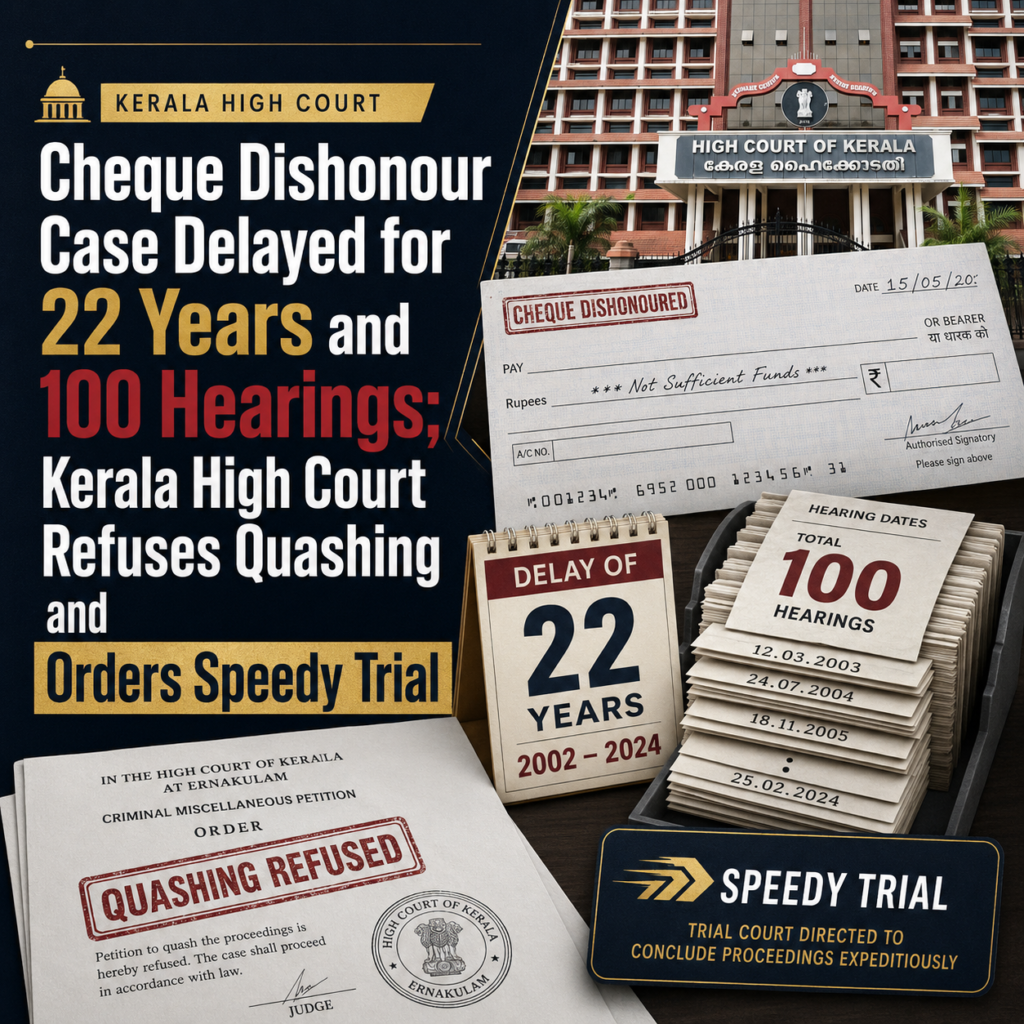
The complainant filed his proof affidavit in December 2005. However, even after more than two decades and approximately 100 posting dates, his cross-examination had not been completed.
The petitioner filed an application before the Trial Court seeking a stay of the cheque dishonour proceedings. She contended that the original documents relied upon by the complainant were unavailable and that photocopies had been marked without proper proceedings. She also questioned the complainant’s financial capacity to advance ₹8,00,000.
The actual ground stated in the stay application was that an appeal was pending before the Kerala High Court against a civil court decree arising from the same cheque transaction. The civil suit had already been decreed in favour of the complainant.
The Trial Court rejected the stay application. The petitioner then approached the High Court seeking to set aside the Trial Court’s order and quash the cheque dishonour complaint and the related proceedings.
Issues
- Whether criminal proceedings under Section 138 of the Negotiable Instruments Act should be stayed merely because an appeal arising from a civil suit concerning the same cheque transaction was pending.
- Whether civil and criminal proceedings arising from the same transaction can continue simultaneously.
- Whether the petitioner could challenge the marking of documents approximately two decades after they had been admitted in evidence without objection.
- Whether disputed questions concerning the complainant’s financial capacity and the existence of a legally enforceable debt could be examined while considering a petition to quash the complaint.
- Whether the cheque dishonour complaint disclosed the essential ingredients of an offence under Section 138 of the Negotiable Instruments Act.
- Whether the prolonged pendency of the complaint justified quashing the proceedings or instead required the Trial Court to complete the trial expeditiously.
Petitioner’s Arguments
The petitioner contended that the complainant had filed his proof affidavit and marked six documents, but the original documents were no longer available.
She alleged that the Trial Court had subsequently marked photocopies of those documents without following a formal procedure. On that basis, she argued that the proceedings were legally defective.
The petitioner also questioned whether the complainant possessed the financial capacity to lend ₹8,00,000 and therefore disputed the existence of a legally enforceable debt.
She further relied upon the pendency of an appeal against the civil court decree relating to the same cheque transaction and sought a stay of the criminal proceedings until the civil appeal was decided.
On these grounds, the petitioner sought:
- Quashing of the original complaint;
- Quashing of the proceedings sheet;
- Setting aside of the order rejecting her stay application; and
- Suspension of further proceedings before the Trial Court.
Respondent’s Arguments
The complainant opposed the request for stay before the Trial Court.
He maintained that the pendency of a civil appeal did not prevent the criminal prosecution under Section 138 of the Negotiable Instruments Act from continuing independently.
The materials before the High Court showed that the documents marked as Exhibits P1 to P6 had been admitted in evidence as early as 12 June 2006. The petitioner had not objected to their marking at that stage.
The complainant had also succeeded in the civil suit arising from the same cheque transaction, although an appeal against the decree remained pending.
The State supported the continuation of the criminal proceedings and opposed interference with the Trial Court’s order.
Analysis of the Law
Simultaneous Civil and Criminal Proceedings
The High Court held that there is no legal prohibition against civil and criminal proceedings arising from the same transaction continuing simultaneously.
A civil suit primarily determines private rights and liabilities between the parties. A prosecution under Section 138 of the Negotiable Instruments Act determines whether the statutory offence relating to dishonour of a cheque has been committed.
The standards, purposes and consequences of the two proceedings are different. Therefore, the pendency of a civil appeal concerning the cheque transaction did not require the criminal case to be stayed.
Challenge to Documents After Two Decades
The Trial Court reported that Exhibits P1 to P6 had been marked on 12 June 2006. Under the practice prevailing at that time, the marking was not separately endorsed on the deposition sheet.
When the matter was taken up in September 2025, the marking of the documents was reflected in the deposition record. Additional documents relating to the civil court judgment and decree were also marked.
The High Court held that the petitioner had remained silent when the documents were originally marked and could not challenge their admission approximately 20 years later.
The Court also found that the petitioner’s claim that the stay application had been filed because of the marking of documents was factually incorrect. The application itself showed that the stay was primarily sought because of the pending civil appeal.
Presumption Under Section 139
Under Section 139 of the Negotiable Instruments Act, a statutory presumption arises that the cheque was issued for the discharge of a legally enforceable debt or liability.
The presumption is rebuttable, but the accused must ordinarily raise and establish the defence during the trial.
Questions such as:
- Whether the complainant had sufficient financial capacity;
- Whether the cheque was issued towards a debt;
- Whether the debt was legally enforceable; and
- Whether the documents were genuine or reliable,
were disputed factual matters that could not be conclusively determined in proceedings seeking quashing of the complaint.
Scope of Quashing
The Court held that, at the quashing stage, it was required to examine whether the allegations in the complaint disclosed the essential ingredients of the alleged offence.
A detailed evaluation of evidence or determination of disputed factual questions was impermissible at the pre-trial stage.
The complaint alleged issuance of the cheque, dishonour for insufficient funds, service of the statutory notice and failure to make payment within the prescribed period. It therefore disclosed the essential ingredients of an offence under Section 138.
Legislative Requirement of Speedy Trial
The Court noted that Chapter XVII of the Negotiable Instruments Act was intended to strengthen confidence in commercial transactions and provide a prompt remedy in cheque dishonour cases.
Section 138 prosecutions are required to be tried summarily and concluded expeditiously. A complaint instituted in 2004 remaining pending in 2026, even without completion of the complainant’s cross-examination, was wholly contrary to the legislative objective.
The Court criticised the repeated and liberal grant of adjournments that had prevented the trial from progressing.
Precedent Analysis
Vishnu Dutt Sharma v. Daya Sapra, (2009) 13 SCC 729
The Supreme Court held that civil and criminal proceedings arising out of the same transaction can proceed simultaneously.
The Kerala High Court relied upon this decision to uphold the Trial Court’s refusal to stay the cheque dishonour prosecution merely because a civil appeal was pending.
P. Swaroopa Rani v. M. Hari Narayana alias Hari Babu, (2008) 5 SCC 765
This judgment reaffirmed that civil and criminal proceedings are independent and that the existence of one does not ordinarily prevent continuation of the other.
D. Purushotama Reddy v. K. Sateesh, (2008) 8 SCC 505
The decision was relied upon to reinforce the principle that civil and criminal proceedings arising from the same cause of action may continue independently.
State of Rajasthan v. Kalyan Sundaram Cement Industries Ltd., (1996) 3 SCC 87
This precedent also recognised that the pendency of civil proceedings does not automatically bar or suspend criminal prosecution concerning the same transaction.
Rangappa v. Sri Mohan, (2010) 11 SCC 441
The Supreme Court held that the presumption under Section 139 includes the presumption that the cheque was issued towards a legally enforceable debt or liability.
The presumption may be rebutted, but that defence must ordinarily be raised and proved at trial.
Rajeshbhai Muljibhai Patel v. State of Gujarat, (2020) 3 SCC 794
The Supreme Court held that a High Court should not quash a Section 138 complaint by deciding disputed factual questions concerning whether the cheque was issued towards a legally enforceable debt.
The Kerala High Court relied upon this principle while refusing to examine the petitioner’s defence concerning the complainant’s financial capacity.
Rathish Babu Unnikrishnan v. State (NCT of Delhi), (2022) 20 SCC 661
The Supreme Court held that, where Section 139 raises a statutory presumption, it would be inappropriate to undertake an elaborate factual inquiry at the pre-trial stage for quashing the complaint.
In Re: Expeditious Trial of Cases Under Section 138 of the Negotiable Instruments Act, 1881, (2021) 16 SCC 116
The Supreme Court issued comprehensive directions for the speedy disposal of cheque dishonour cases.
The Kerala High Court referred to these directions while expressing serious concern over the complaint remaining pending for more than two decades.
Court’s Reasoning
The Court found no illegality or irrationality in the Trial Court’s order refusing to stay the proceedings.
The pendency of the civil appeal did not prevent the criminal prosecution from continuing because the civil and criminal proceedings were legally independent.
The petitioner’s objection concerning the marking of documents was rejected because Exhibits P1 to P6 had been marked in 2006 without any objection. The petitioner could not remain silent for approximately two decades and then seek to reopen the issue.
The Court also found that the cheque dishonour complaint contained the necessary allegations constituting an offence under Section 138.
The petitioner’s arguments regarding the complainant’s financial capacity, the enforceability of the debt and the evidentiary value of the documents involved disputed facts. Such questions had to be decided through evidence during the trial and not in a quashing petition.
The Court considered that the present petition appeared to have been filed to further delay the final determination of the complaint.
It was particularly concerned that:
- The complaint had been filed in November 2004;
- The complainant’s chief affidavit had been filed in December 2005;
- More than 100 posting dates had elapsed;
- Repeated “last chances” had been granted; and
- Even the complainant’s cross-examination had not been completed.
The Court held that allowing cheque dishonour cases to remain pending indefinitely undermines the complainant’s rights, the object of the statute and public confidence in the justice system.
Conclusion
The Kerala High Court dismissed the Criminal Miscellaneous Case as meritless.
It refused to:
- Stay the cheque dishonour proceedings;
- Set aside the Trial Court’s order; or
- Quash the complaint under Section 138 of the Negotiable Instruments Act.
The Court held that the civil appeal and criminal prosecution could continue simultaneously and that disputed factual defences had to be raised before the Trial Court.
Considering that the complaint had remained pending since 2004, the High Court directed the Trial Court to dispose of it as expeditiously as possible and, in any event, within two months from the date on which a copy of the High Court’s order was produced.
A copy of the order was also directed to be furnished to the Registrar (District Judiciary) and the Director of the Kerala Judicial Academy for reference and any further action considered necessary.
Case Details
Case: Sheelarani v. S. Raveendran Nair & Another
Court: High Court of Kerala at Ernakulam
Case Number: Crl. M.C. No. 3234 of 2026
Neutral Citation: 2026:KER:41451
Judge: Hon’ble Mr. Justice C.S. Dias
Date: 11 June 2026
Result: Petition seeking stay and quashing of the ₹8 lakh cheque dishonour complaint dismissed; Trial Court directed to conclude the case within two months.