


HEADNOTE
Mohd. Abbas v. State (CBI)
Court: Delhi High Court
Jurisdiction: Criminal Appellate Jurisdiction
Bench: Justice Manoj Kumar Ohri
Date of Judgment: December 10, 2025
Citation: CRL.A. 614/2002 (Delhi High Court)
Laws / Sections Involved:
Prevention of Corruption Act, 1988 – Sections 7, 13(1)(d) read with 13(2); Section 20
Keywords: CBI trap case, demand of bribe, shadow witness hostile, benefit of doubt, PC Act acquittal
Summary
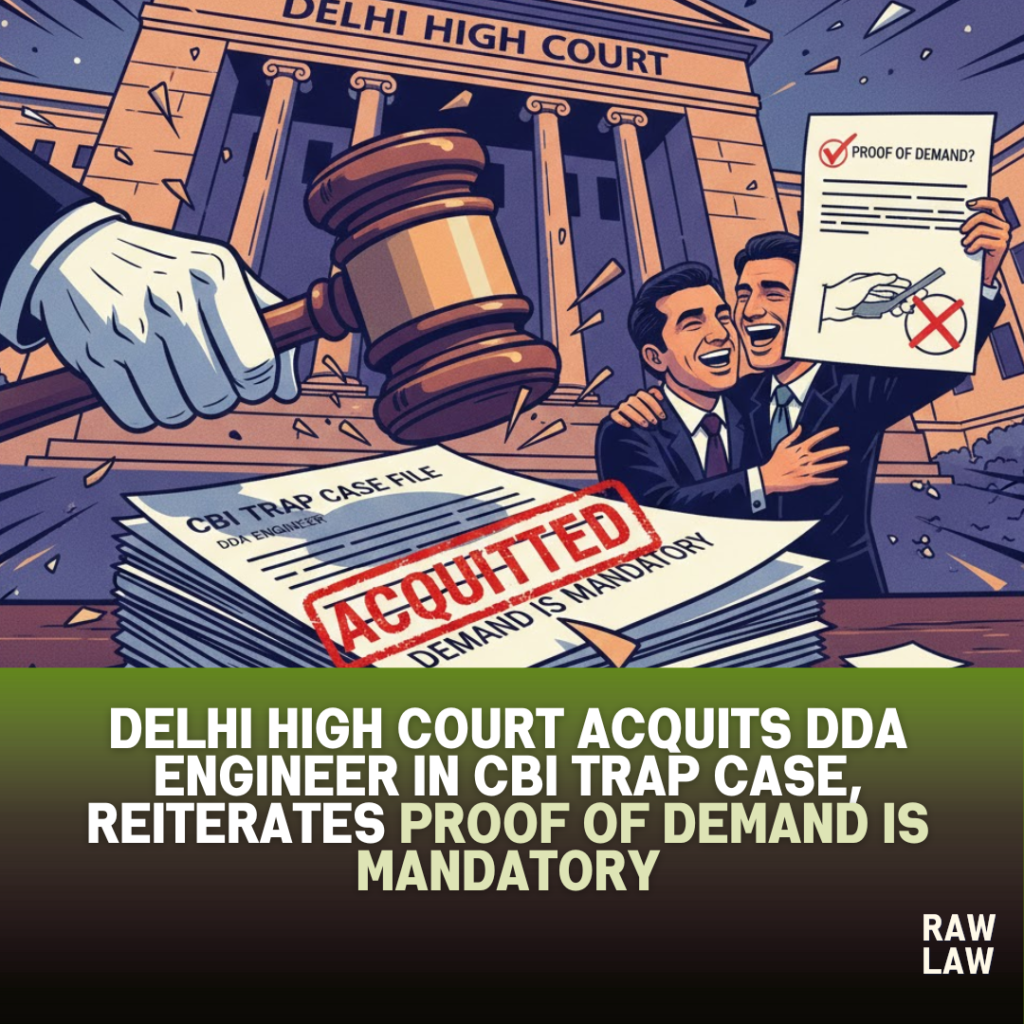
The Delhi High Court allowed a criminal appeal filed by a former Junior Engineer of the DDA and set aside his 2002 conviction in a CBI trap case under the Prevention of Corruption Act. The Court held that proof of demand of illegal gratification is a sine qua non for offences under Sections 7 and 13 of the PC Act, and mere recovery of tainted money is insufficient. Analysing the evidence, the Court found that the prosecution failed to prove demand beyond reasonable doubt, as the shadow witness did not support the case, failed to identify the accused, and categorically denied hearing any demand. The complainant’s testimony remained uncorroborated, while material inconsistencies regarding possession documents further weakened the prosecution case. Granting the benefit of doubt, the Court acquitted the appellant of all charges.
Court’s decision
The Delhi High Court allowed the criminal appeal and set aside the judgment of conviction dated 26 July 2002 and order on sentence dated 27 July 2002 passed by the trial court. The appellant was acquitted of offences under Sections 7 and 13(1)(d) read with 13(2) of the PC Act. Bail bonds were cancelled and sureties discharged.
Facts
The appellant, a Junior Engineer with the DDA, was accused of demanding and accepting a bribe of ₹2,000 (₹1,000 allegedly accepted during the trap) for handing over possession of a DDA SFS flat allotted to the complainant’s wife. A CBI trap was laid on 27 July 1994, during which ₹1,000 was recovered from a table drawer and handwash allegedly turned pink. After an initial acquittal due to lack of evidence, the matter was remanded by the High Court in 2001, leading to conviction in 2002, which was challenged in the present appeal.
Issues
Whether the prosecution had proved demand of illegal gratification beyond reasonable doubt, and whether conviction under Sections 7 and 13 of the PC Act could be sustained solely on the basis of recovery and presumption under Section 20.
Appellant’s arguments
The appellant argued that the complainant was an interested witness whose testimony lacked corroboration. It was pointed out that the shadow witness neither identified the appellant nor supported the demand, and the complainant’s wife—an alleged eyewitness—was not examined. The defence also highlighted serious inconsistencies regarding possession slips and alleged antedating of documents, questioning the very motive for demanding a bribe. Sanction was not pressed in appeal.
Respondent’s arguments
The CBI contended that demand and acceptance were proved through the complainant’s testimony and recovery of tainted money. It relied on Supreme Court precedents to argue that even hostile witness testimony can be relied upon and that presumption under Section 20 of the PC Act was attracted once acceptance was shown.
Analysis of the law
The Court analysed Sections 7 and 13 of the PC Act and reiterated settled law that proof of demand is a foundational fact. It relied extensively on B. Jayaraj v. State of Andhra Pradesh and the Constitution Bench decision in Neeraj Dutta v. State (NCT of Delhi) to hold that presumption under Section 20 arises only after demand and acceptance are proved. Mere recovery, without proof of demand, is legally insufficient.
Precedent analysis
The Court applied B. Jayaraj and Neeraj Dutta to underscore that demand can be proved by direct or circumstantial evidence, but where prosecution evidence itself creates doubt, conviction cannot be sustained. It also referred to A. Subair v. State of Kerala and C.K. Damodaran Nair v. Govt. of India on the meaning of “obtainment” under Section 13(1)(d).
Court’s reasoning
Justice Manoj Kumar Ohri found that the shadow witness gave a “topsy-turvy” deposition, failed to identify the appellant, and expressly stated that he did not hear any demand of money. The recovery witness was never asked to identify the accused. The complainant’s wife, though present, was not examined. Additionally, the Court noted unexplained inconsistencies regarding possession slips dated prior to the alleged demand, which cast serious doubt on the prosecution narrative. In such circumstances, corroboration was essential but absent.
Conclusion
Holding that the prosecution failed to prove demand beyond reasonable doubt, the Court extended the benefit of doubt to the appellant and acquitted him of all charges under the PC Act.
Implications
This judgment reaffirms a strict evidentiary threshold in corruption prosecutions, emphasising that recovery of tainted money and presumptions cannot substitute proof of demand. It serves as a reminder that hostile or unreliable shadow witnesses and unexplained documentary inconsistencies can be fatal to CBI trap cases under the Prevention of Corruption Act.
Case law references
• B. Jayaraj v. State of Andhra Pradesh (2014) 13 SCC 55
Holding: Mere recovery without proof of demand is insufficient for conviction.
Application: Applied to acquit the appellant.
• Neeraj Dutta v. State (NCT of Delhi) (2023) 4 SCC 731
Holding: Proof of demand and acceptance is sine qua non; presumption arises only thereafter.
Application: Relied upon extensively.
• A. Subair v. State of Kerala (2009) 6 SCC 587
Holding: Absence of proof of demand defeats Section 13(1)(d).
Application: Followed.
FAQs
Q1. Is recovery of bribe money sufficient for conviction under the PC Act?
No. Proof of demand of illegal gratification is mandatory.
Q2. Can presumption under Section 20 be invoked without proof of demand?
No. Presumption arises only after demand and acceptance are proved.
Q3. Why was the accused acquitted despite recovery of money?
Because demand was not proved and key witnesses did not support the prosecution case.
Also Read: Delhi High Court upholds injunction against use of “POWER FLEX”, protects Bata’s “POWER” trademark