


Court’s decision
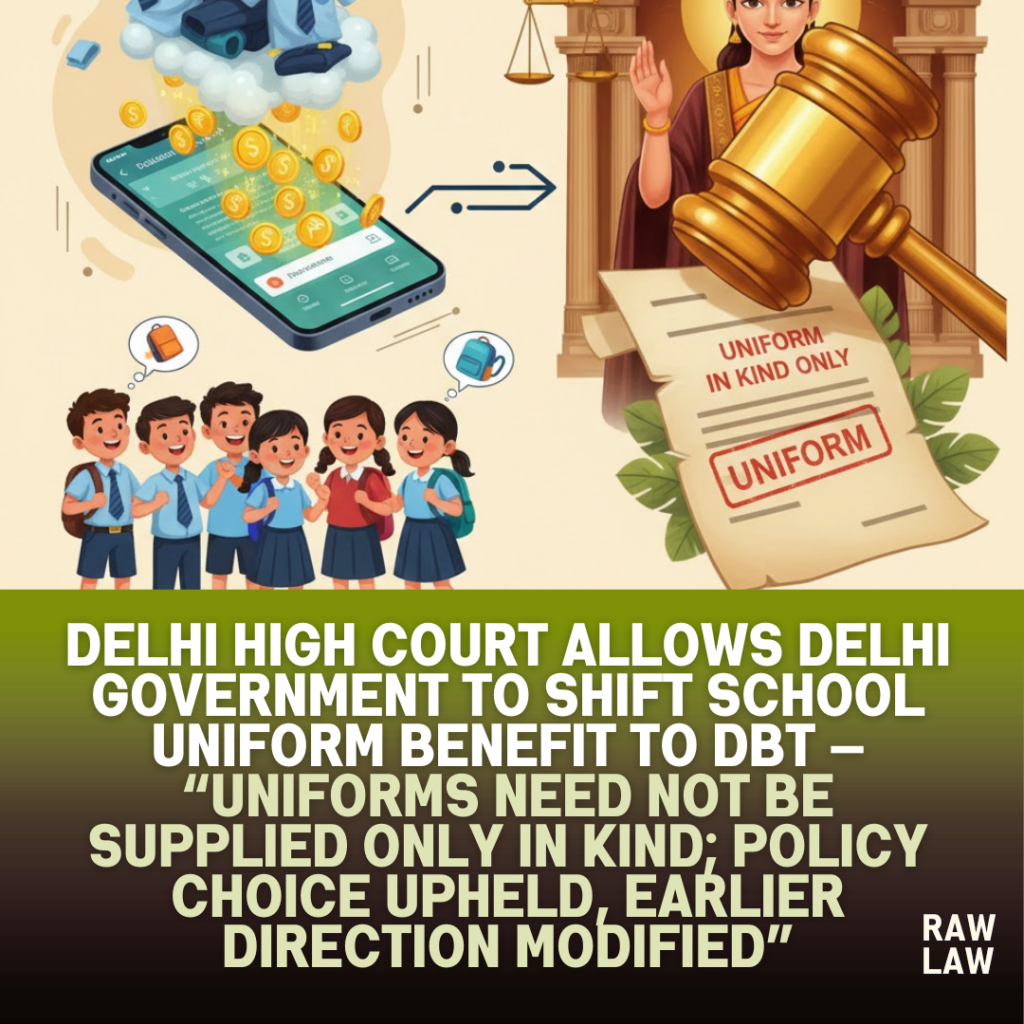
The Delhi High Court allowed a review-cum-modification application filed by the Government of NCT of Delhi and held that the mandate under the Right of Children to Free and Compulsory Education Act does not require school uniforms to be supplied strictly in kind. Upholding the government’s 2025 policy decision to provide enhanced uniform subsidy through Direct Benefit Transfer, the Court modified its earlier 2023 order and ruled that courts should not interfere with bona fide policy choices unless they are arbitrary or contrary to statute — DBT for uniforms permitted, contempt concerns laid to rest.
Court’s decision
A Division Bench comprising the Chief Justice and Justice Subramonium Prasad condoned a delay of 838 days, treated the review petition as a modification application, and allowed the Delhi government to implement its uniform subsidy policy dated 10.06.2025. The Court held that while the State is under a statutory duty to ensure provision of uniforms to EWS and disadvantaged group students, neither the RTE Act nor the 2011 Rules mandate physical distribution of uniforms. The earlier direction insisting on uniforms “in kind” was therefore modified.
Facts
A public interest writ petition was instituted seeking effective implementation of the Right of Children to Free and Compulsory Education Act, 2009, particularly the obligation to provide free textbooks, uniforms, and study material to children admitted under the Economically Weaker Section and Disadvantaged Group categories in Delhi schools. Over the years, multiple directions were issued to ensure compliance, including monitoring affidavits and contempt proceedings.
In April 2023, the High Court disposed of the writ petition while keeping contempt proceedings alive, expressing concern that the Delhi government was providing cash amounts instead of uniforms in kind. Subsequently, after a detailed market study and inter-departmental consultations, the Delhi Cabinet approved a revised policy in May–June 2025 enhancing uniform subsidy amounts and continuing the DBT mechanism, citing serious logistical and operational difficulties in centralized procurement and distribution of uniforms. This policy led to the present review/modification proceedings.
Issues
The principal issue before the High Court was whether the RTE Act and the Delhi Right of Children to Free and Compulsory Education Rules, 2011 mandate supply of school uniforms strictly in kind, or whether the State can discharge its obligation by providing an adequate cash subsidy through Direct Benefit Transfer. A related issue was the extent to which courts can interfere with executive policy decisions in matters of welfare administration and implementation logistics.
Petitioner’s arguments
The original writ petitioner opposed the review application, contending that earlier court orders required uniforms to be supplied in kind and that cash transfer diluted statutory guarantees under the RTE framework. It was argued that providing money instead of uniforms could defeat the objective of ensuring timely and uniform access to prescribed school attire, particularly for vulnerable children. The petitioner asserted that the 2025 policy was contrary to binding judicial directions and amounted to non-compliance with the spirit of the Act.
Respondent’s arguments
The Delhi government argued that its statutory obligation is to ensure that eligible children receive uniforms, not necessarily to physically procure and distribute them. It placed on record extensive material, including Cabinet notes and committee reports, highlighting severe practical difficulties in supplying uniforms in kind across thousands of schools with varying designs, colours, and measurements.
The government submitted that the DBT mechanism ensured timely availability of uniforms before the academic session, avoided procurement delays and litigation, improved transparency, and substantially enhanced subsidy amounts ranging from ₹1,250 to ₹1,700 per student. It was contended that the policy was neither arbitrary nor contrary to statute and deserved judicial deference.
Analysis of the law
The Court analysed Sections 12 of the RTE Act and Rule 11 of the 2011 Rules, noting that while they impose a clear obligation on the State to bear the cost of uniforms and other study materials, they do not prescribe the mode of delivery. The Court held that the statute mandates the outcome — availability of uniforms to eligible children — and not the method.
The Bench also revisited settled constitutional principles governing judicial review of policy decisions, reiterating that courts do not sit as super-administrators and must respect executive choices unless they are manifestly arbitrary, mala fide, or violative of law.
Precedent analysis
The Court relied on authoritative Supreme Court precedent on limits of judicial review in policy matters, including rulings holding that courts cannot substitute their own views for executive wisdom merely because an alternative policy appears preferable. It reiterated that legality, not desirability, is the touchstone of judicial scrutiny. Applying these principles, the Court found no statutory or constitutional infirmity in the DBT-based uniform subsidy policy.
Court’s reasoning
The Court accepted the government’s explanation that supplying uniforms in kind involved impractical steps such as taking individual measurements, managing diverse uniform designs, navigating lengthy procurement processes through government portals, and ensuring timely stitching and distribution. It found these difficulties genuine and noted that delays would directly harm students.
Crucially, the Court held that the RTE framework does not insist on uniforms being supplied only in kind and that adequate monetary support enabling families to purchase uniforms fulfils the statutory mandate. The enhanced subsidy rates approved by the Cabinet further demonstrated bona fide intent to comply with the law.
Conclusion
The Delhi High Court modified its earlier order dated 13.04.2023 to the extent it related to supply of uniforms and permitted the Government of NCT of Delhi to implement its uniform subsidy policy dated 10.06.2025 through Direct Benefit Transfer. The review petition was disposed of, and the government was directed to ensure timely disbursal of adequate amounts in accordance with the approved policy.
Implications
This judgment clarifies that welfare entitlements under the RTE Act focus on ensuring access and affordability rather than prescribing rigid modes of delivery. It reinforces judicial deference to executive policy choices in education administration, particularly where logistical realities are demonstrated and benefits to beneficiaries are enhanced. The ruling may influence similar debates across states on cash versus in-kind delivery of educational benefits.
Case law references
- Judicial review of policy decisions: Courts should not interfere unless policy is arbitrary, mala fide, or contrary to statute. Applied to uphold DBT-based uniform policy.
- RTE Act obligations: Statute mandates provision of uniforms but does not prescribe in-kind delivery. Applied to modify earlier court direction.
- Separation of powers: Courts cannot act as super-administrators in welfare policy. Applied to defer to executive choice.
FAQs
1. Does the RTE Act require uniforms to be supplied only in kind?
No. The Delhi High Court has clarified that the Act requires provision of uniforms but does not mandate physical supply; DBT is permissible.
2. Can courts interfere with government welfare policies?
Only if the policy is arbitrary, mala fide, unconstitutional, or contrary to statute. Courts will not substitute their own policy preferences.
3. Will students still receive uniforms under DBT?
Yes. The policy ensures enhanced cash support is provided in advance so students can purchase prescribed uniforms on time.