


Court’s decision
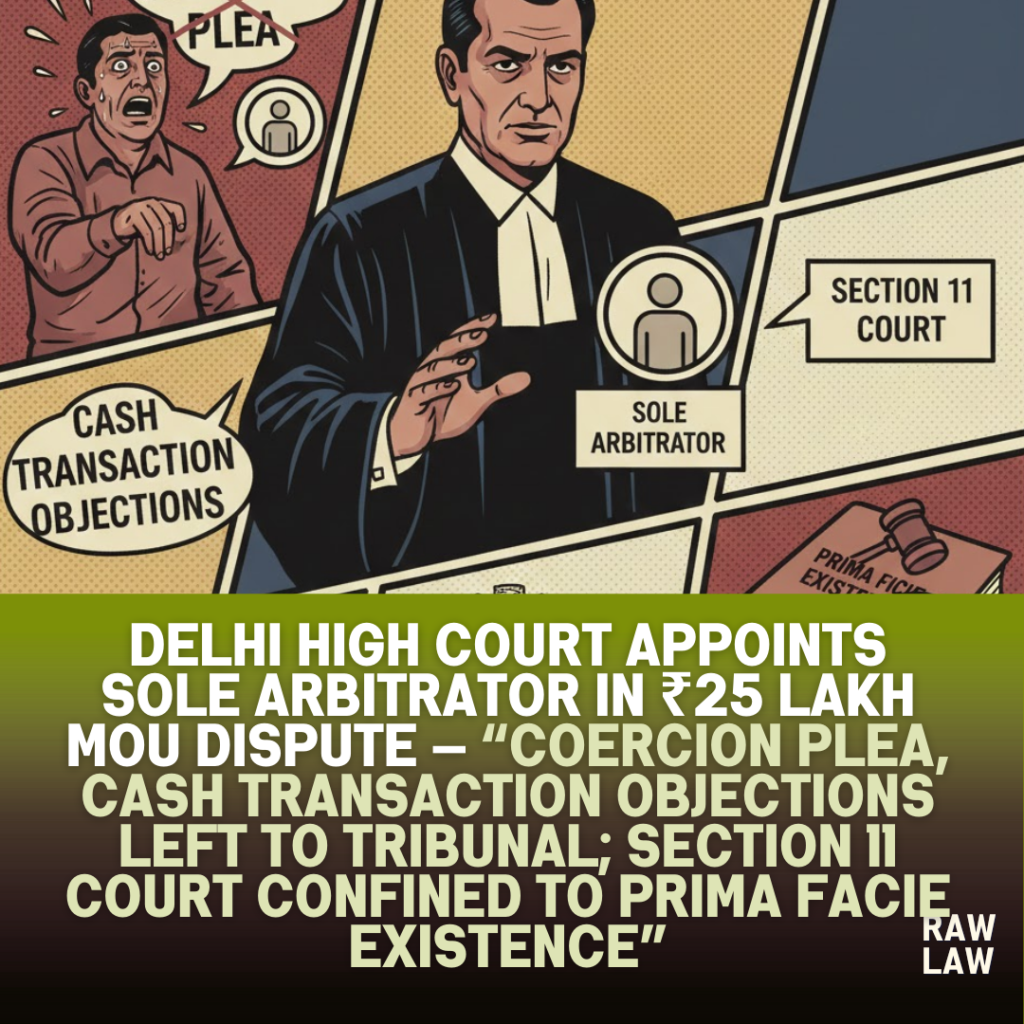
The Delhi High Court allowed a petition under Section 11(6) of the Arbitration and Conciliation Act, appointing an independent sole arbitrator to adjudicate disputes arising from a Memorandum of Understanding involving an alleged ₹25 lakh transaction. The Court held that once a prima facie arbitration agreement exists and disputes have arisen, allegations of coercion, illegality of cash transactions, or merits of the claim must be decided by the arbitral tribunal — “referral court’s role is akin to the eye of the needle”; arbitrator appointed under DIAC.
Court’s decision
Justice Harish Vaidyanathan Shankar rejected objections on territorial jurisdiction and maintainability, holding that the MoU expressly designated New Delhi as the seat of arbitration and conferred jurisdiction on Delhi courts. The Court found that the respondent’s refusal to participate in the appointment process after a Section 21 notice justified intervention under Section 11(6). All merits were left open for adjudication by the arbitrator.
Facts
The petitioner asserted that a sum of ₹25,00,000 was advanced to the respondent on 05 October 2020 for safe custody. According to the petitioner, the respondent utilised the amount for personal purposes without consent.
Subsequently, on 24 November 2020, the parties executed a Memorandum of Understanding in New Delhi, wherein the respondent acknowledged utilisation of the amount and undertook to repay it on or before 01 February 2021. Along with the MoU, the respondent executed a promissory note and an acknowledgment receipt and issued five cheques of ₹5,00,000 each.
The cheques were dishonoured on presentation for insufficiency of funds, leading to criminal proceedings under Section 138 of the Negotiable Instruments Act. The MoU contained an arbitration clause providing for resolution of disputes by a sole arbitrator with the seat at New Delhi. After the respondent declined arbitration, the petitioner approached the High Court.
Issues
The principal issues were whether a valid arbitration agreement existed for the purposes of Section 11, whether the High Court had territorial jurisdiction given objections about place of performance, and whether allegations of coercion, illegality of cash transactions, and pending criminal proceedings could bar reference to arbitration at the threshold.
Petitioner’s arguments
The petitioner argued that Clause 12 of the MoU constituted a valid and binding arbitration agreement and that disputes had undeniably arisen from the transaction and subsequent dishonour of cheques. It was submitted that a notice under Section 21 of the Act was duly issued, but the respondent failed to act in accordance with the agreed procedure for appointment of an arbitrator.
The petitioner further contended that unilateral appointment clauses are unenforceable and that the court’s intervention was therefore necessary to appoint an independent and impartial arbitrator. Objections raised by the respondent, it was argued, went to the merits and could not be examined at the Section 11 stage.
Respondent’s arguments
The respondent opposed the petition, alleging that the MoU was executed under coercion and threat and was therefore not binding. It was claimed that a police complaint had been lodged in this regard. The respondent also contended that the alleged transaction was a cash transaction and could not be legally enforced, and that the cheques were not issued towards a legally enforceable debt.
Additionally, the respondent objected to the territorial jurisdiction of the Delhi High Court, arguing that the performance of the MoU was to take place at Chennai and therefore Delhi courts lacked jurisdiction.
Analysis of the law
The Court reiterated the settled position that the scope of enquiry under Section 11(6) is extremely narrow and confined to a prima facie examination of the existence of an arbitration agreement. Relying on recent Supreme Court jurisprudence post the Constitution Bench decision on the interplay between the Arbitration Act and the Stamp Act, the Court emphasised that issues of accord and satisfaction, coercion, fraud, or illegality generally fall within the arbitral domain.
The Court also reaffirmed that once the seat of arbitration is designated, courts at the seat alone exercise supervisory jurisdiction, irrespective of where performance is alleged to occur.
Precedent analysis
The Court relied on recent Delhi High Court authority summarising Supreme Court rulings in SBI General Insurance v. Krish Spinning and allied cases, which clarified that the referral court must confine itself to identifying the prima facie existence of an arbitration agreement and defer all other issues to the arbitral tribunal. It also noted Supreme Court guidance that frivolity or mala fides cannot be conclusively examined at the Section 11 stage and may be addressed through costs by the tribunal.
Court’s reasoning
On jurisdiction, the Court found the objection meritless, noting that the MoU expressly stipulated New Delhi as the seat of arbitration and conferred jurisdiction on Delhi courts.
On allegations of coercion and illegality, the Court observed that apart from bald assertions, no contemporaneous material or police complaint was placed on record. In any event, such factual controversies could not be adjudicated at the referral stage. The Court held that the existence of the arbitration clause was undisputed on a prima facie basis and that disputes had clearly arisen between the parties. Consequently, the statutory threshold for appointment of an arbitrator was satisfied.
Conclusion
The Delhi High Court appointed a sole arbitrator empanelled with the Delhi International Arbitration Centre to adjudicate the disputes arising from the MoU. The arbitration was directed to proceed under DIAC rules, with disclosures under Section 12 to be furnished and fees governed by the Fourth Schedule. All rights and contentions of the parties were expressly kept open.
Implications
The decision reinforces the post-Interplay jurisprudence that Section 11 courts must exercise strict restraint and avoid converting referral proceedings into mini-trials. It underscores that allegations of coercion, illegality of underlying transactions, and parallel criminal proceedings do not bar arbitration at the threshold. The ruling also reiterates the decisive importance of the designated seat in determining territorial jurisdiction, providing clarity and predictability in arbitration practice.
Case law references
- Section 11(6) Arbitration Act: Referral court’s inquiry limited to prima facie existence of arbitration agreement. Applied to appoint arbitrator.
- SBI General Insurance Co. Ltd. v. Krish Spinning: Scope of Section 11 confined post-Interplay. Relied upon to defer merits.
- Seat–jurisdiction principle: Courts at the designated seat alone exercise supervisory jurisdiction. Applied to reject territorial objection.
FAQs
1. Can allegations of coercion stop appointment of an arbitrator?
No. Such allegations are factual issues to be decided by the arbitral tribunal, not at the Section 11 stage.
2. Does a pending Section 138 case bar arbitration?
No. Criminal proceedings do not prevent reference of contractual disputes to arbitration.
3. How is territorial jurisdiction decided in arbitration matters?
By the designated seat of arbitration; courts at the seat have exclusive supervisory jurisdiction.