


Court’s decision
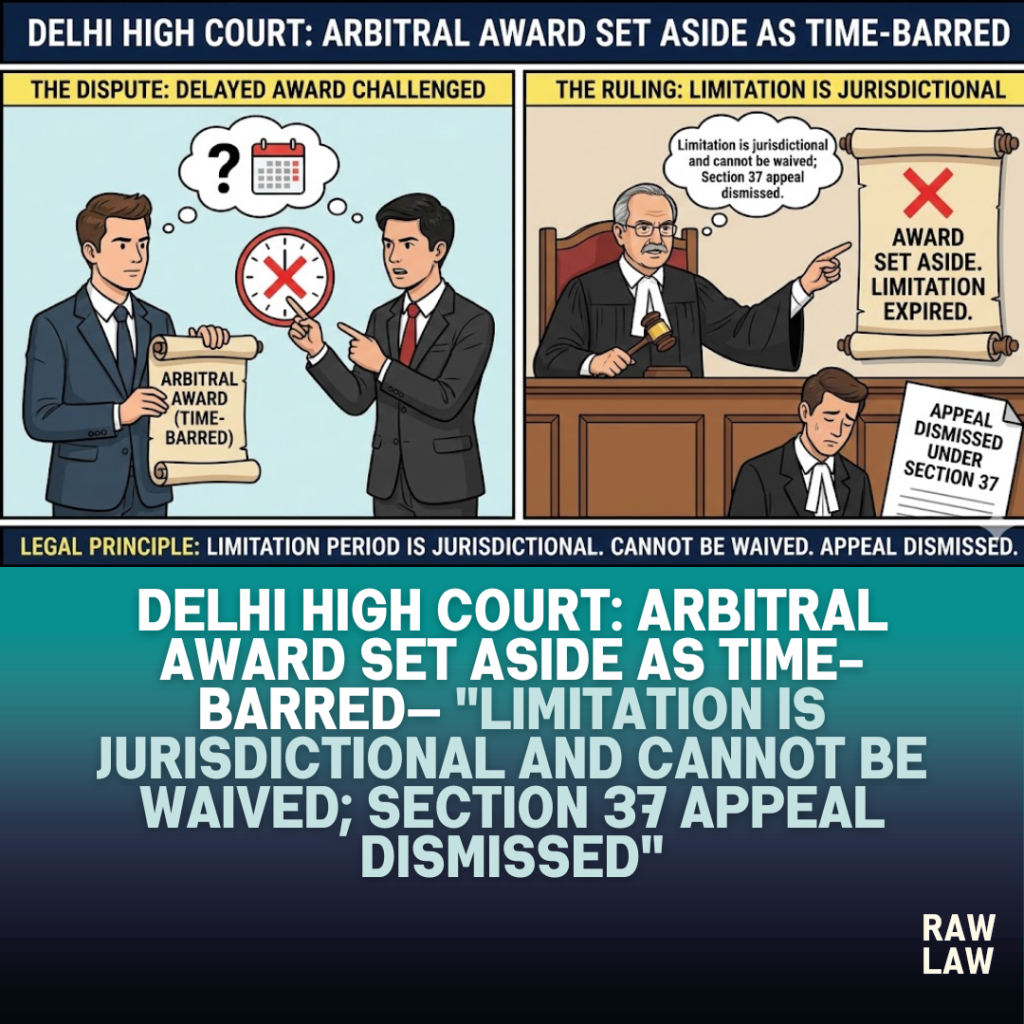
The Delhi High Court dismissed an appeal under Section 37 of the Arbitration and Conciliation Act, 1996, and upheld the District Judge’s order setting aside an arbitral award on the ground of limitation. The Court held that claims invoked nearly seven years after accrual of cause of action were ex facie barred under the Limitation Act, 1963.
Rejecting the contractor’s argument that limitation was waived for not being pressed before the arbitrator, the Court ruled that statutory limitation cannot be overridden by inaction or consent. The impugned order was affirmed and the appeal dismissed.
Facts
The dispute arose from a construction contract awarded in January 2006 for civil and electrical works relating to a zonal office building of a nationalised bank in Ludhiana. The contractor asserted that the work was completed on 30 June 2008 and raised its final bill on 8 September 2008 for ₹25,72,035.87.
On 7 November 2008, the employer released ₹4,98,849 while withholding ₹20,73,187 towards alleged service tax, labour cess, security deposit, and other deductions. Correspondence ensued through 2009 and 2011, with the employer repeatedly stating that no further amount or interest was payable under the contract.
Despite these communications, arbitration was invoked only in 2015. A sole arbitrator passed an award dated 13 July 2018 allowing claims of ₹39,01,041 with interest and costs. The employer challenged the award under Section 34, and the District Judge set it aside as barred by limitation.
Issues
The principal issue before the High Court was whether the District Judge was justified in setting aside the arbitral award under Section 34 on the ground that the claims were time-barred.
A related issue was whether the plea of limitation stood waived because it was not pressed under Section 16 before the arbitrator or at the stage of appointment under Section 11.
The Court also examined the limited scope of interference under Section 37 and whether the appellate court could re-evaluate the merits of the arbitral award.
Appellant’s arguments
The contractor argued that the employer did not raise limitation before the arbitrator under Section 16 and therefore waived the objection under Section 4 of the Act. It was submitted that limitation is a mixed question of fact and law and the arbitrator’s finding could not be substituted by the Section 34 court.
The appellant contended that correspondence between parties and tax proceedings relating to service tax and labour cess kept the dispute alive, and that cause of action ought to be reckoned from subsequent developments rather than 2008.
It was urged that the District Judge reappreciated facts and exceeded the limited scope of interference under Section 34.
Respondent’s arguments
The employer contended that the cause of action arose on 7 November 2008 when partial payment was made and the balance was withheld. The three-year limitation period expired on 6 November 2011.
It was argued that subsequent correspondence did not amount to acknowledgment of liability under Section 18 of the Limitation Act. The arbitration invoked in 2015 was thus clearly barred.
The respondent maintained that limitation goes to the root of jurisdiction and that an award granting time-barred claims suffers from patent illegality warranting interference under Section 34.
Analysis of the law
The High Court examined Section 43 of the Arbitration and Conciliation Act, which makes the Limitation Act applicable to arbitrations. Article 18 of the Limitation Act prescribes three years for recovery of money for work done where no time is fixed for payment.
The Court emphasised that limitation is founded on public policy to prevent resurrection of stale claims and ensure certainty in commercial dealings. A tribunal cannot assume jurisdiction over claims barred by statute.
Referring to Supreme Court precedents including MMTC Ltd. v. Vedanta Ltd., Punjab State Civil Supplies Corporation Ltd. v. Sanman Rice Mills, and UHL Power Co. Ltd. v. State of Himachal Pradesh, the Court reiterated that interference under Section 37 is even narrower than under Section 34.
Precedent analysis
In MMTC Ltd. v. Vedanta Ltd. (2019) 4 SCC 163, the Supreme Court held that appellate interference under Section 37 cannot travel beyond the limitations of Section 34.
In Punjab State Civil Supplies Corporation Ltd. v. Sanman Rice Mills (2024 SCC OnLine SC 2632), it was reiterated that courts cannot reappreciate evidence and must confine themselves to statutory grounds.
The High Court also relied on McDermott International Inc. v. Burn Standard Co. Ltd. (2006) 11 SCC 181, which emphasised the supervisory role of courts in arbitration and that awards contrary to statutory mandates are liable to be set aside.
Applying these principles, the Court held that the District Judge acted within jurisdiction.
Court’s reasoning
The Court found that the cause of action crystallised on 7 November 2008 when part payment was made and the balance withheld. Under Section 9 of the Limitation Act, time once begun continues to run unless validly extended.
No written acknowledgment of liability was made within three years to attract Section 18 of the Limitation Act. Letters dated 7 March 2009, 3 August 2009, and 7 July 2011 categorically denied further liability.
The Court rejected the plea that tax proceedings in 2011 extended limitation. Those proceedings did not revive or create a fresh contractual cause of action.
On waiver, the Court held that Section 4 of the Arbitration Act applies only to derogable procedural requirements and cannot override a statutory bar of limitation.
The arbitrator’s failure to apply limitation correctly rendered the award patently illegal. The District Judge did not reappreciate evidence but merely enforced the statutory prohibition.
Conclusion
The Delhi High Court held that the claims were ex facie barred by limitation and that the District Judge acted within the confines of Section 34 in setting aside the award. Exercising limited jurisdiction under Section 37, the Court found no ground to interfere.
The appeal was dismissed, and the arbitral award remains set aside.
Implications
This ruling reinforces key arbitration principles:
- Limitation applies fully to arbitral proceedings under Section 43.
- Statutory limitation cannot be waived by inaction.
- Awards granting time-barred claims suffer from patent illegality.
- Section 37 jurisdiction is supervisory and extremely limited.
The judgment strengthens judicial consistency in commercial arbitration and underscores that arbitration cannot become a vehicle for reviving stale contractual claims.
Case law references
- MMTC Ltd. v. Vedanta Ltd. (2019) 4 SCC 163
Held that Section 37 appeals are limited and cannot expand Section 34 review. - Punjab State Civil Supplies Corporation Ltd. v. Sanman Rice Mills (2024 SCC OnLine SC 2632)
Reaffirmed narrow scope of interference under Sections 34 and 37. - UHL Power Co. Ltd. v. State of Himachal Pradesh (2022) 4 SCC 116
Emphasised limited appellate jurisdiction under Section 37. - McDermott International Inc. v. Burn Standard Co. Ltd. (2006) 11 SCC 181
Explained supervisory role of courts in arbitration and limited interference.
FAQs
1. Can limitation be waived in arbitration proceedings?
No. Limitation is a statutory bar and cannot be waived by consent or inaction of parties.
2. Does correspondence extend limitation automatically?
No. Only a clear written acknowledgment of liability under Section 18 of the Limitation Act can extend limitation.
3. What is the scope of a Section 37 appeal?
It is limited to examining whether the Section 34 court acted within jurisdiction. It does not permit reappreciation of evidence or merits.