


Court’s decision
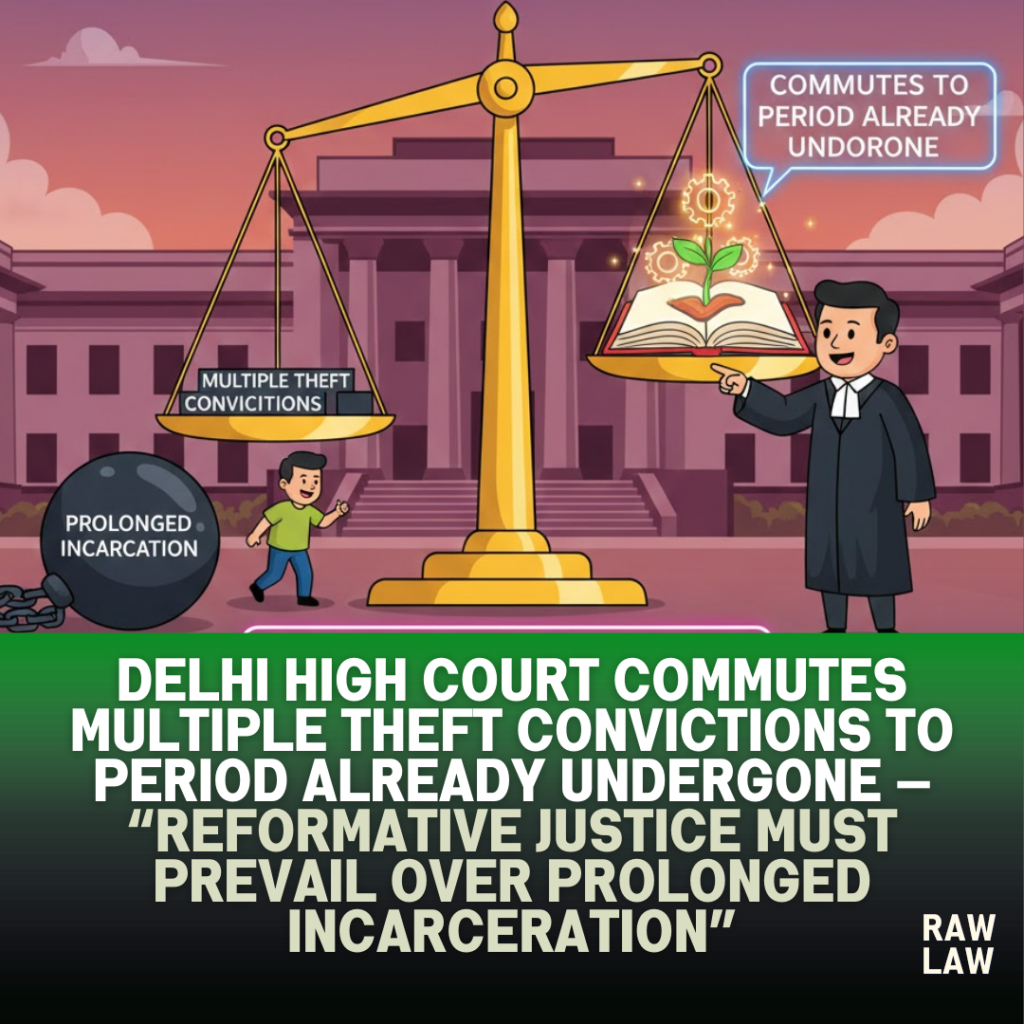
The Delhi High Court upheld the convictions of a repeat offender in four separate theft-related cases but substantially reduced all sentences to the period already undergone. The Court held that, in the peculiar facts of the case, continued incarceration would serve no meaningful purpose and that the reformative objective of criminal sentencing warranted primacy. Emphasising proportionality and humanitarian considerations, the Court ordered the appellant’s immediate release from custody while maintaining the findings of guilt recorded by the trial courts.
Facts
The appeals before the High Court arose out of four different criminal cases registered between 2013 and 2023 at different police stations in Delhi. In each case, the appellant stood convicted by the trial courts for offences primarily under Sections 328 and 379 of the Indian Penal Code, along with allied provisions relating to receiving stolen property and common intention. The cases involved allegations of administering intoxicating substances and committing theft, reflecting a consistent modus operandi.
The trial courts, considering the appellant’s criminal antecedents, had imposed rigorous imprisonment ranging from six to ten years in the different cases, along with fines. The sentences in some matters were ordered to run concurrently, while in others they were to commence after completion of earlier sentences. By the time the appeals were taken up, the appellant had already undergone substantial periods of incarceration in all cases, including completion of sentence in one matter and more than five years in others.
Issues
The principal issue before the High Court was whether, despite the seriousness of the offences and the appellant’s repeat involvement, the sentences warranted interference at the appellate stage. Specifically, the Court had to determine whether the ends of justice would be met by commuting the remaining sentences to the period already undergone, while leaving the convictions undisturbed. The case also raised the broader question of how courts should balance deterrence against reformative justice in sentencing habitual offenders.
Appellant’s arguments
At the outset, the appellant did not press the challenge to the findings of conviction. Instead, the limited plea advanced was for reduction of sentence. It was contended that the appellant belonged to an economically marginalised background and was the sole breadwinner of his family. The affidavit placed on record highlighted that his wife was suffering from respiratory ailments and that he had two minor children, aged about two and four years, entirely dependent on him.
The appellant urged the Court to consider that he had already spent a substantial portion of his life in incarceration across the different cases. It was submitted that further imprisonment would neither rehabilitate him nor serve any meaningful deterrent purpose, and that the reformative aspect of sentencing deserved precedence in the peculiar facts of the case.
Respondent’s arguments
The State opposed interference with the convictions but fairly conceded on the aspect of sentencing. The Additional Public Prosecutor submitted that, considering the mitigating circumstances brought on record and the substantial period of imprisonment already undergone by the appellant, the State would have no serious objection if the sentences were reduced to the period already served. The prosecution thus left the matter to the discretion of the Court, emphasising that societal interests had already been substantially addressed by the prolonged incarceration.
Analysis of the law
The Court examined the principles governing sentencing in criminal law, reiterating that punishment is not a purely mechanical consequence of conviction. Sentencing must involve a careful balancing of multiple considerations, including the nature of the offence, the circumstances of the offender, the objectives of deterrence, and the possibility of reformation.
The Court noted that for offences under Sections 328 and 379 of the Indian Penal Code, no minimum mandatory sentence is prescribed. This legislative choice vests courts with discretion to mould sentences in accordance with the facts of each case. The High Court emphasised that appellate courts retain the power to interfere with sentences where the interests of justice so demand, even while maintaining the conviction.
Precedent analysis
The judgment drew upon well-established principles that sentencing must be humane and proportionate. Courts have consistently held that where an offender has already undergone a substantial part of the sentence, particularly in the absence of statutory minimums, continued incarceration may not advance the cause of justice. The reformative theory of punishment, repeatedly endorsed by constitutional courts, requires consideration of the offender’s socio-economic background, family circumstances, and the realistic prospects of rehabilitation.
While recognising that repeat offences ordinarily justify stricter punishment, the Court distinguished cases where the offender has already suffered long periods of imprisonment and where further detention would be largely punitive without corresponding societal benefit.
Court’s reasoning
Applying these principles, the High Court carefully analysed the period of incarceration already undergone by the appellant in each case. It found that in one matter the sentence had already been completed, while in two others the appellant had undergone nearly the entire term of imprisonment awarded. Even in the most recent case, where a longer sentence had been imposed, the appellant had already spent over two years in custody.
The Court placed significant weight on the appellant’s personal circumstances, including his impoverished background, responsibility towards an ailing spouse, and the presence of two very young children. It observed that sentencing must not lose sight of its reformative purpose and that continued incarceration, in these circumstances, would only aggravate hardship without serving any constructive goal.
Conclusion
The Delhi High Court concluded that while the convictions recorded by the trial courts did not warrant interference, the sentences imposed deserved modification. Holding that no useful purpose would be served by subjecting the appellant to further imprisonment, the Court reduced all sentences to the period already undergone. The appellant was directed to be released forthwith, and all bail bonds and sureties were discharged.
Implications
This ruling reinforces the judiciary’s commitment to reformative justice in sentencing, even in cases involving repeat offenders. It underscores that prolonged incarceration is not an end in itself and that courts must remain sensitive to human and social realities while imposing punishment. The judgment serves as a reminder that sentencing discretion must be exercised with proportionality, compassion, and a clear focus on rehabilitation alongside deterrence.
Case law references
- Reformative theory of sentencing (general principle)
Held: Sentencing must balance deterrence with rehabilitation and proportionality.
Applied: Used to justify commutation of sentence to period already undergone. - Appellate interference in sentencing
Held: Appellate courts may reduce sentences where continued incarceration serves no meaningful purpose.
Applied: Basis for modifying sentences while sustaining convictions.
FAQs
Q1. Can a High Court reduce a criminal sentence while upholding conviction?
Yes. Appellate courts can modify or reduce sentences without disturbing the conviction if the interests of justice so require.
Q2. Does long incarceration affect sentencing decisions?
Yes. Courts often consider the period already undergone, especially where no minimum sentence is prescribed.
Q3. Are family circumstances relevant in sentencing?
Yes. Courts may consider socio-economic background, dependency, and humanitarian factors while determining appropriate punishment.