


Court’s decision
The Delhi High Court allowed a writ petition filed by the Staff Selection Commission and related authorities challenging the order of the Central Administrative Tribunal.
The Tribunal had directed that the candidate be subjected to a fresh medical examination by a newly constituted medical board after he produced a certificate from a government hospital stating that he was medically fit.
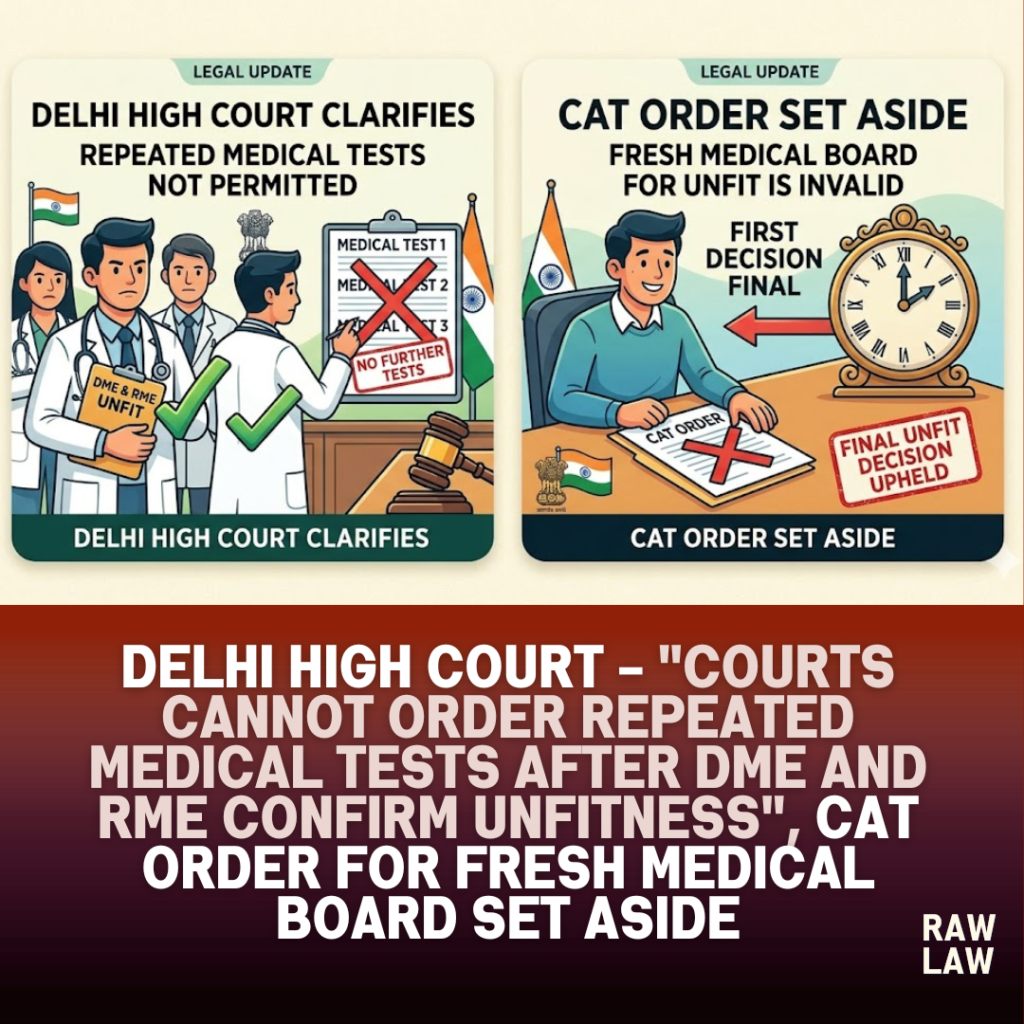
The High Court held that such a direction was legally unsustainable because the candidate had already undergone both DME and RME in accordance with the prescribed recruitment framework.
Accordingly, the Court set aside the Tribunal’s order and upheld the findings of the medical boards declaring the candidate medically unfit.
Facts
The respondent candidate participated in a recruitment process conducted by the Staff Selection Commission for appointment to the post of Constable (Executive).
After clearing the earlier stages of the selection process, he became eligible to undergo medical examination as required under the recruitment rules.
During the Detailed Medical Examination conducted on 25 January 2024, the medical board found that the candidate was suffering from varicose veins in his left leg.
Based on this finding, the board declared him medically unfit for appointment to the post.
The candidate exercised his right to seek a Review Medical Examination, which was conducted on 31 January 2024.
The Review Medical Board independently examined him and concurred with the earlier findings, again declaring him medically unfit.
Subsequently, the candidate obtained a certificate dated 30 March 2024 from a government hospital stating that he was medically fit to participate in competitive or non-competitive examinations.
Relying on this certificate, he approached the Central Administrative Tribunal challenging the medical findings.
Issues
The High Court considered the following issues:
- Whether the Tribunal was justified in directing a fresh medical examination after the candidate had already undergone DME and RME.
- Whether a medical certificate obtained independently by the candidate could justify reopening the recruitment medical process.
- What is the scope of judicial review in medical fitness assessments conducted during recruitment to disciplined services.
Petitioner’s arguments
The Staff Selection Commission argued that the Tribunal’s order disregarded the governing recruitment framework and medical standards prescribed under the Delhi Police (Appointment and Recruitment) Rules, 1980.
It was submitted that the candidate had participated in the recruitment process with full knowledge of the applicable rules and standards.
The petitioners emphasized that the certificate relied upon by the candidate merely stated that he was fit to participate in examinations and did not certify that he was fit for the specific post of Constable (Executive).
They further argued that courts must exercise limited judicial review in matters involving expert medical opinions.
Reliance was placed on judicial precedents emphasizing that courts should not substitute their opinion for that of duly constituted medical boards.
Respondent’s arguments
The candidate contended that the certificate issued by the government hospital raised doubt about the correctness of the findings recorded during the DME and RME.
According to the respondent, the existence of conflicting medical opinions justified a fresh examination by an independent medical board.
It was also argued that courts have, in certain cases, directed fresh medical examinations where the material on record indicated possible error in the earlier medical assessment.
Analysis of the law
The High Court examined the legal principles governing judicial review in matters relating to medical fitness in recruitment to disciplined services such as the police.
The Court noted that medical fitness assessments fall primarily within the domain of expert medical boards constituted for that purpose.
Judicial review in such matters is therefore limited.
Courts may interfere only where:
- The prescribed procedure has been violated
- There is a significant discrepancy between medical examinations
- The medical board lacks necessary expertise
- The decision is arbitrary or mala fide
In the absence of such circumstances, courts must refrain from interfering with expert medical determinations.
Precedent analysis
The Court relied on earlier judgments emphasizing judicial restraint in medical fitness disputes.
In Indian Council of Agricultural Research v. Shashi Gupta, the Supreme Court held that courts should not lightly interfere with the opinion of expert medical boards unless the decision-making process is shown to be arbitrary or illegal.
The Court also relied on Staff Selection Commission v. Aman Singh, where the Delhi High Court clarified that medical certificates obtained independently by candidates cannot ordinarily be used as a basis for directing fresh medical examinations.
These precedents reaffirm the principle that medical boards constituted under recruitment rules are the primary authorities for determining fitness.
Court’s reasoning
The Court observed that both the DME and the RME had reached the same conclusion that the candidate was suffering from varicose veins, rendering him unfit for the post.
There was therefore no discrepancy between the two examinations.
The Court further noted that the certificate produced by the candidate merely stated that he was fit to participate in competitive examinations and did not certify that he was medically fit for police service.
Moreover, the certificate had been obtained independently by the candidate and was not part of the recruitment medical process.
Permitting candidates to rely on such certificates would undermine the finality of recruitment procedures and encourage repeated challenges to medical assessments.
Conclusion
The Delhi High Court held that the Tribunal’s order directing a fresh medical examination was legally unsustainable.
Since the candidate had already undergone both the DME and RME in accordance with the recruitment rules and both examinations produced consistent findings, there was no justification for reopening the medical assessment.
The Court therefore set aside the Tribunal’s order and allowed the writ petition filed by the Staff Selection Commission.
Implications
This judgment reinforces the principle that courts must exercise restraint when reviewing medical fitness determinations in recruitment to disciplined services.
The ruling clarifies that candidates cannot seek repeated medical examinations merely by producing independent medical certificates after being declared unfit.
For recruitment authorities, the decision strengthens the authority of DME and RME processes as final medical assessments.
For candidates, the ruling highlights that challenges to medical findings must demonstrate procedural irregularity, arbitrariness, or contradiction between medical boards.
Case Law References
- Indian Council of Agricultural Research v. Shashi Gupta (1994)
Held that courts should not substitute their judgment for that of expert medical boards unless the decision-making process is arbitrary or illegal. - Staff Selection Commission v. Aman Singh (Delhi High Court)
Clarified that independently obtained medical certificates cannot ordinarily justify fresh medical examinations in recruitment processes.
FAQs
1. Can courts order a fresh medical test after DME and RME in recruitment?
Generally no. Courts intervene only in exceptional cases where procedural irregularity, discrepancy between medical boards, or arbitrariness is shown.
2. Can a candidate rely on a private or independent medical certificate to challenge recruitment medical findings?
Courts have held that independently obtained medical certificates cannot ordinarily override findings of recruitment medical boards.
3. What is the role of judicial review in medical fitness decisions?
Judicial review is limited. Courts examine the fairness of the process but do not substitute their own medical opinion for that of expert boards.