


Court’s decision
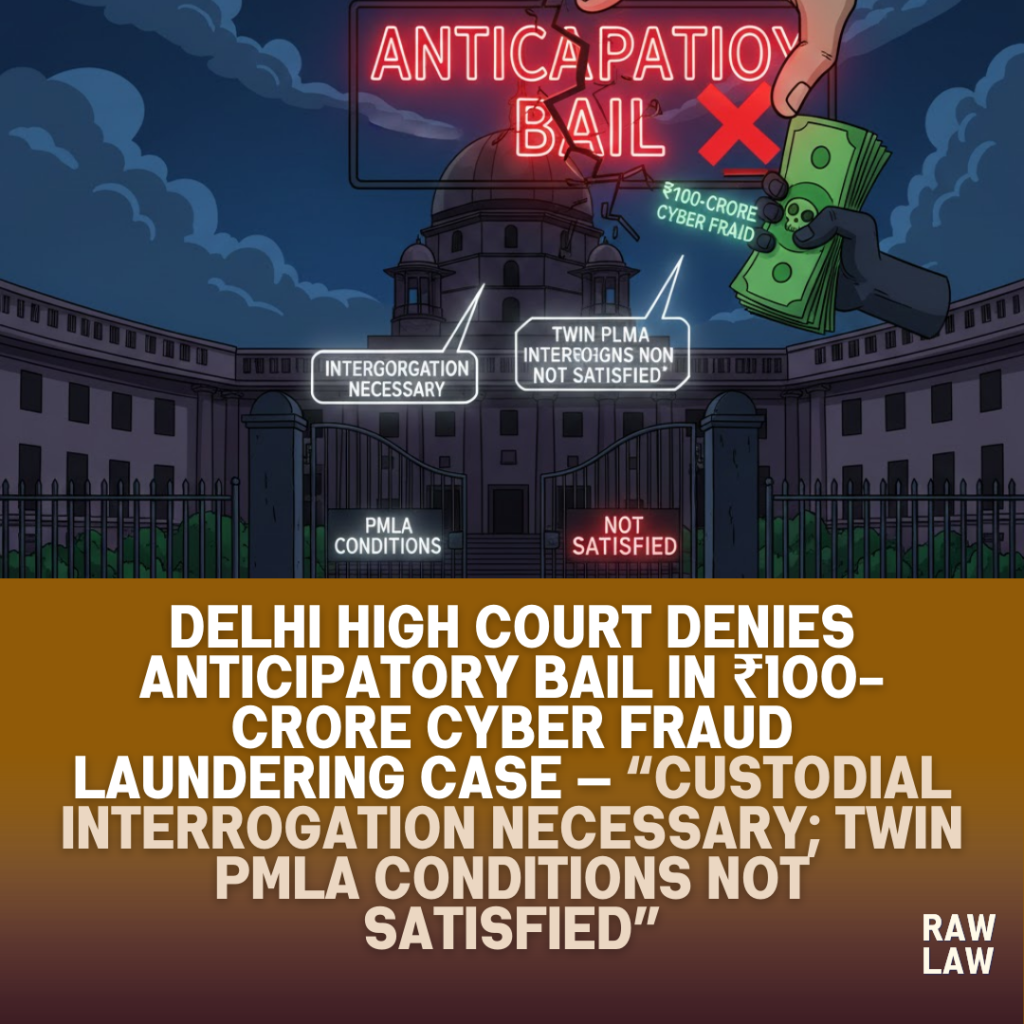
The Delhi High Court rejected anticipatory bail pleas of two accused alleged to be key operatives in a massive cyber fraud and money laundering syndicate involving cross-border cryptocurrency transactions exceeding ₹100 crore. Emphasising the stringent twin conditions under Section 45 of the Prevention of Money Laundering Act, 2002, the Court held that no reasonable ground existed to believe that the accused were not guilty, nor that they would refrain from further offences if granted pre-arrest protection. The Court underscored that custodial interrogation was imperative to unravel the complex, multi-layered laundering operation.
Facts
The Enforcement Directorate initiated proceedings under the Prevention of Money Laundering Act following registration of multiple predicate offences by the Central Bureau of Investigation relating to large-scale cyber frauds. The prosecution alleged that an organised syndicate, with foreign handlers, duped Indian citizens through online investment scams and part-time job frauds. The ill-gotten money was first collected in mule bank accounts in India and then layered through numerous accounts before being transferred abroad.
According to the investigation, thousands of Indian bank accounts were misused to upload funds onto an overseas digital payment platform, which issued virtual cards usable internationally. These funds were then withdrawn abroad, primarily in Dubai, or converted into cryptocurrency through foreign wallets. The accused were alleged to be central figures of a Delhi-based group managing dozens of shell entities and mule accounts used for laundering proceeds of crime.
Issues
The primary issue before the High Court was whether the applicants were entitled to anticipatory bail in light of the rigorous statutory framework governing bail under the Prevention of Money Laundering Act. The Court was required to consider whether the accused satisfied the twin statutory conditions of Section 45, and whether custodial interrogation was necessary given the ongoing investigation into an expansive cyber-enabled money laundering network.
Petitioners’ arguments
The petitioners contended that the allegations essentially related to cryptocurrency dealings, which are not per se illegal in India. They argued that taxation of virtual digital assets under fiscal laws indicated legislative acceptance of such transactions. It was submitted that despite the investigation running for over a year, the agencies had not clearly identified the original source of funds or the top layer of the syndicate. The petitioners highlighted that certain co-accused had been granted bail and claimed parity.
They further asserted that they had cooperated with the investigation, joined proceedings multiple times even without interim protection, and that the Enforcement Directorate had earlier chosen not to arrest them. Relying on evolving jurisprudence, they argued that the rigour of Section 45 stood diluted, particularly where personal liberty under Article 21 of the Constitution was implicated.
Respondent’s arguments
The Enforcement Directorate strongly opposed the bail pleas, arguing that the case involved a sophisticated, transnational money laundering operation affecting thousands of victims. It was submitted that the petitioners were not mere peripheral actors but key facilitators who opened and controlled numerous mule accounts, routed proceeds of crime through foreign payment platforms, and converted funds into cryptocurrency.
The agency asserted that custodial interrogation was essential to trace further layers of laundering, identify foreign handlers, and uncover the role of bank officials. Allegations were also raised that the accused had destroyed electronic evidence, assaulted investigating officers, and attempted to bribe local police to settle cyber crime complaints. These factors, it was argued, disentitled them to anticipatory bail.
Analysis of the law
The Court undertook an extensive examination of Section 45 of the Prevention of Money Laundering Act, which mandates satisfaction of twin conditions before bail can be granted. It reiterated that offences under the Act constitute a distinct class of serious economic crimes with transnational ramifications, justifying a departure from ordinary bail principles.
The Court rejected the contention that recent jurisprudence had diluted the twin conditions to the extent of making them redundant. It clarified that constitutional courts have relaxed these conditions primarily in cases of prolonged incarceration, not at the pre-arrest stage where custodial interrogation is sought. The Court emphasised that anticipatory bail under Section 438 of the Code of Criminal Procedure does not override the special statutory regime of the PMLA.
Precedent analysis
The Court relied upon authoritative Supreme Court pronouncements which uphold the constitutional validity and strict application of Section 45. It reaffirmed that while considering bail in money laundering cases, courts are not required to conduct a mini-trial but must assess whether there exist reasonable grounds to believe the accused are not guilty.
The judgment also drew from precedents recognising that economic offences involving deep-rooted conspiracies and large-scale public harm require a stricter approach to bail. The Court reiterated that personal liberty, though fundamental, must be balanced against the societal interest in effective investigation of grave financial crimes.
Court’s reasoning
Applying these principles, the Court found that the prosecution material prima facie indicated active involvement of the accused in managing mule accounts, routing proceeds of crime, and facilitating cross-border laundering. The magnitude of transactions, alleged destruction of evidence, and continuing inflow of new cyber fraud complaints weighed heavily against the petitioners.
The Court rejected claims of parity, noting that other accused had been granted regular bail after arrest and custodial interrogation, whereas the present pleas sought pre-arrest protection. It held that earlier non-arrest by the agency did not create an entitlement to anticipatory bail, particularly when circumstances had evolved and further investigation was necessary.
Conclusion
The Delhi High Court concluded that the petitioners failed to satisfy the mandatory twin conditions under Section 45 of the Prevention of Money Laundering Act. Given the scale of the alleged offence, the ongoing investigation, and the expressed need for custodial interrogation, the Court dismissed both anticipatory bail applications.
Implications
This decision reinforces the strict approach adopted by courts in money laundering cases involving cyber fraud and cryptocurrency-based layering. It clarifies that anticipatory bail under the PMLA remains an exception, not the rule, and that investigative agencies will be afforded latitude to conduct custodial interrogation in complex economic offences. The ruling also signals judicial intolerance towards attempts to cloak organised cyber fraud under the guise of legitimate cryptocurrency activity.
Case law references
- Interpretation of Section 45, Prevention of Money Laundering Act
Held: Twin conditions for bail are mandatory and apply equally to anticipatory bail.
Applied: Used to deny pre-arrest protection. - Economic offences jurisprudence
Held: Economic crimes involving large-scale public harm require a stricter bail approach.
Applied: Justified rejection of anticipatory bail. - Custodial interrogation principle
Held: Effective investigation in complex financial crimes may necessitate custodial interrogation.
Applied: Central to denial of anticipatory bail.
FAQs
Q1. Can anticipatory bail be granted in PMLA cases?
Yes, but only if the accused satisfies the twin conditions under Section 45, which is rarely met at the pre-arrest stage.
Q2. Does dealing in cryptocurrency shield an accused from money laundering charges?
No. Cryptocurrency transactions used to conceal or layer proceeds of crime can attract PMLA liability.
Q3. Does prior non-arrest guarantee anticipatory bail?
No. The decision to arrest lies with investigators, and courts assess bail independently based on statutory criteria.