


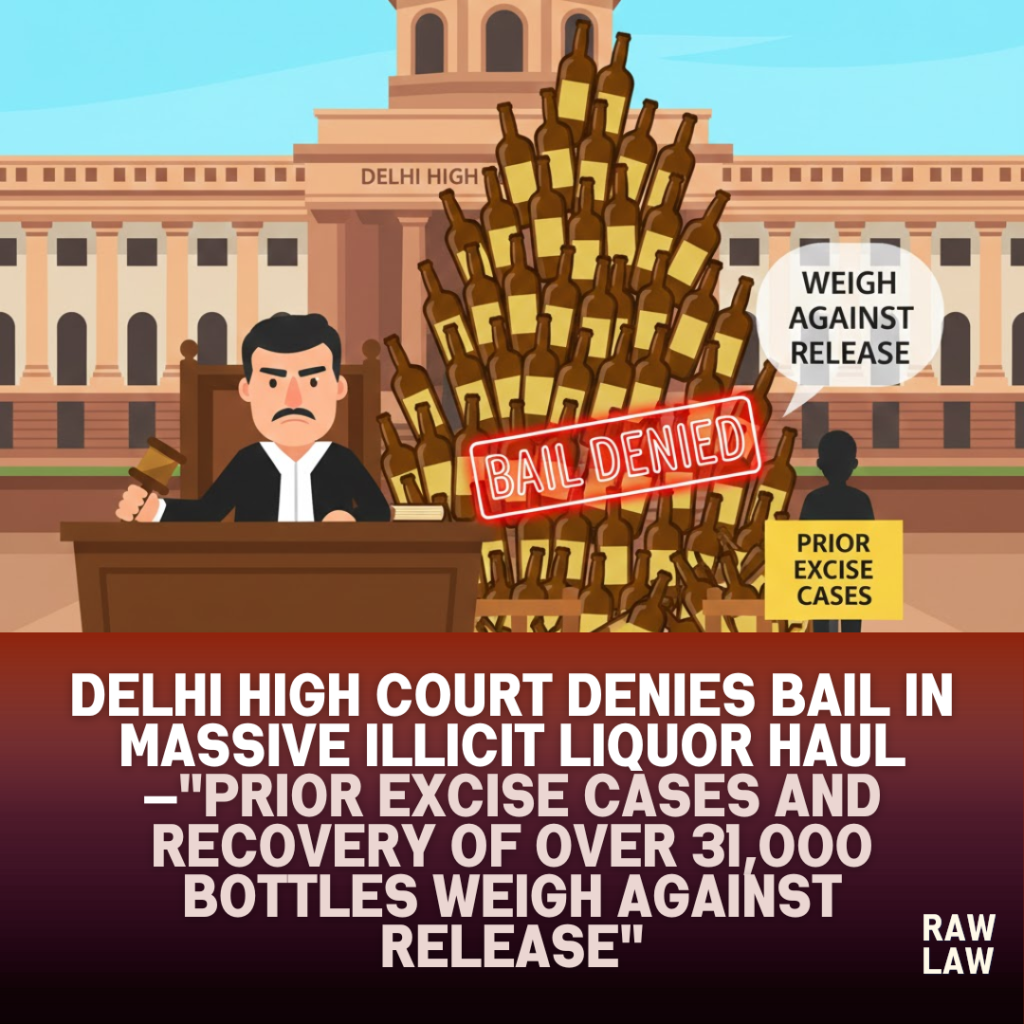
Court’s decision
The Delhi High Court dismissed a regular bail application filed by an accused booked under the Delhi Excise Act and the Bharatiya Nyaya Sanhita, holding that the scale of the alleged offence, criminal antecedents, and the manner of recovery disentitled him from bail at this stage. The Court underscored that recovery of an enormous quantity of illicit liquor, coupled with prior involvement in excise-related offences, pointed towards habitual conduct. Observing that the applicant was caught red-handed and was not a resident of Delhi, the Court concluded that releasing him on bail could risk repetition of the offence. The bail application was accordingly rejected.
Facts
The prosecution case arose from a raid conducted in June 2025 by the Anti-Narcotics Cell following secret information regarding illegal transportation and storage of liquor. Initially, a vehicle was intercepted near Kashmere Gate, Delhi, leading to the recovery of 44 cartons of illicit liquor meant for sale outside Delhi. During interrogation, the apprehended accused disclosed that the consignment had been supplied by the present applicant, who was allegedly operating a godown in Village Khampur, Delhi. Acting on this disclosure and subsequent intelligence, the police conducted a raid at the said location, where the applicant was apprehended near his vehicle while cartons of liquor were being loaded. From the godown and vehicle, a total of 652 cartons—amounting to over 31,000 quarter bottles of illicit liquor—were recovered. The applicant was arrested and remained in judicial custody.
Issues
The principal issue before the Court was whether the applicant was entitled to regular bail under Section 483 read with Section 439 of the Code of Criminal Procedure in a case involving large-scale recovery of illicit liquor. Ancillary issues included whether the applicant’s alleged non-mention in the FIR, completion of investigation, filing of the charge-sheet, and parity with co-accused justified grant of bail, despite the prosecution’s reliance on criminal antecedents and the magnitude of the offence.
Petitioner’s arguments
The applicant contended that he had been falsely implicated, asserting that he was neither named in the FIR nor present at the initial place of interception. It was argued that his involvement surfaced only through disclosure statements of co-accused, which by themselves carried limited evidentiary value. Learned counsel stressed that the investigation was complete and the charge-sheet had already been filed, rendering further custodial detention unnecessary. The applicant’s consistent cooperation with the investigation was highlighted, along with the fact that all co-accused had already been granted bail. Invoking the principle of parity, it was submitted that continued incarceration of the applicant was unjustified.
Respondent’s arguments
Opposing the bail plea, the State argued that the applicant was not a peripheral figure but the main supplier operating a godown storing huge quantities of illicit liquor. The prosecution emphasised that the applicant was apprehended red-handed during the raid and that recovery of 652 cartons established active involvement. It was further pointed out that the applicant had criminal antecedents, including prior cases under excise laws and other penal provisions, demonstrating a pattern of habitual offending. The State submitted that releasing the applicant on bail could facilitate repetition of similar offences and frustrate the administration of justice, particularly given the organised nature of the alleged illegal trade.
Analysis of the law
The Court reiterated that grant of bail is governed by well-settled parameters, including the nature and gravity of accusations, severity of punishment, likelihood of the accused fleeing justice or repeating the offence, and criminal antecedents. In offences involving economic and regulatory crimes such as illicit liquor trade, the impact on public order and revenue also becomes relevant. The Court referred to binding Supreme Court jurisprudence which mandates a cautious approach where allegations disclose organised or habitual criminal activity. Completion of investigation or filing of a charge-sheet, though relevant, does not automatically entitle an accused to bail if other factors weigh against release.
Precedent analysis
The Court relied on Supreme Court decisions laying down bail parameters, including rulings which emphasise that antecedents and the likelihood of misuse of liberty are critical considerations. These precedents hold that while bail is the rule, it is not an absolute right, particularly in cases involving serious offences and repeat conduct. Applying these principles, the Court distinguished the applicant’s case from those where bail is granted on parity, noting that parity cannot override individual role, recoveries effected, and past criminal conduct.
Court’s reasoning
After examining the record, the Court found that the applicant was allegedly caught in possession of an extraordinarily large quantity of illicit liquor, far exceeding the recovery from the initially intercepted vehicle. The Court gave weight to the applicant’s prior involvement in three criminal cases, two of which related specifically to excise offences, characterising him as a habitual offender. It also noted that the applicant was not a resident of Delhi, which heightened concerns regarding his availability for trial. Considering the gravity of accusations, the organised nature of the alleged activity, and the risk of repetition, the Court held that no ground for bail was made out at this stage.
Conclusion
The Delhi High Court dismissed the regular bail application, holding that the applicant failed to satisfy the parameters for release. While clarifying that observations were confined to adjudication of the bail plea and would not affect the merits of the trial, the Court concluded that continued judicial custody was warranted in view of the magnitude of recovery, antecedents, and potential risk to the justice process.
Implications
This decision reinforces a strict judicial approach in cases involving large-scale illicit liquor trade. It signals that claims of parity and completion of investigation will not suffice where recoveries indicate organised activity and antecedents suggest habitual offending. For enforcement agencies, the ruling affirms judicial support in tackling excise-related offences. For accused persons, it highlights that prior involvement and quantum of recovery can decisively tilt the balance against bail, even at the post-charge-sheet stage.
Case law reference
- Prasanta Kumar Sarkar v. Ashis Chatterjee – Laid down key parameters for grant or refusal of bail, including gravity of offence and antecedents.
- State of Uttar Pradesh v. Amaramani Tripathi – Emphasised that likelihood of repetition and misuse of liberty are crucial bail considerations.
- Deepak Yadav v. State of Uttar Pradesh – Reiterated that bail discretion must be exercised cautiously in serious offences.
Application in present case: These principles were applied to deny bail due to habitual conduct and massive recovery of illicit liquor.
FAQs
Q1. Can bail be denied even after filing of the charge-sheet?
Yes. Filing of a charge-sheet does not automatically entitle an accused to bail if other factors like gravity of offence and antecedents weigh against release.
Q2. Does parity with co-accused guarantee bail?
No. Parity applies only when the role and circumstances of the accused are comparable. Courts will assess individual involvement and recoveries.
Q3. Why are excise offences treated seriously in bail matters?
Large-scale illicit liquor trade affects public order and revenue, and often indicates organised criminal activity, warranting stricter scrutiny.